Why "human" is the Cambridge Dictionary's Word of the Year 2026
Why Cambridge chose human as its 2026 Word of the Year, with an original five-area map of the examples and clear source attribution.
The Cambridge Dictionary has named "human" its Word of the Year for 2026. The University of Cambridge says the year was defined by global debate over what it means to be human when AI blurs the line between people and machines. The dictionary defines the word as "having the qualities, faults, and feelings that people have, as opposed to gods, animals, or machines."
A common word winning is the interesting part. Lexicographer Colin McIntosh said AI is changing how we talk about being human, and that this renewed interest is what made "human" the choice. He told the BBC that the growth of AI means it is now necessary to say "human" explicitly for things that once could only be done by humans.
Five places the word was being defended
The University of Cambridge's announcement lists examples. We grouped them into five areas.
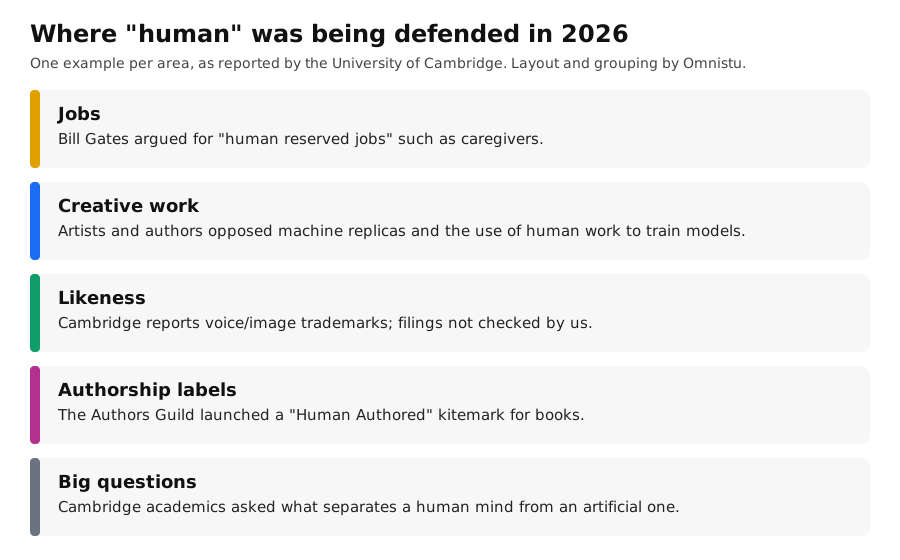
Original graphic by Omnistu. Examples are from the University of Cambridge announcement; the five-area grouping is ours.
- Jobs. Bill Gates wrote of "human reserved jobs" such as caregivers that machines should never take.
- Creative work. Actors, musicians and authors, including Scarlett Johansson, Cate Blanchett and Jodi Picoult, opposed what they called an assault on human creativity, as the Human Artistry Campaign and the Artist Rights Alliance opposed machine-generated replicas.
- Likeness. Cambridge reports that Matthew McConaughey trademarked clips of his voice and face, and that Taylor Swift followed in April. We have not independently checked the trademark filings.
- Authorship labels. The Authors Guild launched a "Human Authored" kitemark for books. The BBC adds that academics hope to create a universally recognized "human made" symbol, similar to the "Fairtrade" label.
- Big questions. Cambridge philosopher Tom McClelland asked whether consciousness, creativity or compassion sets humans apart, and said nothing about AI's future is inevitable.
The language side
According to the BBC, McIntosh's research found the word "human" is used four times as much as in 1900, and that compounds such as "human-made" and "human-driven" have become more common as people separate their work from AI's. He said "man" used to carry the general sense more often, and that this use is no longer acceptable. We do not use the origin-century claim here.
What this does not tell you
A dictionary's choice reflects how editors read the year, not a measured count of public opinion. The articles above are reports of what people said, and we have not verified claims in the individual statements. Whether labels like "Human Authored" will be trusted or adopted widely is not something these sources show. This guide was prepared with AI assistance and reviewed on 19 November 2026.
Sources
- University of Cambridge: https://www.cam.ac.uk/news/cambridge-dictionary-reveals-word-of-the-year-2026
- BBC News: https://www.bbc.com/news/articles/c6x2ev38k4yno