Chrome 158: the Web Install API, WebHID on Android and what to check in your own site
Chrome 158 (scheduled stable 17 November 2026): the Web Install API and HTML install element, media playback pseudo-classes, WebHID on Android, the focus-without-user-activation policy, the smaller items, and what the release notes do not say.
Chrome 158 has a scheduled stable release date of 17 November 2026 on Chrome Platform Status. The release notes list 14 items. This guide covers the ones most likely to need action from a site owner, and says plainly what the notes do not tell you. Everything below comes from Chrome's own release notes. We did not test any feature in a browser.
Install a web app from another site
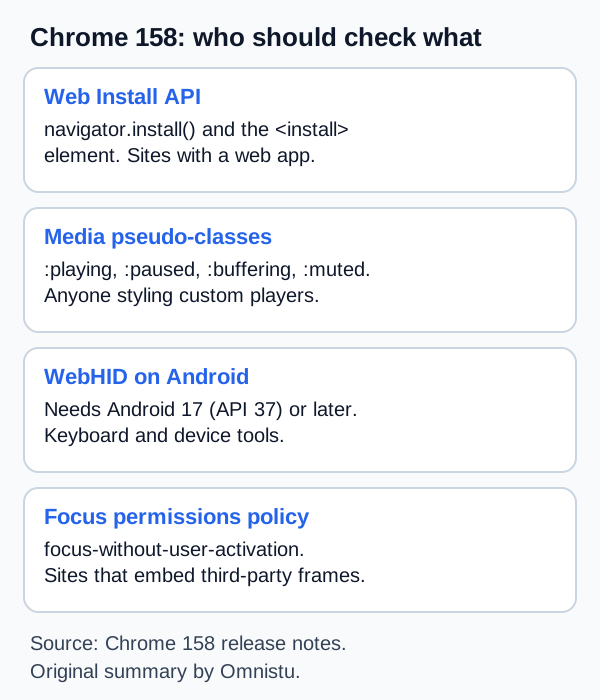
Original summary by Omnistu of the Chrome 158 release notes.
The notes describe two new entry points to one capability. Starting in Chrome 158, the Web Install API lets a site prompt users to install a web app, given a manifest URL and an optional manifest ID. The method is navigator.install(). An HTML <install> element does the same declaratively, without JavaScript. Both allow cross-origin installation, meaning the page offering the install does not have to be the app's own site. The notes say this is a better developer experience than handling beforeinstallprompt events.
What to check:
- If your site already shows a custom install button built on
beforeinstallprompt, the notes do not say that code stops working. They also do not say whether to migrate. Read the Chrome documentation before changing anything. - Admins can switch it off. The enterprise policy
WebAppInstallByUserEnableddisables user web app installs in general, including installs started throughnavigator.install(). A permissions policy namedweb-app-installationallows or disallows the feature on origins the enterprise controls, such as internal sites or iframes. - The notes do not describe the prompt a user sees, or whether other browsers will support it.
Style media by playback state
New CSS pseudo-classes match audio and video elements by state: :playing, :paused, :seeking, :buffering, :stalled, :muted and :volume-locked. The notes link this to a focus area of Interop 2026. For anyone with a custom player, these can replace script that toggles state classes. The notes do not say how Safari or Firefox compare.
WebHID reaches Chrome on Android
WebHID lets a web app talk to devices beyond ordinary mice and keyboards, such as mechanical keyboards, keypads, gaming mice, gamepad calibration and headset call controls. It has shipped on desktop since Chrome 89. In 158 it comes to Chrome on Android, with no change to the API. The notes say it relies on OS support in Android 17 (API level 37) and later, and that WebView is not supported because it lacks a device chooser and permission controls. Six enterprise policies control it, starting with DefaultWebHidGuardSetting.
If your tool works with hardware, test on an Android 17 device. Older Android versions are not covered by the notes.
Limit focus stealing from embedded frames
The new focus-without-user-activation permissions policy lets an embedding page block programmatic focus from a frame. When denied, element.focus(), autofocus, window.focus() and the focusing steps for dialogs and popovers are blocked unless the frame has transient user activation or focus is already inside it. Dialogs and popovers can still open. Clicking and tabbing are not affected. Set it with a Permissions-Policy header or the iframe allow attribute. The existing Chromium restriction on autofocus in cross-origin iframes is unchanged.
Smaller items
The notes also list the ::highlight(*) selector, flow-start and flow-end alignment keywords, object-fit and object-position for embedded SVG documents, a side attribute for SVG textPath, incremental rendering for OfflineAudioContext, Source Specific Multicast for Direct Sockets in Isolated Web Apps, and three WebTransport additions: stream hints, a draining promise and reliability attributes.
What the notes do not say
They do not report adoption, performance numbers or other browsers' plans. They list no removals or breaking changes. Other pages may describe removals. We did not find a primary source for any, so we make no claim either way.
Source
- Chrome Platform Status, Chrome 158 release notes: https://chromestatus.com/release-notes/158
- Chrome for Developers, Chrome 158 beta announcement (28 October 2026): https://developer.chrome.com/blog/chrome-158-beta
Drafted with AI assistance from these two sources. Check the release notes and test in your own browsers before relying on any detail.