The CreditNirvana exposure: two login flaws, 6.6 million collections accounts and 315,000 call recordings, and what they teach about AI call-center software
An independent researcher's account of two login flaws at CreditNirvana, an AI debt-collection platform: a hardcoded API key in its AI call center and an unchecked identity token in its main platform, exposing 6.6 million accounts and 315,000 call recordings. What the write-up, CERT-In and WIRED say, and what they leave open.
On 18 November 2026 an independent researcher, Eaton Zveare, published a write-up of two vulnerabilities in CreditNirvana, an India-based debt collection platform owned by Perfios that advertises AI-driven collections. WIRED covered it the same day. This guide sets out what the researcher says he found, how the two flaws worked at a high level, what the sources do not say, and the engineering lessons for teams building similar systems. Everything below is the researcher's, CERT-In's or WIRED's account. We did not test any system.
What was reported
- Two flaws, both reported through India's CERT-In. The researcher's post lists CVE-2026-110474 (CVSS 8.7, High) and CVE-2026-110475 (CVSS 9.3, Critical), under CERT-In note CIVN-2026-0523. CERT-In lists the affected software as all call-center versions before 2.0.0 and all collections-platform versions before 4.8.2.
- Fixed in June. His timeline: reported 30 May 2026, both flaws fixed on 2 June 2026, CVE notes issued 26 October, write-up published 18 November. WIRED says the company did not respond to its requests for comment.
- Scale, per the researcher. About 315,000 call recordings in the AI call center, which served one lender's customers, and 6.6 million accounts across three clients of the main platform (3.4 million for one lender plus 3.2 million for two others, as he counts them).
- Kinds of data he says were reachable. ID cards, credit reports, legal notices, payment receipts, emails, text messages, call recordings and summaries, and the tracked locations of field collection agents.
How the two flaws worked, in outline
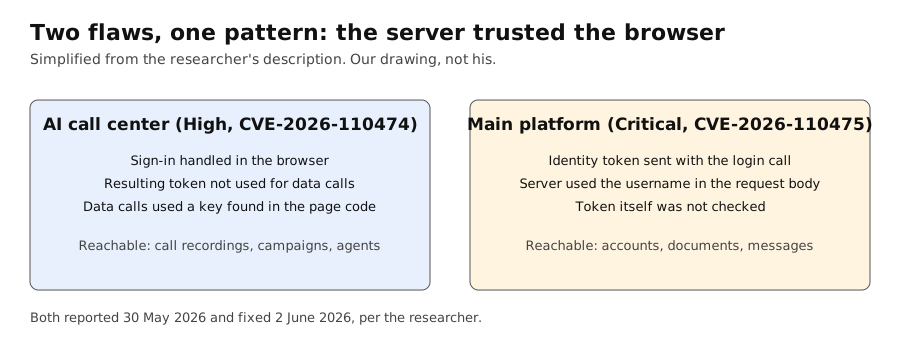
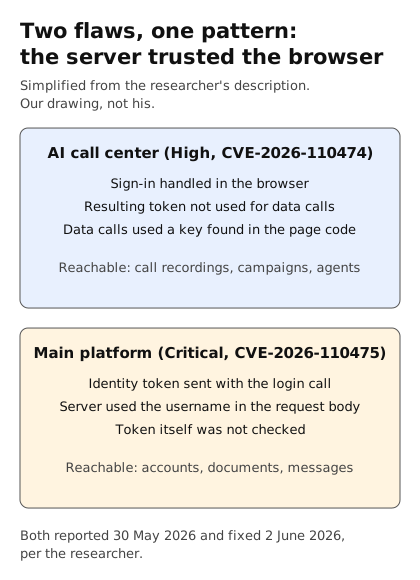
Original diagram by Omnistu, simplified from the researcher's description. Not his figure.
- Call center (High). According to the write-up, the web app handled sign-in in the browser with Amazon Cognito, but the token it received was not used for the data calls. Those calls relied on an API key hardcoded in client-side JavaScript. Anyone who read the page's code could find the key. The researcher says it gave access to the call recordings, post-call recommendations, AI agent management and campaign tools.
- Main platform (Critical). The write-up says the app used Keycloak for identity, but the platform's own login call accepted a username in the request body and did not check the identity token sent alongside it. Combined with an unauthenticated call that listed more than 10,000 users, this let him sign in as a high-level user. CERT-In's wording is that an unauthenticated attacker could "establish sessions as arbitrary users including administrative users".
Both are the same class of mistake: the server trusted something the user's browser supplied instead of verifying it on the server.
What the sources do not say
- Whether anyone else accessed the data. Neither the write-up nor WIRED reports evidence of misuse. The researcher describes his own access. The EU vulnerability database lists CVE-2026-110475 as not in the CISA or EU known-exploited catalogs and gives a 0.48% 30-day exploitation probability estimate. That is a forecast, not a finding about June.
- How long the flaws existed. WIRED reports the researcher saying they may have been present for years. The write-up gives no start date.
- Whether the company has notified borrowers or regulators. We found no statement.
- Whether the figures are exact. They are the researcher's counts, and the company has not confirmed them in anything we read.
- A second Keycloak issue. The researcher says another vulnerability, to be disclosed in December, could be exploited in a similar fashion. We have no details.
Lessons for teams building AI-driven call or messaging tools
These are our suggestions, not findings from the sources.
- Verify identity tokens on the server for every data call. A signed-in screen in the browser proves nothing to the API.
- Keep secrets out of client-side code. Anything shipped to the browser can be read.
- Check that endpoints which list users or accounts require authentication. A simple unauthenticated "list users" call gave the researcher the names he needed.
- Treat call recordings and AI summaries as sensitive records. They hold the same personal details as the original accounts.
- Give the AI agent tools their own access limits. The researcher says one flaw could have been used to manage AI agents and launch campaigns, which is a write risk and not only a read risk.
- Make a vulnerability report easy to act on. The researcher credits the same-day fix. A short path from report to patch limited the time window, even though the public notes came months later.
For people with loans in India
None of the sources tells individual borrowers to take a specific step, and they do not list who is affected. The three clients named by the researcher are Aditya Birla Capital Finance, BharatPe and International Asset Reconstruction Company. If you hold an account with one of them and want to know whether your data was involved, ask the lender directly. Standard precautions apply to anyone: be careful with calls or messages that quote account details, and check your credit report for items you do not recognize.
This guide was prepared with AI assistance and reviewed on 19 November 2026.
Sources
- Eaton Zveare, "The AI Repo Man: Exploiting Agentic AI Debt Collection Platforms" (18 November 2026)
- WIRED, "An AI Debt Collection Service Exposed 6.6 Million Accounts and 315,000 Call Recordings" (18 November 2026)
- CERT-In Vulnerability Note CIVN-2026-0523, "Multiple Vulnerabilities in CreditNirvana Products" (26 October 2026)
- Tenable, CVE-2026-110475 (published 26 October 2026)
- ENISA EUVD, EUVD-2026-109788