F-22 memory-card notice: 256 MB is a minimum, not an order
The F-22 sources-sought record sets a minimum card capacity and host compatibility rule. What it says about market research, quantities and the response deadline.
A U.S. Air Force notice is looking for firms that can supply a particular kind of removable flash storage for the F-22 program. Its small capacity number makes an easy headline. The more useful distinction is between a minimum capacity, a compatibility requirement and a purchase commitment.
The public SAM.gov record, published on 16 November 2026, is a Sources Sought notice titled "F-22 Next-Generation micro-Data Transfer Cartridge (mDTC)". Its notice ID is FA8611-27-R-F-22. This is market research, not an awarded order for memory cards.
Capacity is not quantity
The Modernization Branch of the F-22 Division at the Air Force Life Cycle Management Center is exploring qualified suppliers for either of these options:
- PC Standard 95 Type II form-factor flash ATA cards, called PC cards in the notice.
- CompactFlash cards with passive CF-to-PCMCIA Type II adapters. The notice specifies a 5 mm-thick Type II adapter.
The minimum storage capacity is 256 megabytes per card, or greater. The number 256 is not a requested number of cards, and it is not an upper capacity limit. The card must also be readable and writable in a government-furnished host system. Capacity alone therefore does not demonstrate that a product meets the requirement.
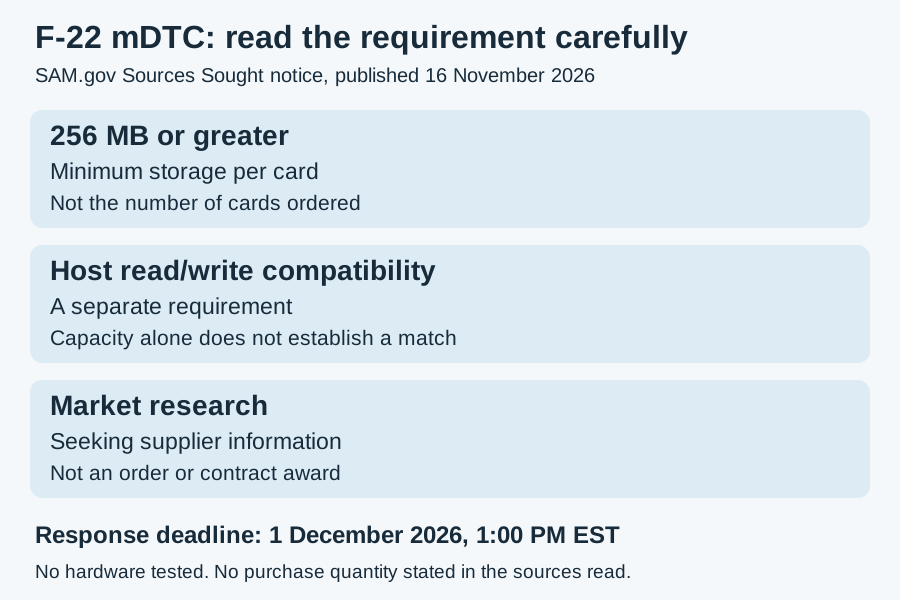
Original Omnistu summary of the public notice. No product or host-system compatibility was tested.
What the attached notice adds
SAM.gov lists a public attachment named "F-22 mDTC SSN (RM).pdf". We read the full text extracted by GovTribe, separately from that site's AI summary. The original PDF download did not become readable in our browser, so this part uses a third-party extraction rather than a checked original PDF layout.
That extracted text says the government does not presently intend to award a contract and is gathering information for planning. It says the notice is not a formal solicitation, a request for quote or a guarantee of a future request for proposals. Responding does not create a binding contract, and the government will not pay response costs.
The supplier questions are more revealing than the capacity headline. They ask for manufacturer and part details, country of manufacture and assembly, supply-chain traceability, counterfeit-avoidance procedures, unit price, operating temperature range, delivery time, minimum order quantity, end-of-life information and warranty terms. A vendor's minimum order quantity is something the survey asks vendors to report. It is not a quantity the Air Force has ordered.
These questions describe information being collected, not evidence that a particular supplier has passed inspection. This article is an explanation of the record, not a bid-response checklist.
What the card-format description can establish
SanDisk's CompactFlash Memory Card Product Manual, revision 10.1 from 2003, documents use of its CompactFlash cards through a Type II PCMCIA adapter. It also describes their electrical relationship to the PCMCIA specifications. That is documentary context for why a CompactFlash card and an adapter can appear together in this notice.
It does not certify a current card, adapter or firmware for the Air Force's host. The notice itself uses the word "passive"; we are not inferring the internal design of every adapter from that word. The manual describes a manufacturer's products of its time, not an approved-parts list for this procurement.
Dates, and what remains unknown
The SAM.gov page gives a response deadline of 1 December 2026 at 1:00 PM EST. The extracted attachment gives the same deadline. The record's 16 December 2026 inactive date is a separate listing-management date, not the response deadline or a promised delivery date.
The visible notice and the extracted attachment do not state an Air Force purchase quantity, a total purchase price, the identity of the government-furnished host, or why this capacity and interface were chosen. We have not verified supplier stock, scarcity or an eventual purchase. A notice about a program's data-transfer cartridge does not establish the capacity of every computer aboard an F-22.
The grounded conclusion is narrower than a story about a fighter running out of storage: the program is researching suppliers for specified removable media, with a minimum capacity and a host compatibility requirement. What happens after that research is not established by this notice.
Prepared with AI assistance and reviewed on 19 November 2026. No procurement response was submitted and no hardware was tested.
Sources
- SAM.gov, official public notice and attachment listing, published 16 November 2026: https://sam.gov/workspace/contract/opp/8948e8601e964c6aba9c801eee16b1be/view
- GovTribe, full-text extraction of the attached Sources Sought Notice, not its AI summary: https://govtribe.com/file/government-file/fa861127rf22-f-22-mdtc-ssn-rm-dot-pdf
- SanDisk, CompactFlash Memory Card Product Manual, revision 10.1, sections 1.1 and 1.3, hosted by Farnell: https://www.farnell.com/datasheets/39782.pdf