Google Play's new adaptive quality rules: what Android app teams must do by April and August 2027
From April 2027, Google Play requires foldable screenshots and a Tier 3 adaptive-quality baseline for new and updated apps; Android 17 targeting follows in August 2027. What Google's own announcement and Tier 3 guideline page say, and what they leave open.
On 18 November 2026 Google announced new "adaptive app quality" requirements for Google Play. After April 2027, apps that do not meet a baseline for foldable devices are due to be blocked from publishing or updating. This guide lays out the dates, what the baseline asks for in Google's own test list, and the parts Google's announcement leaves open. Everything below is Google's account unless we say otherwise. We did not test any app against these rules.
The dates in Google's announcement
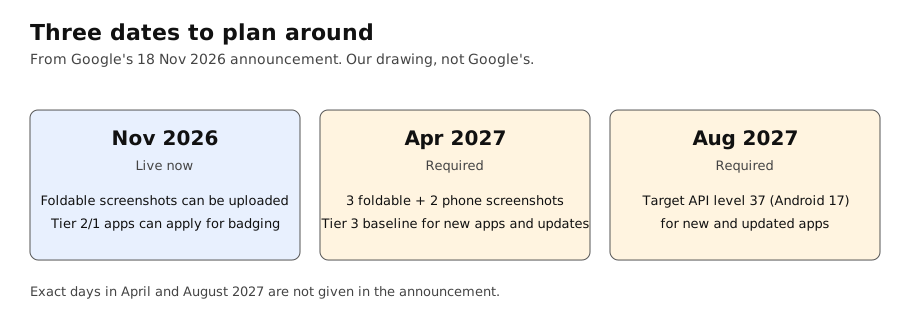
Original timeline by Omnistu from the Android Developers Blog post. Not Google's figure.
- November 2026 (live): developers can upload foldable screenshots in Play Console. Apps that meet Tier 2 or Tier 1 can apply for badging and enhanced merchandising.
- April 2027: new apps and updates must include dedicated foldable screenshots. The baseline "Tier 3" adaptive quality takes effect for standard applications. Google says apps that do not meet it will no longer be able to publish or update, and may have reduced visibility. Existing apps that are not updated remain downloadable.
- August 2027: new and updated apps must target API level 37 (Android 17). Google says this removes developer opt-outs for orientation and resizability restrictions on large screens.
Games have their own requirements, announced by Google the same day in a separate post: games must add foldable screenshots to listings by April 2027 and meet the games Tier 3 ("Ready") large-screen guidelines from August 2027. The games Tier 3 differs from the app Tier 3: games may letterbox or pillarbox cleanly in-engine when rotated to an unsupported orientation, and it asks for unobstructed HUD safe areas and preserved touch alignment across folding, unfolding, rotation and multi-window resizing.
What the screenshots requirement says
From April 2027 Google says apps will need 3 foldable screenshots in addition to the standard 2 phone screenshots. It names three formats: a phone landscape screenshot (16:9), at least one unfolded inner-screen screenshot at 1:1, and for devices with a 4:3 inner display at least one unfolded 4:3 screenshot plus one folded outer-screen portrait screenshot (10:16). Google says screenshots from the Android Emulator's foldable devices (1:1 and 4:3) meet the requirement.
What Tier 3 asks, from Google's guideline page
Google's announcement summarizes Tier 3 ("Adaptive ready") as filling the display without letterboxing, preserving state during rotation, folding and resizing, and supporting multi-window. The Tier 3 guideline page, last updated 13 November 2026, lists more. It groups the requirements into:
- Configuration and continuity: the app fills the available area, is not letterboxed or in compatibility mode, and keeps or restores state across rotation, folding and window resizing, including combinations of these.
- Multi-window and multi-resume: the app works fully in multi-window mode and keeps updating when it is not the focused app, for example continuing media playback, and handles losing the camera or microphone.
- Camera preview and media projection: correct proportions and orientation in landscape, portrait, folded, unfolded and multi-window states.
- Keyboard, mouse and trackpad: text input with an external keyboard, switching between physical and virtual keyboards without relaunching, and basic click, select and scroll with a mouse or trackpad.
- Stylus: basic stylus use, and on Android 14 and higher, writing into text fields.
The page says Adaptive ready apps must first meet the core app quality requirements, in particular the user experience requirements. Each guideline has named tests, such as scrolling, starting playback and entering text, then rotating, folding and resizing and checking nothing is lost.
Note the difference: the announcement mentions foldables and four headline items, while the guideline page covers input devices, camera and multi-resume too. Which of these Play Console will check automatically at April 2027 is not stated in the sources we read.
What the sources do not say
- Whether phone-only or portrait-only apps get an exemption. Google says the baseline applies to "standard applications" and, in one place, "for foldables". We could not find an exemption rule in the pages we read. Check Play Console and Google's current policy pages before assuming either way.
- How "reduced visibility" is measured.
- The exact day in April 2027 or August 2027.
Preparing, per Google
Google's suggested steps are to review the adaptive design guidelines, optimize the app (it points to the Jetpack Compose adaptive tooling), test on foldable devices or the 1:1 and 4:3 emulators, and upload the screenshots in Play Console under Grow, Store presence, Store listings. A reasonable first step for any team is to run the Tier 3 tests above on its own app and record which fail. That suggestion is ours, not Google's.
This guide was prepared with AI assistance and reviewed on 19 November 2026.
Sources
- Android Developers Blog, "Elevating apps: New adaptive quality standards on Google Play" (18 November 2026)
- Android Developers, "Tier 3 — Adaptive ready" (last updated 13 November 2026)
- Android Developers Blog, "Elevating games: New large screens and foldables quality standards on Google Play" (18 November 2026)
- 9to5Google, "Google Play wants Android apps to nail foldable basics by April" (18 November 2026)
- The Verge, "Google is forcing Android app developers to properly support foldables" (November 2026)