Java4Shell explained: why the same Java app can be exposed on one server and not on another
The Java4Shell Base64 flaw only bites when four conditions align, and one of them is your CPU. What Calif's own write-up, the OpenJDK advisory and national alerts actually say.
On 17 November 2026 the OpenJDK project and Oracle released fixes for CVE-2026-114938, a flaw nicknamed "Java4Shell" by its discoverers at the security firm Calif. It is a memory-corruption bug in the optimized version of Java's Base64 decoder, and whether a server is exposed depends partly on its CPU. This guide explains that condition, why different organizations give the flaw different severity scores, and what the advisories say to do. It summarizes other people's findings: Calif's technical write-up, the OpenJDK advisory, the Canadian Centre for Cyber Security's alert and The Hacker News's report. We did not test the flaw, and the sources we read reported no confirmed exploitation.
Where the bug is, per Calif's own write-up
Calif, whose researcher Quang Luong found the flaw, says it sits in the hand-rolled assembly of the Base64 decoder that OpenJDK uses on x86-64 chips with AVX-512 VBMI instructions, after the JVM has compiled that decoder for speed. Its proof of concept uses a 65-character input, 64 "A" characters followed by one stray =. For that input OpenJDK allocates a 50-byte result array; the routine mishandles the stray =, calculates a negative output length, and that becomes a full 64-byte write that lands 62 bytes past the end of the array (offsets 50 to 111). Java rejects the string, but only after the write. Calif says the corruption can reveal sensitive memory or, with a per-application exploit chain, lead to remote code execution, and that it demonstrated RCE in sample applications built on widely used frameworks including Apache Struts and Spring Boot.
Servers often decode Base64 before checking who is logged in, for example in HTTP Basic login headers, SAML artifacts and CSRF tokens, which is why an attacker with no account could reach the decoder. Calif also says researcher samczsun shared a client-side exploit with them: a Java program that opens a TLS connection to a malicious server can be compromised, even if it exposes no service of its own. Calif is holding back the application-specific exploit chains until users have had a chance to upgrade; its published proof of concept only demonstrates the out-of-bounds write.
Four conditions that all have to be true
This list combines the OpenJDK advisory, Calif's write-up, the Cyber Centre alert and The Hacker News. Our arrangement, not a figure from any of them.
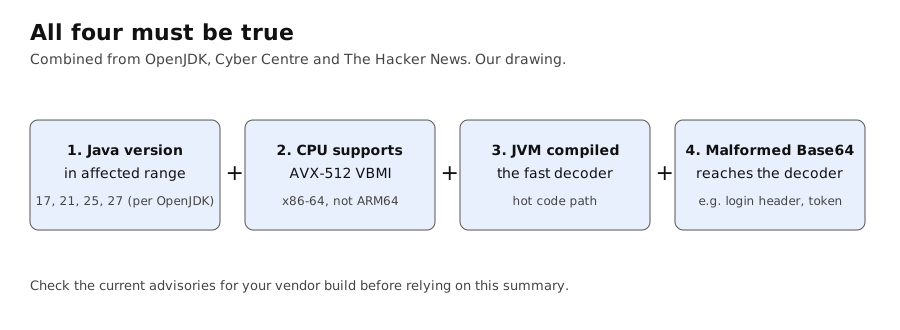
Original diagram by Omnistu from the sources named. Not a figure from any of them.
- A Java version with the flaw. Calif says the vulnerable code is in OpenJDK 17.0.6 and newer. OpenJDK's advisory table marks Java 17, 21, 25 and 27 as affected and Java 8 and 11 as not affected for this CVE. Calif, citing information Oracle provided ahead of publication, lists the vulnerable Oracle Java SE builds as 8u511b33-perf, 17.0.21.0.3, 21.0.13.0.3, 25.0.5.0.3 and 27.0.1.0.3. The Cyber Centre's table also lists the Oracle Java 8 Performance Pack build, and The Hacker News adds some GraalVM builds.
- A CPU that supports the feature. Calif says the vulnerable path runs only on x86-64 chips with AVX-512 VBMI: Intel Xeon Ice Lake, Sapphire Rapids, Emerald Rapids and Granite Rapids, and AMD Zen 4 or newer. ARM64 chips do not run it.
- Java choosing the fast decoder. The JVM switches to the optimized decoder after compiling it for hot code paths, so a rarely used decoder may never take the vulnerable route.
- Attacker-controlled Base64 reaching the standard decoder. For example through login headers and tokens.
Because of the second condition, the same container image can be exposed on one server and not on another.
Why the severity scores differ
The sources give several scores for one flaw. They use different CVSS versions and assumptions, so they are not directly comparable:
- Oracle: 8.1 out of 10 under CVSS 3.1, shown in OpenJDK's advisory table.
- Calif: 9.2 under CVSS 4.0, in its own write-up.
- Red Hat: a preliminary 9.8, per The Hacker News.
- Amazon: 8.8, which its Linux entry says may mean a JVM crash for unauthenticated users or, in certain application environments, code execution by an authenticated low-privileged user.
Calif stresses there is no universal exploit: each target needs its own chain matched to how the application uses Base64, and its remote grooming is sensitive to network conditions. The Hacker News reports that other labs reproduced crashes and a memory leak but not code execution. We did not verify those lab results.
What the advisories say to do
- Update. The Cyber Centre lists fixed releases for Oracle Java: 17.0.21.1, 21.0.13.1, 25.0.5.1 and 27.0.1.1, and 8u513-perf for the Java 8 Performance Pack. Other vendors have their own timing; The Hacker News said Red Hat's fixes were still being prepared when it published.
- Find where Java runs. The Cyber Centre recommends inventorying Java runtimes, including vendor and full build, and checking third-party products, appliances and containers that bundle Java. Prioritize internet-facing systems.
- Check the CPU if patching must wait. The Cyber Centre suggests
lscpu | grep avx512on Linux. Calif's check looks for four features, avx512f, avx512bw, avx512vbmi and bmi2, and all four must appear. - A stopgap. The Cyber Centre says to consider the JVM flag
-XX:UseAVX=2if you cannot patch. The sources we read do not describe its performance cost, so test it first. - Watch logs. The Cyber Centre recommends reviewing web server, application, authentication and endpoint logs.
What this does and does not tell you
The Cyber Centre said on 17 November that it was not aware of active exploitation, and added that this could change quickly. We checked CISA's Known Exploited Vulnerabilities catalog on 19 November 2026 (catalog version 2026.11.18): CVE-2026-114938 was not listed. Status may change; check the current advisories. This guide is a general explanation, not a way to determine whether your own systems are safe. This guide was prepared with AI assistance and reviewed on 19 November 2026.
Sources
- Calif: Java4Shell (CVE-2026-114938) technical write-up (17 November 2026)
- OpenJDK Vulnerability Advisory 2026/11/17
- Canadian Centre for Cyber Security, AL26-029 (17 November 2026)
- The Hacker News, "Java4Shell Flaw (CVE-2026-114938) Enables Pre-Auth RCE in Jira, Jenkins, Keycloak and More" (18 November 2026)