Jetpack Compose November '26 (1.13): an upgrade checklist from the release post
Google's Compose 1.13 release-post checklist: Kotlin and SDK requirements, selected deprecations, behavior changes and benchmark limits. No migration or device testing performed.
The Jetpack Compose November '26 release is stable, according to the Android Developers Blog post of 18 November 2026. It brings version 1.13 across the core Compose modules. This guide turns that post into a checklist: what you need before you upgrade, what is deprecated, what changes behavior, and what is new. Everything below comes from that one post. We did not build or run any code.
Before you upgrade
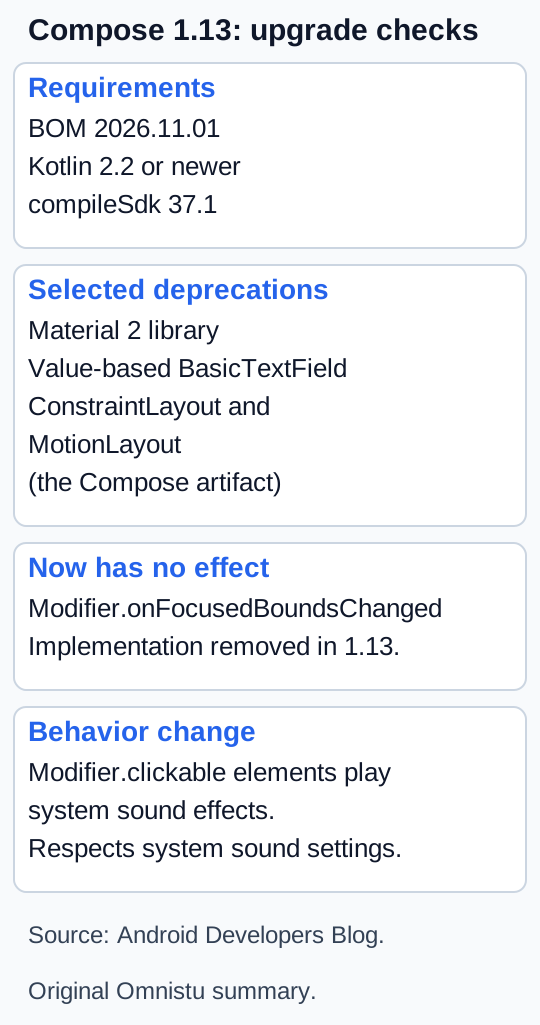
Original summary by Omnistu of Google's release post.
The post says to move to Compose BOM version 2026.11.01. It states that this upgrade requires Kotlin 2.2 or newer and compileSdk 37.1. Check your build against both first.
Deprecations to plan for
- Material 2. The post says Compose Material 2 is deprecated and no longer actively maintained, and recommends moving to Material 3. Material 3 1.5.0 is stable in this release.
- Value-based text fields. The value-based
BasicTextFieldand Material 2TextFieldare officially deprecated. The post recommends the state-basedBasicTextFieldandTextFieldState. Material 3's existing value-basedTextFieldoverloads are not deprecated yet in 1.5.0, but Google recommends moving to the state-based overloads.VisualTransformationis deprecated in favor ofOutputTransformationandInputTransformation. - ConstraintLayout and MotionLayout. Both are deprecated in Compose (the
constraintlayout-composeartifact). The post points to FlexBox, Grid and shared element APIs as replacements. - FlowRow and FlowColumn. Not deprecated, but the post says FlexBox supersedes them and recommends FlexBox for new code.
Behavior changes
Modifier.onFocusedBoundsChangedwas deprecated in 1.12. In 1.13 its implementation is removed, so it has no effect. The post says built-in scrolling containers such asLazyColumnandModifier.verticalScrollalready bring focused content into view and are not affected. For custom containers it points toFocusTargetModifierNode.getFocusedRect(),Modifier.onFocusChangedandBringIntoViewRequester.Modifier.clickableelements, and components built on them, now automatically play standard Android interaction sounds, respecting the user's system sound settings. Check any component where you already play a click sound by hand, since the post does not say how the two interact.
What is new
- Graphics. Progressive blur through
Modifier.blur { ... }, polygon shapes and morphing (PolygonShape,MorphPolygonShape), and blur settings on dialogs and popups. - Layouts.
FlexBoxandGridare stable.LazyLayoutCacheWindowis stable and its settings move from the scroll state into the layout composables. - Performance.
computedStateOf, a lighter alternative toderivedStateOffor condition checks. The post says to keepderivedStateOffor heavy calculations or where caching is needed. It also adds recomposition tracing in Perfetto, which adds overhead, so the post says to turn it off when measuring performance. - Animation.
CapturedAnimatedVisibilityanimates out a snapshot of the last frame, so you can clear state at once. The post reports exits 7 to 8 percent faster in frame time thanAnimatedVisibilityin its own benchmarks. - Testing.
TestFailurePolicycan capture a screenshot and the UI hierarchy when a test fails. - Alpha libraries.
androidx.web:web:1.0.0-alpha01forWebContent, andmaterial3-a2ui:1.0.0-alpha02, a Compose renderer for the A2UI protocol. Alpha means the APIs can change. The Styles API also stays experimental.
Numbers in the post
Google reports that Compose 1.13 matches 1.12.1 on its baseline startup and scrolling benchmarks, with 0% jank on a Pixel 6. It gives cold-start Time to Initial Display as 147.65 ms for Compose and 152.87 ms for Views. It says Views remain faster on Time to Full Display (180.32 ms against 202.79 ms) and on P50 scroll frame duration (3.06 ms against 3.51 ms). These are Google's figures on one device. We did not reproduce them.
What the post does not say
It does not give a migration order, effort estimates or a list of every API change. It points to the BOM comparison tool and linked talks for the full set. Read the release notes for each module you use before upgrading.
Source
- Android Developers Blog, "What's new in the Jetpack Compose November '26 release", 18 November 2026: https://developer.android.com/blog/posts/jetpack-compose-november-2026-release
Drafted with AI assistance from that single source. Check the source and your own build before relying on any detail.