KVM CVE-2026-99312: a reported host-memory read and a Moderate vendor rating
Terra reports host-memory access; Red Hat gives a preliminary Moderate rating. A source-attributed guide to AMD nested KVM scope, host checks and patch-status limits.
Terra Security reports a guest-to-host memory read through a Linux KVM flaw. Red Hat rates the same CVE Moderate and describes denial of service or memory corruption. These are different assessments, not independent confirmation that the researcher's entire exploit chain applies to every vendor build. The useful first step is to establish the host CPU, nested-virtualization setting and vendor patch status.
The affected path, in plain terms
KVM is the hypervisor in the Linux kernel. Terra's 18 November research describes a flaw on AMD hosts with nested virtualization enabled. Nested virtualization lets a guest VM run another VM. The Linux CVE description imported by OSV says an emulated INIT processor-reset signal can leave a stale memory-management context when the nested guest has paging disabled. It says this affects nested SVM, AMD's virtualization path, rather than Intel VMX.
Terra describes the next consequence: a page-table pointer can still name a page that KVM has freed. Its exploit then turns that stale pointer into access to host memory. That is the researcher's account. We did not reproduce it or test a host.
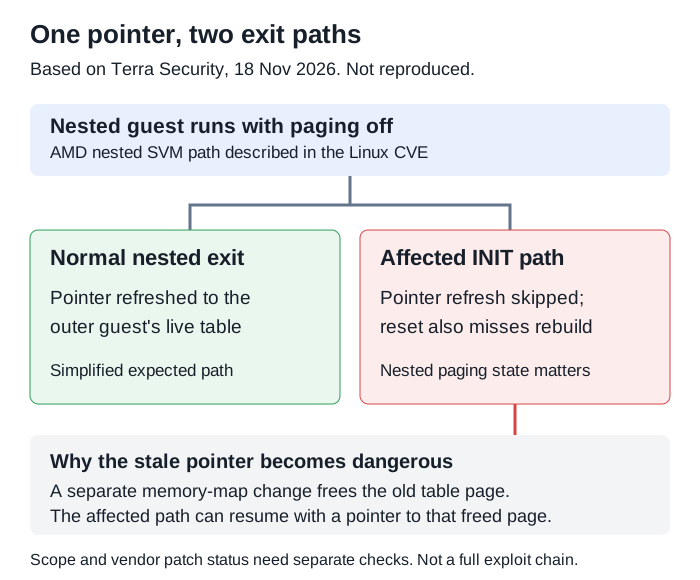
Original Omnistu diagram of Terra's explanation, not a complete description of every KVM exit. The affected INIT path also depends on the nested guest's paging state and a separate memory-map change. No exploit was run.
What Terra demonstrated, and what Red Hat rates
Terra reports reading about 127 GB of host RAM from a DigitalOcean droplet, including a host-kernel version banner. It distinguishes that cloud read from its write demonstration: it says a guest wrote 32 chosen bytes into a host-kernel page on its own bare-metal AMD server. Its reported first-stage race succeeded on six of twelve boots of the large droplet it tested. Those results are not our measurements, and do not establish the current patch status of DigitalOcean or any other provider.
Red Hat's CVE page describes denial of service or memory corruption. Its statement limits the affected setup to AMD-based KVM hosts with nested virtualization and specific guest conditions. It says standard environments without nested AMD virtualization, and Intel-based KVM deployments, are not affected by this flaw.
Red Hat lists a preliminary CVSS 3.1 score of 5.6, with high availability impact and no confidentiality or integrity impact in that vector. It explains that its scores reflect its products and may differ from other vendors. That does not independently refute or validate Terra's host-memory-read claim. Neither page alone settles exploitability on a particular distribution build. NVD could not be read during our check; we do not infer a missing score from that failed fetch.
A bounded host-side check
A host administrator should check whether the host uses AMD KVM, whether nesting is enabled, and whether the running distribution kernel contains the fix for this CVE. Do not treat a guest's kernel version as proof about the physical host.
Red Hat's RHEL 7 nesting documentation explicitly uses this read-only check on the physical host:
cat /sys/module/kvm_amd/parameters/nested
That guide describes Y or 1 as enabled and N or 0 as disabled. This is documented inspection, not a command we ran on a KVM host. An absent file is not a patch verdict. The guide's RHEL 7 default is not a claim about every current distribution: upstream kernel documentation says nesting defaults on from Linux 4.20, while distributions can override it.
Terra reports the mainline fix merged on 2 November 2026, first tagged in 7.4-rc2 on 9 November, with stable releases 7.3.5, 6.18.64 and 6.12.118 on 17 November. OSV lists those stable versions as fixed boundaries in its ecosystem ranges. We have not independently audited the patch or mapped every supported vendor package. Distribution backports mean a version-only scanner can be misleading, as Red Hat's page explains. Use the vendor's CVE advisory and running-package status, not these three numbers as a universal safe-version list.
If updating must wait, Terra proposes disabling nesting through the kvm_amd module's nested parameter. Do not change or unload a live host module from a generic checklist. Coordinate a vendor-supported maintenance procedure and check workloads that require nested VMs first. A saved module setting is not proof that the running host has applied it. This article does not provide a tested change procedure.
If you rent a VM and do not administer the underlying host, you cannot patch that physical host from your guest. Ask the provider about its host-side patch and nesting status; continue maintaining your own guest software separately.
Limits and sources
No exploit, cloud-account test, module change or kernel upgrade was performed. Terra is the security vendor publishing the research. OSV imports the Linux CVE description; its version data is not our independent release audit. The direct kernel commit page returned a browser challenge, so we relied on the attributed description rather than claiming a patch review. Prepared with AI assistance and reviewed on 19 November 2026.
- Terra Security, research published 18 November 2026: https://www.terra.security/blog/kvm-guest-to-host-escape
- Red Hat, CVE description and preliminary product-specific rating: https://access.redhat.com/security/cve/cve-2026-99312
- OSV, imported Linux CVE text and version ranges: https://osv.dev/vulnerability/CVE-2026-99312
- Linux kernel documentation, nesting terminology and defaults: https://docs.kernel.org/virt/kvm/x86/running-nested-guests.html
- Red Hat RHEL 7 documentation, host-side nesting inspection: https://docs.redhat.com/en/documentation/red_hat_enterprise_linux/7/html/virtualization_deployment_and_administration_guide/sect-nested_virt_setup