Is your nginx affected by the HTTP/2 flaws? A version check, tested
A tested upstream version-range model for two nginx HTTP/2 advisories, including stable/mainline boundaries and configuration-check limits.
On 18 November 2026, Rapid7 said it and F5 were disclosing a critical nginx HTTP/2 flaw, and Wiz published details on two. Wiz rates both memory-safety bugs critical, while nginx.org labels CVE-2026-123007 major and CVE-2026-123633 medium: CVE-2026-123633, a use-after-free, and CVE-2026-123007, an integer underflow in flow control. The nginx.org advisory list marks the fixed versions as 1.30.7 and later on the stable branch and 1.31.9 and later on mainline. This guide turns those ranges into a small check, and tests where a hasty version rule would go wrong. It was prepared with AI assistance and reviewed on 19 November 2026.
Scope update, 19 November: This version-check fixture covers two HTTP/2 flaws only. Disabling HTTP/2 does not address the resolver, HTTP/3 or mail-proxy paths in the wider NGINX2ROOT disclosure. Read the five-path update below.
What the sources say
Wiz reports that both flaws need HTTP/2 enabled on the affected nginx server, and that either can lead to unauthenticated remote code execution. Its additional conditions differ: it describes CVE-2026-123633 in reverse-proxy processing when available connection slots run low, while CVE-2026-123007 can also affect directly served content. HTTP/2 being enabled alone does not prove exploitability. For CVE-2026-123007 it says versions are affected back to 1.9.5 (from 2015), and for CVE-2026-123633 the first affected version is 1.19.7. Rapid7, which discovered CVE-2026-123007, says the flaw lets a client cancel queued response data so that nginx later copies with an invalid length. Rapid7 also states limits on its own proof of concept: it needed about 128 GB of HTTP/2 data, relied on a specific x86-64 glibc memcpy path, and would likely not work through a proxied HTTP/2 connection. Rapid7 does not say other exploit paths are impossible, and neither do we.
The trap in the version numbers
The advisory ranges are: CVE-2026-123007 vulnerable from 1.9.5 through 1.31.8, and CVE-2026-123633 from 1.19.7 through 1.31.8. For the listed upstream release lines, fixes are in 1.30.7 and later 1.30.x stable releases, or 1.31.9 and later mainline releases. That is not a single "upgrade past X" line. Version 1.30.7 is fixed, yet 1.31.0 through 1.31.8 are still vulnerable, because the stable branch got its fix before the mainline did.
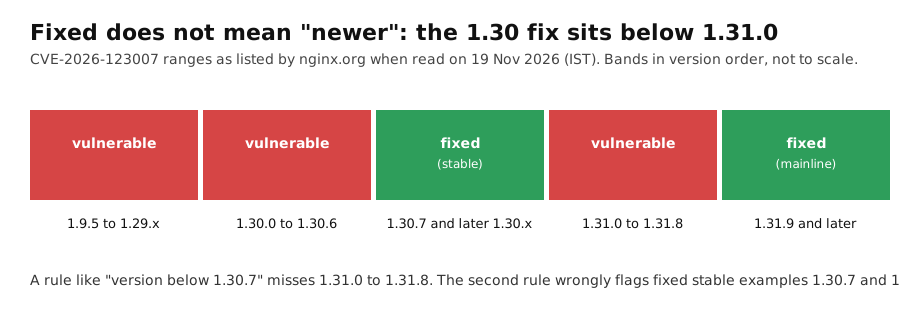
Original diagram by Omnistu from the nginx.org ranges. Not to scale.
The fixture encodes this and checks twelve versions, including each boundary: 1.9.4 (not affected), 1.9.5, 1.19.6 (affected by the first flaw only), 1.19.7, 1.30.6, 1.30.7, 1.31.0, 1.31.8, 1.31.9 and 1.32.0. Two deliberately weaker rules are tested against it. A rule that flags only versions below 1.30.7 misses 1.31.0 and 1.31.8. A rule that flags everything below 1.31.9 wrongly flags the fixed stable examples 1.30.7 and 1.30.9. The fixture asserts both failures by name, so the check fails if the real rule is ever replaced by either.
def vulnerable(version, cve):
    v = parse(version)
    lo, hi = ADVISORIES[cve]
    if not (lo <= v <= hi):
        return False
    if v[:2] == (1, 30) and v >= (1, 30, 7):
        return False          # 1.30 stable fix
    return True
Is HTTP/2 even on?
This is a temporary workaround for CVE-2026-123007 and CVE-2026-123633, not all five NGINX2ROOT paths. Wiz's workaround for people who cannot upgrade immediately is to disable HTTP/2: set http2 off; on nginx 1.25.1 or later, remove the http2 parameter from listen directives, test, reload, and confirm that old workers have exited. The fixture includes a small detector for http2 on; and listen ... http2;, and it ignores commented lines. It matched five sample configs. It does not follow include files or tell server blocks apart, so it is a starting point for reading your configs, not an audit tool. Directive inheritance, quoted values, runtime state, include expansion and per-server overrides are not modeled; a regex match does not prove exposure.
Five NGINX2ROOT paths need separate checks
Xint's 18 November report describes five independent nginx vulnerabilities. CIRCL TR-105 also maps their prerequisites. Each nginx flaw can provide code execution with worker-process privileges in an affected configuration, not automatically root on the host. This added source-based summary does not extend our two-CVE fixture or claim that we tested exploitation.
- CVE-2026-123007: HTTP/2 enabled on an affected listener. Disabling HTTP/2 blocks this path.
- CVE-2026-123633: HTTP/2 with requests forwarded to an upstream, including the connection-pressure conditions described above. Disabling HTTP/2 blocks this path.
- CVE-2026-123634: a resolver, a request-derived proxy destination and subrequests. Xint demonstrated it with
mirrorandmirror_request_body off, and says other subrequest features, such as SSI, may reach the bug. Turning off onlymirroris not a complete exclusion. HTTP/2 off does not block this path. - CVE-2026-121810: HTTP/3/QUIC with requests proxied upstream, per Xint and CIRCL. HTTP/2 off does not block it.
- CVE-2026-113425: the mail proxy with
proxy onandauth_http. HTTP/2 off does not block it.
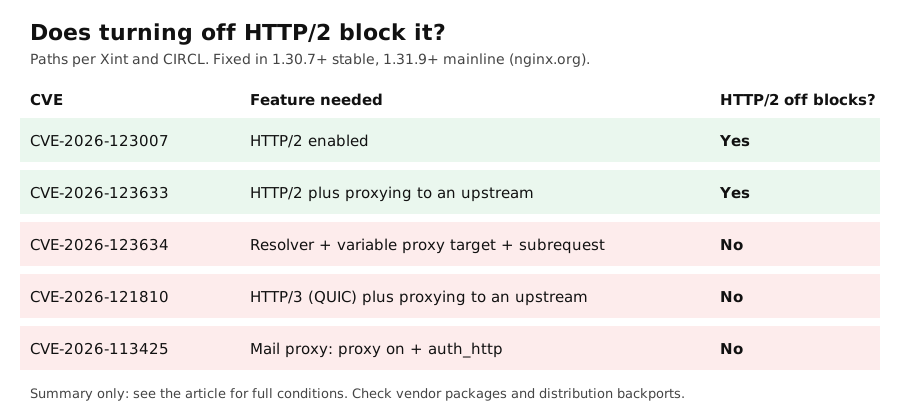
The current nginx.org advisory list marks all five fixed in 1.30.7 and later 1.30.x stable builds, and 1.31.9 and later mainline builds. Do not treat a single numeric cutoff as a substitute for branch-aware and vendor-package checks. After installing patched binaries, restart nginx or use a supported live binary upgrade. A configuration reload alone does not replace the running executable.
There are two lower-bound disagreements. Xint's tested-path table and CIRCL start the resolver path at 1.13.4, while nginx.org lists CVE-2026-123634 from 0.6.18 through 1.31.8. For mail, Xint and CIRCL list 0.5.15, while nginx.org lists CVE-2026-113425 from 0.5.33 through 1.31.8. Use the owning nginx and distribution advisories for patching decisions, not our fixture as a five-CVE classifier. CIRCL's 18 November text also calls 1.31.9 pending; the newer vendor advisory snapshot used here lists the fixed branches.
Xint reports address-disclosure techniques that bypass ASLR; CIRCL says ASLR and PIE are not reasons to dismiss these findings. Keep those protections enabled, but do not treat them as substitutes for patches. Xint and CIRCL separately describe a Linux SCTP kernel flaw used to turn worker access into host-root access in their tests, including a Docker scenario. That step also needs a reachable vulnerable kernel path. CIRCL's 18 November report names no kernel CVE. We have not verified a later kernel-fix status, tested the chain or assessed any customer system.
What this does not cover
A version string is not proof. Linux distributions may backport fixes without changing the nginx version number, and some vendors build nginx with their own numbers, so check your distribution's or vendor's advisory too. NGINX Plus has its own fixed releases, which are in the Wiz table and not tested here. The nginx.org list also shows several other recent advisories, including an HTTP/3 one, which this check does not cover. The ranges were read from nginx.org on 19 November 2026 and can change. Versions outside the supplied range mean only that this snapshot does not list them for these two issues, not that a future release is proven safe. This guide does not describe how to exploit anything.
Sources
- nginx.org security advisories: https://nginx.org/en/security_advisories.html
- Wiz: https://www.wiz.io/blog/nginx-http2-rce-vulnerabilities
- Rapid7: https://www.rapid7.com/blog/post/ve-cve-2026-123007-critical-nginx-http-2-integer-underflow-leads-to-rce-fixed/
- Xint disclosure and tested-path table: https://xint.io/blog/nginx2root-remote-code-execution
- CIRCL TR-105: https://www.circl.lu/pub/tr-105/
- Sophos advisory coverage: https://www.sophos.com/en-us/blog/patches-released-for-critical-nginx2root-vulnerabilities