Optimizely's incident shows why a trusted script is still a trust decision
What the Optimizely incident reports do and do not establish, why the CSP table needs care, and 17 local browser cases instead of a misleading safe/unsafe grade.
A third-party script can arrive from the expected domain and still contain hostile code. That is the useful lesson from the November 16 Optimizely Web Experimentation incident. It is not evidence that Content Security Policy is useless, or that one keyword can certify a website as protected.
Optimizely's November 17 interim report says a flaw in its account signup flow let an unauthorized party impersonate administrator users and change customer Project JavaScript. The company says it fixed the flaw and removed the injected code. Its forensic investigation with Mandiant was still ongoing in that report. This article compares that account with Report URI's technical investigation and KrebsOnSecurity's reporting, then tests a few CSP behaviors on a local page. We did not test any affected website or run the malware.
What is confirmed, and by whom
Optimizely says the problem involved Web Experimentation, not Feature Experimentation, its SDKs or legacy Full Stack. It reports no indication of impact to its other products. According to its report, the attacker exploited impersonation rather than stealing customer passwords. Customer JavaScript was then delivered through the normal snippet path. That is different from a CDN cache-poisoning attack.
Report URI says it fetched 1,611 distinct snippets and found 188 infected snippets associated with 178 organizations. These are the researcher's observed counts, not a census of visitors, a count of compromised devices, or Optimizely's final customer total. An organization can have multiple snippets and hosts.
The two accounts should not be flattened into one precise timeline. Optimizely dates its first malicious project write to 07:51 UTC on November 16, detection to 13:34, the fix to 16:10, and code removal to 22:24. Report URI's timeline includes an earlier 04:21 observation involving a different loader in a BBC snippet. Its later update says all infected files it monitored were clean as of 23:11. We have not reconciled the earlier observation with the company's first-write time. A monitored cleanup observation is also not the same event as the company's internal removal milestone. Customers need their own project history and exposure window, not a universal window inferred from this article.
Report URI describes wallet-address replacement, on-page card skimming, readable-cookie and screenshot theft, and an iOS exploit-kit stage. Optimizely's report also discusses on-page card and crypto risks, readable cookies/screenshots when a wallet address was swapped, and an iOS second stage. Neither this article nor those mechanisms establish how many cards, visitor sessions or devices were actually compromised. The operator says it could see when code loaded, not whether theft succeeded.
Both sources distinguish card fields in a site's own page from hosted payment iframes, which their described skimmer could not read. That is a boundary in this incident's analysis, not a general guarantee that every checkout using an iframe is safe.
Read the CSP table without inventing a success rate
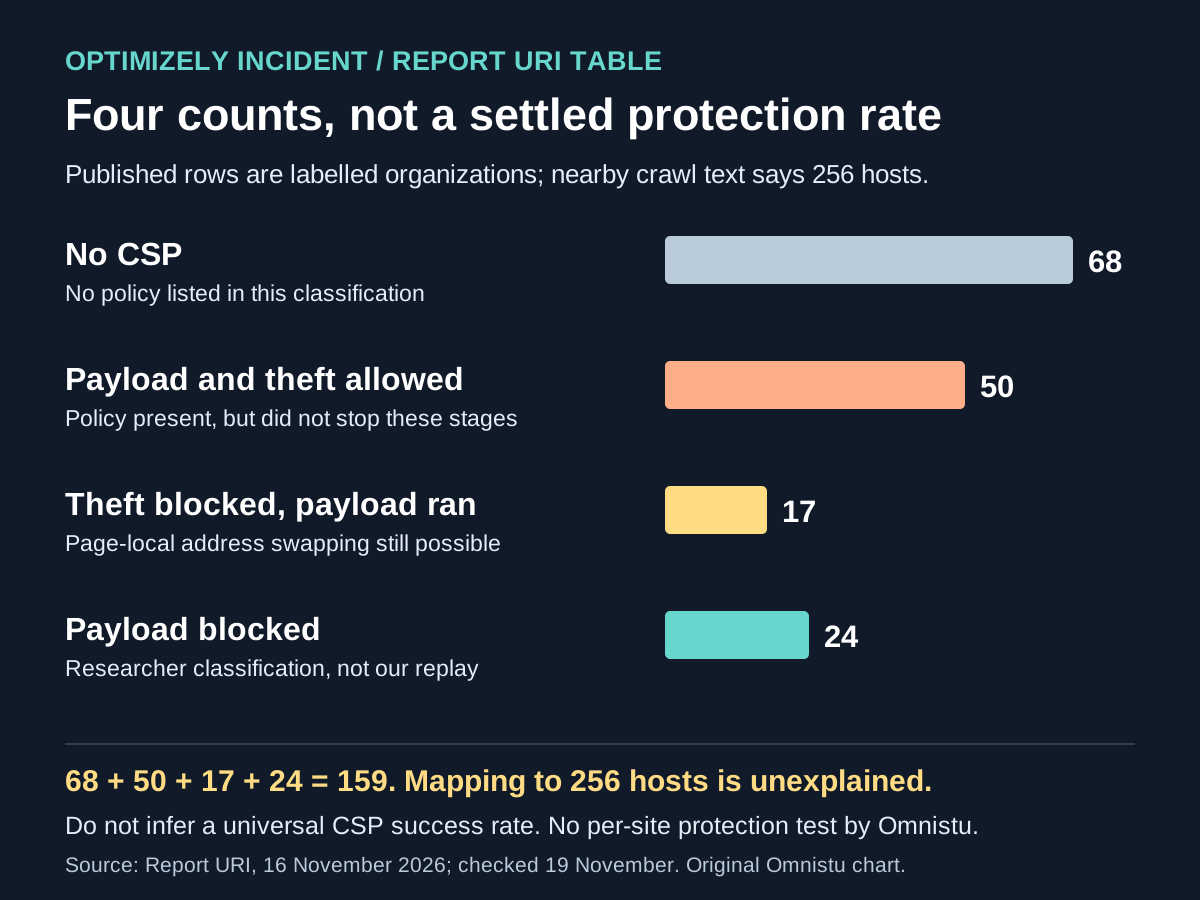
Original Omnistu chart of Report URI's published table. Its row label is organizations, while the nearby crawl description refers to 256 hosts. The four rows total 159. We have not established a one-to-one mapping or an explanation for the mismatch.
Report URI lists 68 with no CSP, 50 whose policy allowed the payload and data theft, 17 where the payload ran but data theft was blocked, and 24 where the payload was blocked. Its post labels that last group 15%. We do not repeat that as a protection rate for all 256 hosts, all 178 organizations, or websites generally. The units and coverage are not sufficiently explained. Dividing one number by a convenient denominator would not repair the missing mapping.
The partial group matters: Report URI says a restrictive connect-src stopped the described card, cookie and screenshot transfers on those 17 sites, but not address replacement inside the page. That observation is attributed to its analysis. We did not reproduce its per-site classifications, inspect their complete policies, or prove that every other exfiltration route was closed. Report URI sells CSP reporting and script-monitoring services, so its claims about what its products would have detected are also vendor claims, not our test results.
CSP checks happen at different boundaries
An allowed script already has substantial access to its page. Blocking a later script load does not undo page changes made by the first script. A policy can still stop particular follow-on resource loads and network requests. These are different claims.
For script elements, modern CSP uses script-src-elem when present, otherwise script-src, otherwise default-src. String compilation through mechanisms such as eval() is governed separately by script-src with default-src as its fallback. A restrictive element directive must not be treated as an automatic prohibition on every JavaScript execution mechanism.
MDN explains that a nonce/hash-based policy with 'strict-dynamic' can propagate trust from an explicitly trusted script to scripts it dynamically inserts. That is useful for managing script trust and is not inherently a weak configuration. It does, however, mean that a compromised trusted loader can pass that trust onward. Simply spotting 'strict-dynamic' does not tell you that a policy is bad, or that a host allowlist is still the active boundary.
Likewise, 'unsafe-inline' is ignored for script elements when a valid nonce or hash source is present in supporting browsers. And 'none' mixed with other source expressions is not a magic override that blocks everything. A checker that returns a reassuring label for script-src 'none' * is misleading.
A report-only policy records violations rather than enforcing its restrictions. Monitoring is useful before an enforced rollout, but reports alone do not block an attack. Multiple enforced policies can further restrict a page; reading one header value cannot settle the combined result.
A descriptive inspector, not a safe/unsafe grade
We replaced our draft's three-level checker with a smaller, more honest tool. It accepts one supplied header value, shows the separate script-element, string-evaluation and connection directives, lists ignored duplicate directives, and points out interactions worth reviewing. It makes no network requests and produces no protection verdict.
Download the inspector, unit tests, local browser fixture and recorded results. The bundle includes a README with commands and limits. Supply the header on standard input, rather than trying to hand-escape its quoted keywords in a shell command.
We ran 16 unit tests for parsing, fallback selection and descriptions, plus 17 local Chrome cases that observed whether a root script, a dynamically inserted child, an untrusted inline block and an eval() expression ran. The cases include mixed 'none', duplicate directives, nonce/inline interactions, 'strict-dynamic', script-src-elem, report-only mode and two enforced policies. These are representative local behavior tests, not an incident replay, a complete CSP parser conformance suite, or a Safari/Firefox compatibility test.
The inspector rejects combined comma-separated policy input and line breaks rather than quietly pretending it can evaluate multiple response headers. It does not validate a nonce's randomness or reuse, verify hash bytes, resolve source paths, inspect meta policies, analyze redirects, or determine what an allowed third-party script will do. A syntactically present nonce/hash expression is not proof of a correctly deployed policy.
What operators should take from this
For affected Web Experimentation customers, start with Optimizely's current customer-specific guidance and preserve your own project-change, web, CDN, CSP, payment and fraud records. Its interim report asks customers to investigate exposure and obtain exact project timelines through their customer contact. Whether a visitor's data was taken needs investigation; a script-load record is not an exfiltration record.
Credential advice needs the same precision. Report URI recommends reviewing access and rotating potentially exposed credentials or browser-readable secrets. Optimizely says the platform impersonation flaw did not steal customer passwords and does not require blanket password or API-token resets. Those refer to different evidence and potentially different secrets. Do not turn either into a universal instruction to reset everything or to ignore potentially exposed visitor sessions. A site's incident team should decide from its own exposure and the vendor's latest guidance.
For ongoing design, reduce unnecessary third-party code on sensitive pages, review who can change it, monitor changes, and test an appropriate CSP before enforcing it. Report-only can help find breakage, but an enforced policy is needed to block what it disallows. No generic header snippet can replace testing your page, its dependencies and its payment flow.
Sources and limits
Checked on November 19, 2026. AI-assisted synthesis of linked sources, with local fixture results described above. We read the operator's interim report, not a final root-cause analysis. No affected-site scan, malware execution, independent incident confirmation, customer audit or proof of data safety is claimed.
- Optimizely: Security Incident Initial Report for Customers, November 17
- Report URI: technical investigation and November 17 update
- KrebsOnSecurity: reporting and company response, updated November 18
- MDN: script-src and strict-dynamic
- MDN: script-src-elem and its limits
- MDN: CSP header, source expressions, report-only and multiple policies