Supercite's preliminary AI-answer study: what 701 changed brand lists mean
Supercite reports different brand sets in 701 of 839 answer pairs. A guide to its preliminary two-day sample, definition of change and limits, not a general daily rate.
Supercite, a company selling AI brand-visibility tracking, reported on 18 November 2026 that the brand lists in 701 of 839 matched answer pairs differed between two consecutive days. That is about 83.6%, rounded to 84%. It is a result from the vendor's preliminary sample, not an established daily change rate for AI answers in general.
The distinction matters: an answer with one added or missing brand counts as changed. The number does not mean 84% of recommendations were replaced, that the answers became wrong, or that any engine is better at choosing products.
What was compared
According to Supercite's method, it asked 210 buying questions across 21 categories on ChatGPT, Gemini, Google AI Overviews and Google AI Mode, as a US user in English, on 17 and 18 November 2026. Examples included CRM software and email marketing services.
The post reports 839 answers that could be compared across both days. Here, the unit is a matched question-and-engine answer pair across the two dates, not 839 different questions. Multiplying 210 questions by four engines gives 840 possible pairs. The published method does not explain the one-pair shortfall, so we do not assume a cause.
The company says it matched brand names automatically, removed names it treated as platforms rather than recommendations, and still expects some matching noise. It defines a changed answer as one whose set of named brands is not exactly the same. A change in ordering alone would not change a set.
The reported engine percentages
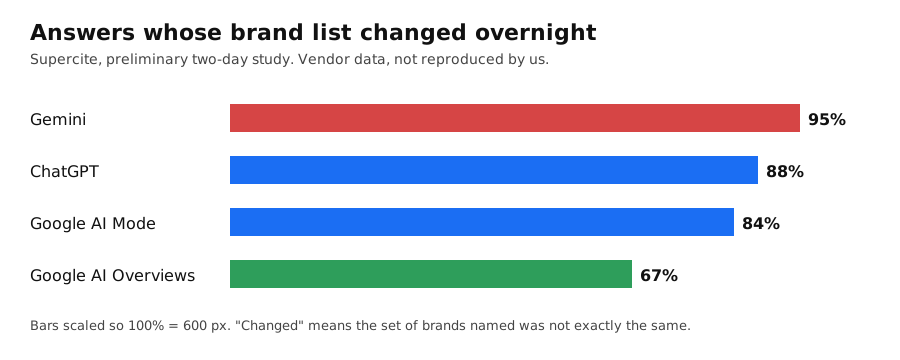
Original Omnistu chart using Supercite's published table. Bars share a zero baseline and represent percentages, not answer counts. The post does not give per-engine counts in that table. These percentages describe this sample only, not answer quality or a permanent consistency ranking.
The overall 701/839 figure can be checked arithmetically. The per-engine percentages cannot be reconstructed from the table alone because its underlying engine-level numerators and denominators are not supplied there. We have not analyzed raw answers or rerun the experiment.
Two days cannot isolate an overnight effect
Supercite labels the result preliminary: days one and two of a planned seven-day run, with one sample per question per engine each day. It also says the measured difference includes both real change and normal answer randomness.
With this design, a difference observed on day two is not proof that the passage of a day caused it. Repeating the same question several times on day one could also produce different answers. Without a within-day comparison, the result cannot separate that variation from changes in sources, systems or other conditions between dates.
OpenAI's developer documentation separately describes Chat Completions as non-deterministic by default. That is context about an API, not a replication of this study and not evidence that the consumer products in Supercite's sample used particular settings. The archived reproducibility recipe also warns that matching settings does not guarantee identical output.
Different percentages answer different questions
Supercite additionally reports that a day-one first-place brand was still named the next day 90% of the time, but remained first only 63% of the time. Being mentioned again and keeping the top position are different outcomes. Neither is the same as an unchanged full brand set.
We do not combine those percentages into a single stability score. We also do not treat the post's cited-page retention figure as interchangeable with its brand-overlap measure. The published definition of brand overlap divides shared brands by the union of brands across the two answers, a different denominator from day-one retention.
A small logging exercise, not a proven growth tactic
If you want to inspect your own case, start with a fixed set of buying questions and record the exact prompt, date, time, engine, visible product or model label, language, location setting, full answer and cited links. Keep the wording and other controllable conditions the same.
Repeat some questions within the same day as well as on later days. Separate three observations: whether your brand appeared, whether the full brand set changed, and whether its position changed. This is a suggested logging exercise, not a tested method for estimating a market-wide rate. A small convenience sample does not establish what all customers see.
There is also a commercial conflict to keep visible. Supercite sells a product for repeated tracking, so a finding that encourages repeated checks supports its business. That does not disprove the numbers. It does make independent replication useful before treating the headline as a general rule.
The vendor's related post recommends getting onto more cited lists. That post itself acknowledges correlation. Neither it nor this two-day comparison establishes that buying links, pitching list writers or publishing a list will cause an engine to recommend a brand. This article makes no backlink or traffic guarantee.
Sources and review limits
Prepared with AI assistance and reviewed on 19 November 2026. We read the published method and tables, checked the headline arithmetic, and compared the claim with separate developer documentation and coverage. We did not reproduce the experiment or analyze its raw data. Repeated coverage of the vendor's figures is not independent verification.
- Supercite, preliminary two-day study, 18 November 2026: https://supercite.ai/blog/ai-answers-change-every-day
- Supercite, related one-day list-citation study, 17 November 2026: https://supercite.ai/blog/ai-recommendations-come-from-lists
- OpenAI, advanced usage and reproducible outputs: https://developers.openai.com/api/docs/guides/advanced-usage
- OpenAI, archived reproducible-output example, historical API context only: https://developers.openai.com/cookbook/examples/reproducible_outputs_with_the_seed_parameter