Vercel eve 1.0: what the release says, and ten questions to ask before putting an agent into production
Vercel's 17 November 2026 eve 1.0 announcement: what the open-source agent framework claims, what its two headline latency and cost numbers actually measure, the differing latency values inside the post, and ten questions to ask any agent framework.
On 17 November 2026 Vercel announced eve 1.0, which it describes as an open-source framework for building production-ready agents. This guide sets out what the announcement claims, what its two headline numbers measure, and a checklist you can use on eve or any other agent framework. Everything attributed to Vercel below comes from its own launch post. We did not install eve, run it, or test any figure.
What Vercel says is in 1.0
According to the post, eve is a "harness": the loop that calls models, runs tools and hands work to subagents. You pick the model, replace tools, edit instructions and decide which actions need human approval. The announcement lists these areas:
- Durable runs. The open-source Workflow SDK saves progress so an agent can resume from its last completed step after a crash.
- Shared sessions. Several people can use one session. Approvals are routed to the right person. Slack, Microsoft Teams, Discord, Telegram, GitHub, Linear, Twilio, web chat and iMessage are named as native channels.
- Multi-tenant setup. One deployment can use each customer's own credentials and approval rules.
- Memory. Built-in file memory, or a provider you choose or build. The post says built-in file memory is held in memory during local development and in a private Vercel Blob store on Vercel.
- Tracing. Rebuilt around OpenTelemetry, with controls over what is collected. Per the post, private production conversations send only metadata by default.
- Extensions. Shared packages of tools, skills, instructions, channels and subagents.
- Versioning. Semantic versioning. Breaking changes to stable APIs only in major releases. Experimental and internal APIs can change between major releases.
The post gives Node.js 24 or newer as the requirement for the terminal setup.
The two numbers
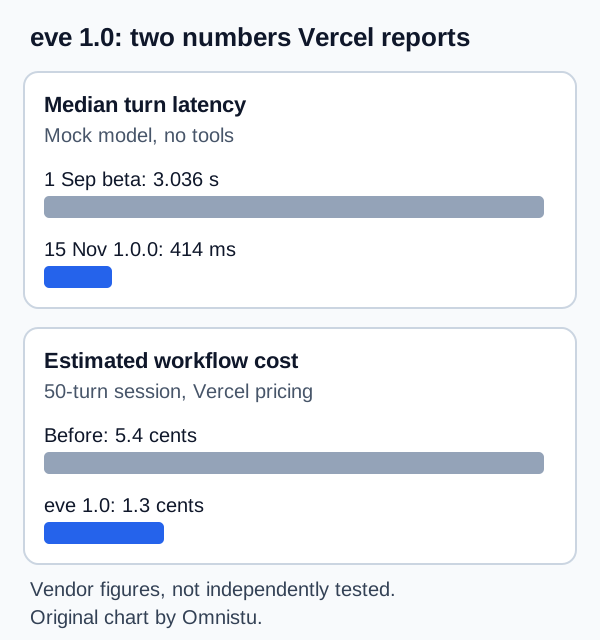
Original chart by Omnistu from figures in Vercel's post. Not independently tested.
Latency. Vercel says a hosted stress test on its own Workflows product had a median of 3.036 seconds per turn at the start of September and 414 milliseconds in 1.0.0 on 15 November (p95: 3.692 s and 633 ms). The test sends messages one at a time, with an immediate mock-model reply and no tool calls. So it measures framework and workflow overhead only, not a real model, real tools or real traffic. By our arithmetic, 414 ms is about 86% lower than 3.036 s. One caution: the post's text and table say 414 ms, but a caption under the chart reads "3.04s to 626ms". We could not tell which is the final figure, so we use the text and table value and flag the difference.
Cost. For a 50-turn session, Vercel's estimate for workflow cost falls from 5.4 cents to 1.3 cents, which it calls about 76% lower. Our check: 1.3 divided by 5.4 is 0.24, so about 76% lower, which matches. The estimate assumes roughly two model steps per turn and 30-day retention, and it uses Vercel Workflows pricing. It covers workflow cost, not model tokens.
The post also quotes customers: Rillet's shipping rate tripled in three months; 30 to 40 percent of Clay's company used its Slack data agent every week; an Evisions engineer reported halving AI costs. These are the companies' reports as relayed by Vercel.
What the post does not show
- No published benchmark code or raw data for the latency run; the post describes the setup in a short paragraph, not a reproducible method. The post links separate benchmark results for coding harnesses, which we did not read.
- No test with a real model, tool calls or concurrent users.
- No comparison with other frameworks on latency or cost.
- No independent review of the security controls or crash-recovery behavior.
- Hosted features such as Agent Runs and managed sandboxes are described for Vercel. How much works the same when you self-host is something to check in the docs.
Ten questions for any agent framework
This list is ours, not Vercel's. It is a reading aid for launch posts like this one.
- Which actions need human approval, and who is asked when several people share a session?
- What happens to a half-finished run if the process restarts?
- Where is memory stored, who can read it, and how do you delete it?
- What do traces record by default, and can you exclude prompts and tool output?
- Can you swap the model without rewriting tools?
- How are customer credentials separated if one deployment serves many customers?
- Which APIs are stable and which are experimental?
- What does a benchmark actually include: real model, real tools, real load?
- What does it cost per long session once model usage is added?
- How do you leave: can you run it outside the vendor's platform?
Sources
- Vercel, "Introducing eve 1.0", 17 November 2026: https://vercel.com/blog/eve-is-now-generally-available
Drafted with AI assistance from that single source. Check the primary source and your own tests before relying on any figure.