Voyager 1's one-light-day milestone: what a 48-hour round trip means
The one-light-day milestone, exact-constant arithmetic and what a 48-hour signal round trip means. Original log-axis and timeline diagrams, with source limits.
On 18 November 2026, Voyager 1 became the first human-made object to be one light-day from Earth. NASA describes a light-day as the distance light travels in 24 hours. Spaceflight Now reports the crossing at 5:16:07 a.m. EST (10:16:07 UTC, or 3:46:07 p.m. IST in India), with the probe about 25.9 billion kilometers (16.1 billion miles) away and moving at nearly 38,000 mph.
The number is easy to say and hard to picture. This guide turns it into three comparisons you can check.
The distance, from first principles
Light moves at 299,792,458 meters per second. Multiply by the 86,400 seconds in a day and one light-day is 25,902,068,371 kilometers, which is 173.1 astronomical units, where one AU is a fixed reference length close to the average Earth-Sun distance. This is the exact-constant calculation rounded to a kilometre, not an independent measurement of Voyager. It rounds to the 25.9 billion km figure in Spaceflight Now; NASA gives the coarser 25.89 billion km using a rounded light-speed figure. We computed it with a short script and keep its exact-constant result separate from the rounded numbers in those reports.
For comparison, sunlight takes 499 seconds, about 8.3 minutes, to cover one AU. Voyager 1 sits at roughly 173 times that distance. A light-year is 9.461 trillion kilometers, so a light-day is only about 0.27 percent of one.
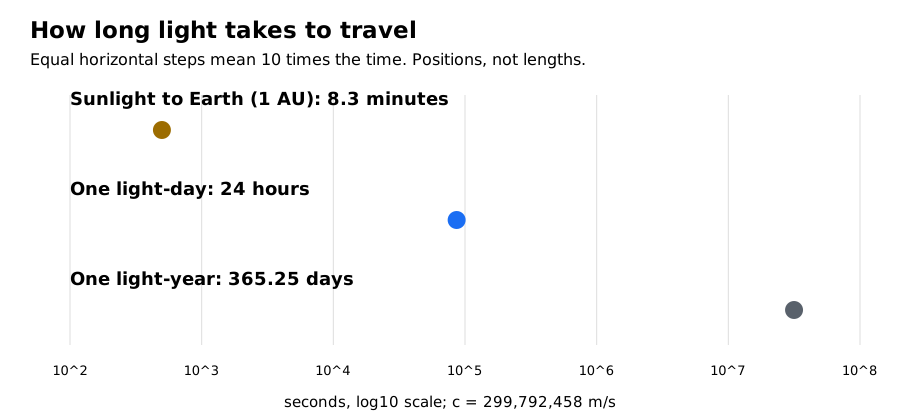
Original chart by Omnistu, computed from the speed of light. Equal horizontal steps mean ten times the travel time, not equal added seconds. Dot positions, not bar lengths, encode time.
What it means for commands
Spaceflight Now says a command from NASA's Deep Space Network now takes a full day to reach the spacecraft, and its reply takes another day to come home. At light speed the shortest possible round trip is therefore 48 hours, and that leaves out any time the spacecraft needs to act.
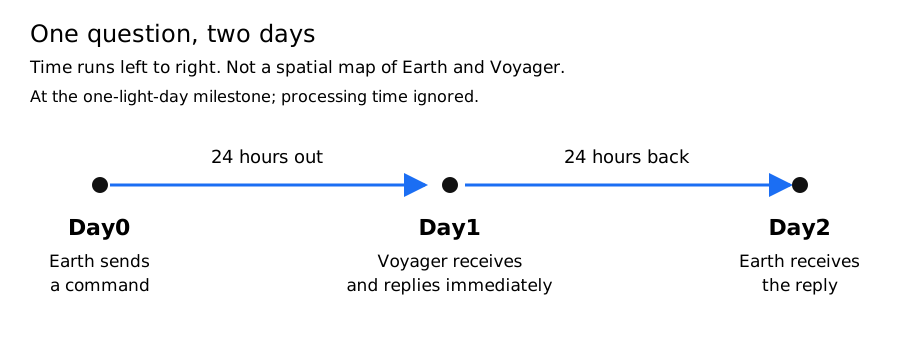
Original diagram by Omnistu. Light-speed travel only.
Why this is an engineering milestone
Alan Cummings, a Caltech senior research scientist who has worked on Voyager's Cosmic Ray Subsystem since before launch, told Spaceflight Now it is "not a scientific milestone" but "an engineering milestone." The same report says the probe has two working science instruments, a shrinking power supply, and went silent for two days last month before engineers reestablished contact. Spaceflight Now attributes the statement that the milestone causes no physical change to NASA JPL. Smithsonian's National Air and Space Museum notes that Voyager 1 launched on 5 September 1977.
A scale check, with an assumption
If a probe kept going at NASA's quoted speed of about 61,000 km/h, covering one light-year would take about 17,700 years. This is our own arithmetic, assuming the speed stays constant, and it is a way to picture the gap between a light-day and a light-year, not a mission forecast.
What this does not cover
This article does not report new science results or the mission's remaining lifetime. The milestone date comes from NASA and the cited reports; the precise crossing second is Spaceflight Now's reported value, not a time we independently measured. Distances describe the crossing, not a live tracker. Earth-spacecraft distance can vary with Earth's orbit as well as the probe's motion. The charts were made for this article from the numbers above. This guide was prepared with AI assistance and reviewed on 19 November 2026, and the arithmetic was run with Python 3.10.12.
Sources
- NASA Science, Voyager One Light-Day: https://science.nasa.gov/resource/voyager-one-light-day-downloads/
- Spaceflight Now: https://spaceflightnow.com/2026/11/18/nasas-voyager-1-is-one-light-day-from-earth/
-
Smithsonian Voices, National Air and Space Museum: https://www.smithsonianmag.com/blogs/air-space-museum/2026/11/18/nasas-voyager-1-has-reached-1-lightday-from-earth-it-is-the-first-humanmade-object-in-space-to-reach-that-distance/
-
NASA JPL astrodynamic constants: https://ssd.jpl.nasa.gov/astro_par.html
- NIST speed of light: https://physics.nist.gov/cgi-bin/cuu/Value?c