Escape for the context you are in: an HTML output-encoding test
Escape for the HTML context you are in. Python fixtures run five payloads through three templates and three encoders, and show where escaping stops.
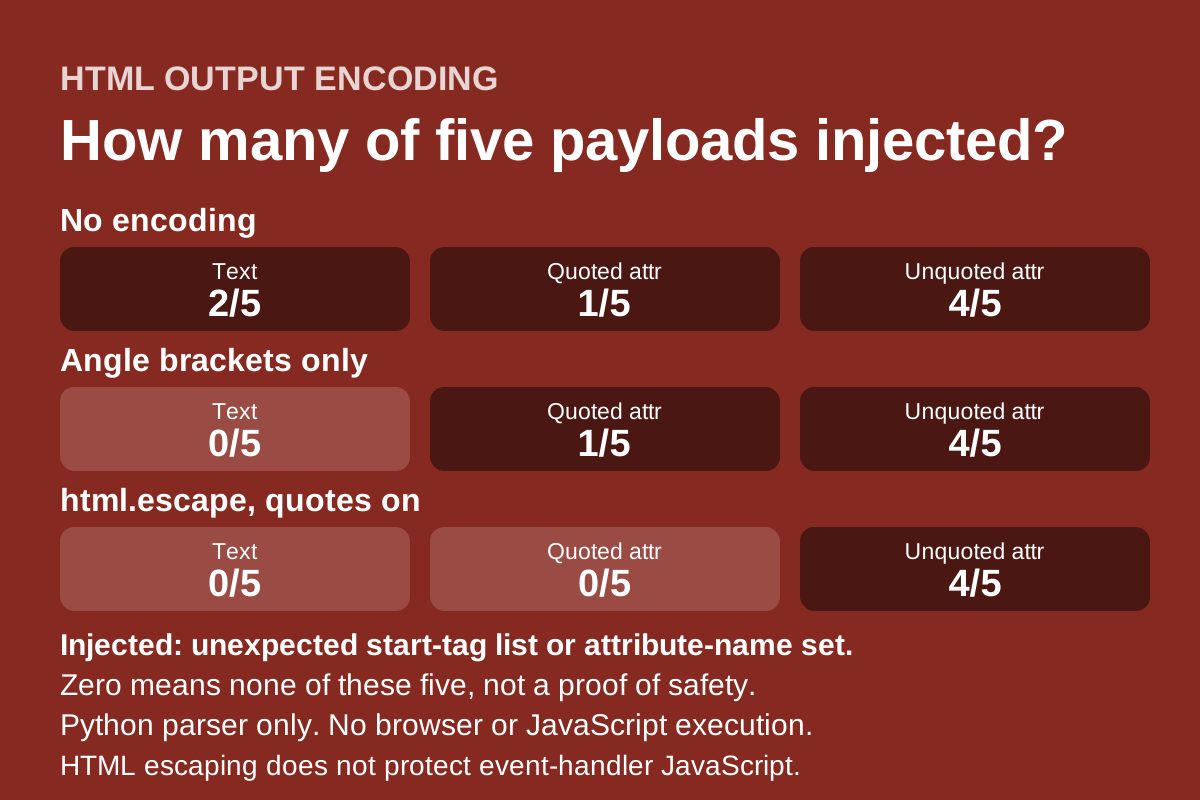
A comment shows up inside a <div>, and the same user's name is placed in an <input value="...">. Both are "HTML", yet the characters that break out of each one differ. A fix that works in one place can leave the other open.
The OWASP Cross Site Scripting Prevention Cheat Sheet says that the right protection depends on how the data is used, and that browsers parse HTML, JS, URLs and CSS differently, so the wrong encoding method can introduce weaknesses. For an HTML context it recommends HTML entity encoding. For an ordinary text attribute it says to use attribute encoding, always surround the value with quotation marks, and keep element and attribute names fixed. It also says attribute encoding alone does not protect JavaScript in an event-handler attribute, because the HTML parser decodes character references before the JavaScript is interpreted. This guide tests those statements with Python's html module. It was prepared with AI assistance and reviewed on 18 November 2026.
The method
Three templates: text (<div>{}</div>), a quoted attribute (<input value="{}">), and an unquoted attribute (<input value={}>). Five payloads: a script tag, a double-quote breakout with onfocus, a single-quote variant, a space followed by onfocus for the unquoted case, and an img tag with onerror. Three encoders: none, replacing only < and >, and html.escape(value, quote=True).
Python's html.parser reads each result. A payload counts as structurally injected if the ordered start-tag list differs from the template or the set of attribute names differs from the intended set. That is a narrow structural predicate: it does not execute JavaScript, inspect end tags, or generally validate duplicate attributes or attribute values. Separate round-trip assertions require the exact original text or single attribute value for the fully escaped, quoted cases. The parser is not a browser, so this shows how one HTML tokenizer reads the markup, and nothing about any browser.
QATTR = '<input value="{}">'
safe = QATTR.format(html.escape(value, quote=True))   # quoted, and quotes escaped
What the table shows
- No encoding. Text context: the script tag and the
imgtag are injected. Quoted attribute: the double-quote breakout is injected. Unquoted attribute: all four payloads that contain a space are injected. - Angle brackets only. The text context is clean, and that is why it looks like a fix. The quoted attribute is still injected by the double-quote breakout, because it never touched the quote.
html.escapewith quotes. Text and quoted attribute: nothing is injected, and each payload comes back from the parser as the exact original string. The unquoted attribute is still injected by the four payloads that contain a space, which fits the sheet's advice to always quote.
The result comes from the template, not the encoder alone. Quoting the attribute is part of the defense, and the test fails if it is dropped.
The limit that encoding does not fix
The last check puts ');alert(1);// through html.escape and into onclick="show('...')". The parser decodes the entities, and the decoded handler attribute text is show('');alert(1);//'). The input has broken the intended JavaScript string in the decoded handler text even though the HTML was escaped. The fixture does not invoke a JavaScript engine or demonstrate execution. This matches the sheet's second warning, and it is why the sheet prefers addEventListener() with trusted handlers and user values passed as data.
All checks pass on Python 3.10.12.
What this does not cover
It does not test a browser, script or style contexts, URL attributes such as href, CSS, or sanitizing user-authored HTML. It does not test a template engine's auto-escaping, which the sheet recommends starting with, and it does not cover Content Security Policy or DOM-based XSS. Five payloads are a sample, not a proof of safety. Treat the fixture as a teaching test of why context and quoting matter.
Sources
- OWASP Cross Site Scripting Prevention Cheat Sheet: https://cheatsheetseries.owasp.org/cheatsheets/Cross_Site_Scripting_Prevention_Cheat_Sheet.html