Google picks Blue Origin's New Glenn to launch its Project Suncatcher AI data-center satellites in 2029
Google blog, 19 November 2026: Blue Origin's New Glenn rocket will carry Project Suncatcher satellites, each with roughly the computing capacity of a data center rack, into sun-synchronous orbit in Q1 2029. Orbital AI data centers remain a long-term research effort, not a dated service.
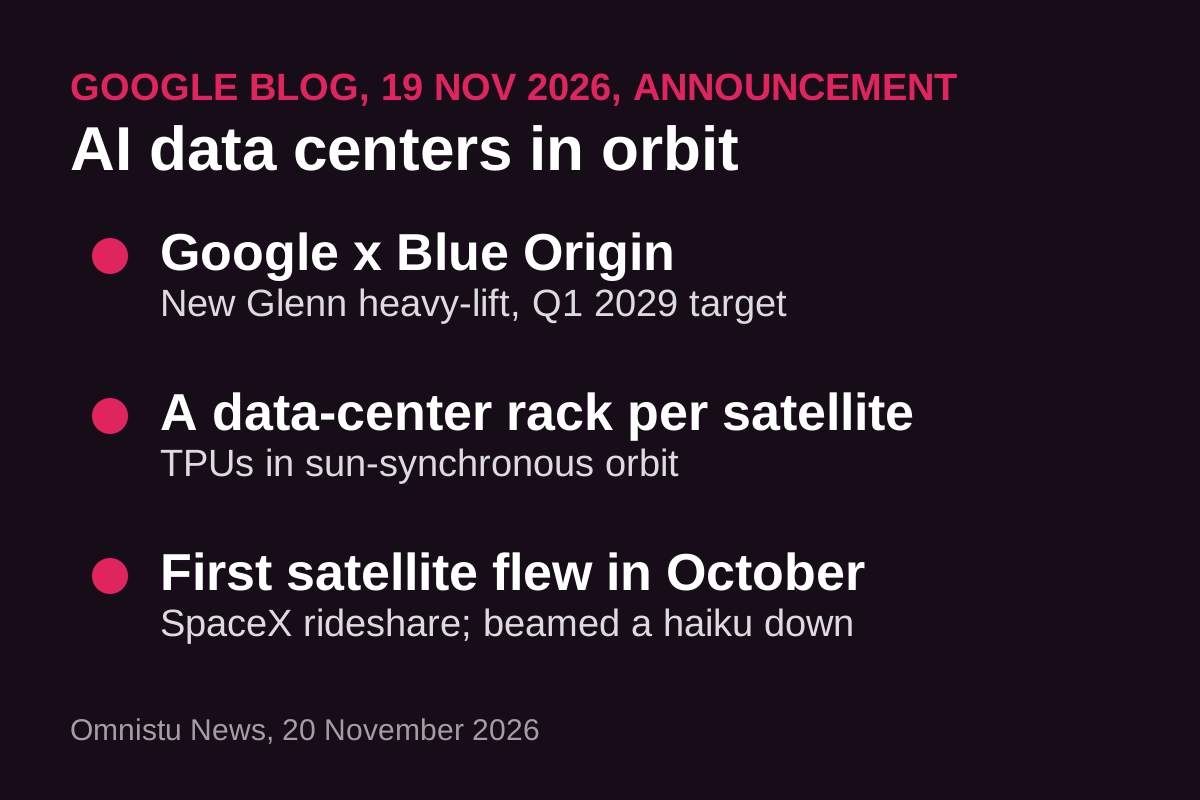
Google announced on 19 November 2026 that it is partnering with Blue Origin for the first dedicated heavy-lift launch of Project Suncatcher, its long-term research effort to run AI computing infrastructure in orbit. Blue Origin's New Glenn rocket is targeted to deploy the satellites into sun-synchronous orbit in the first quarter of 2029. The announcement was made in a Google blog post by Travis Beals, Senior Director of Paradigms of Intelligence, and covered the same day by SpaceNews, The Verge, Engadget and Reuters.
What was announced
According to Google's post, each Suncatcher satellite will carry roughly the computing capacity of a data center rack, and the project aims to tap abundant solar power in orbit to scale AI infrastructure. Google describes the Blue Origin launch as a milestone on a long-term roadmap that also involves other satellite and launch partners. The Verge reports that the satellites will be equipped with Google's Tensor Processing Units (TPUs). Neither company's announcement gives a satellite count, contract value or payload mass.
The first satellite already flew
The Verge notes this is not Google's first hardware in orbit: the company deployed a first AI server satellite in October aboard a SpaceX Falcon 9 rideshare launch, where it booted its TPUs and used an onboard Gemma 4 model to transmit an AI-generated haiku to Earth. The Blue Origin deal moves the project from rideshare prototypes to a dedicated heavy-lift launch.
Why it matters, and the caveats
Space-based AI computing is an attempt to escape the power and cooling constraints of terrestrial data centers; sun-synchronous orbit gives near-continuous sunlight for solar power. The caveats are significant: 2029 is a target, not a schedule commitment; prototype-scale results from one satellite do not establish economics at data-center scale; and launch, thermal and radiation challenges at this scale are unproven. Google itself frames Suncatcher as a "long-term moonshot", so treat any timeline beyond the announced Q1 2029 target as aspirational.
- Google blog: We're partnering with Blue Origin on our first heavy-lift Project Suncatcher launch (19 November 2026)
- The Verge: Blue Origin will launch Google's AI server satellites in 2029 (19 November 2026)
- SpaceNews: New Glenn to launch Project Suncatcher data center satellites for Google (19 November 2026)