OpenAI opens its GPT-Live-1.1 voice model to developers, billed by the minute
GPT-Live-1.1, the default voice model in ChatGPT for paid tiers since mid-October, is now available to developers through the OpenAI API on the Live endpoint only, at $0.05 per active minute and $0.02 per standby minute. Vercel's AI Gateway added support on 19 November 2026.
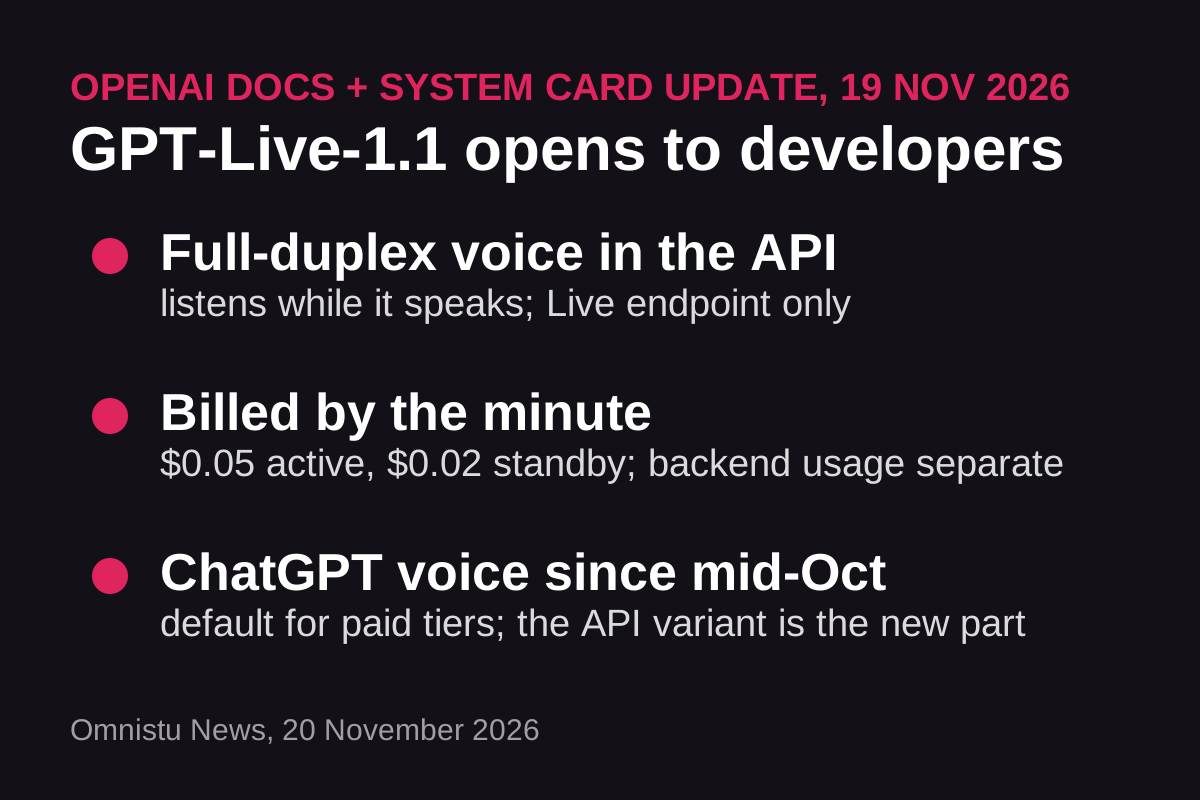
OpenAI's GPT-Live-1.1, the voice model that has been the default in ChatGPT for Plus and higher tiers since mid-October 2026, is now available to developers through the OpenAI API under the model ID gpt-live-1.1. OpenAI's model documentation lists the API variant, Vercel's AI Gateway added it on 19 November 2026, and OpenAI updated the model's system card the same day with evaluation results for the API voice models.
What the model does
GPT-Live-1.1 is a full-duplex voice model: it listens while it speaks, so a caller can pause, interrupt or add detail mid-reply, and the model decides in the moment whether to respond or keep listening. OpenAI says that compared with GPT-Live-1 it transcribes speech more accurately, keeps a more consistent accent and voice across languages, and improves instruction following and voice fidelity. Developers can describe in plain language when the model should hand a task to a backend model for reasoning or tool use; the backend's safeguards apply to the delegated work. The documentation lists streaming and function calling as supported features, with audio and text in both directions.
Access, pricing and limits
The model is served only on the Live endpoint (v1/live/sessions); the documentation marks Chat Completions, Responses, Realtime, audio speech and transcription endpoints, and the rest of the API surface as not supported for this model. Sessions are billed by duration: $0.05 per active minute and $0.02 per standby minute, the lower rate applying to WebRTC sessions while inference is paused, with backend model and tool usage billed separately. GPT-Live-1.1 and GPT-Live-1 carry separate concurrent-session limits. Per Vercel's changelog, the model uses the same Live endpoint and client delegation as its predecessor, so an existing GPT-Live integration only needs the new model ID.
What the updated system card says
OpenAI's GPT-Live-1.1 system card, first published 15 October 2026, was updated on 19 November with evaluation results for the API voice models. On synthetic adversarial audio prompts, OpenAI reports the API variant scored numerically higher than its predecessor in all eight categories, with the largest gain on gore (0.74 to 0.85); on production prompts it scored numerically higher on mental health, emotional reliance and self-harm, with sexual content, illicit behavior and personal data at parity. OpenAI cautions these evaluations are deliberately difficult and not prevalence-weighted, so they are not a guide to real-world rates. For the ChatGPT variant, OpenAI reports statistically significant regressions versus GPT-Live-1 on four synthetic categories (sexual, mental health, emotional reliance and gore), says those evaluations exclude system-level safeguards such as crisis helplines and parental controls, and says more research is needed and improvements are planned.
- OpenAI developer documentation: GPT-Live-1.1 model page (checked 20 November 2026)
- Vercel changelog: GPT-Live 1.1 now available on AI Gateway (19 November 2026)
- OpenAI Deployment Safety Hub: GPT-Live-1.1 system card (published 15 October 2026, updated 19 November 2026)