Signal blocks screenshots by default to keep AI agents out of private chats, Reuters reports
The messaging app's new phone settings, on by default, are meant to keep AI agents from screenshotting private chats - protections Signal itself calls incomplete, with no reliable block on macOS. It says OS-level AI like Siri AI and Gemini Intelligence is an existential threat to its mission.
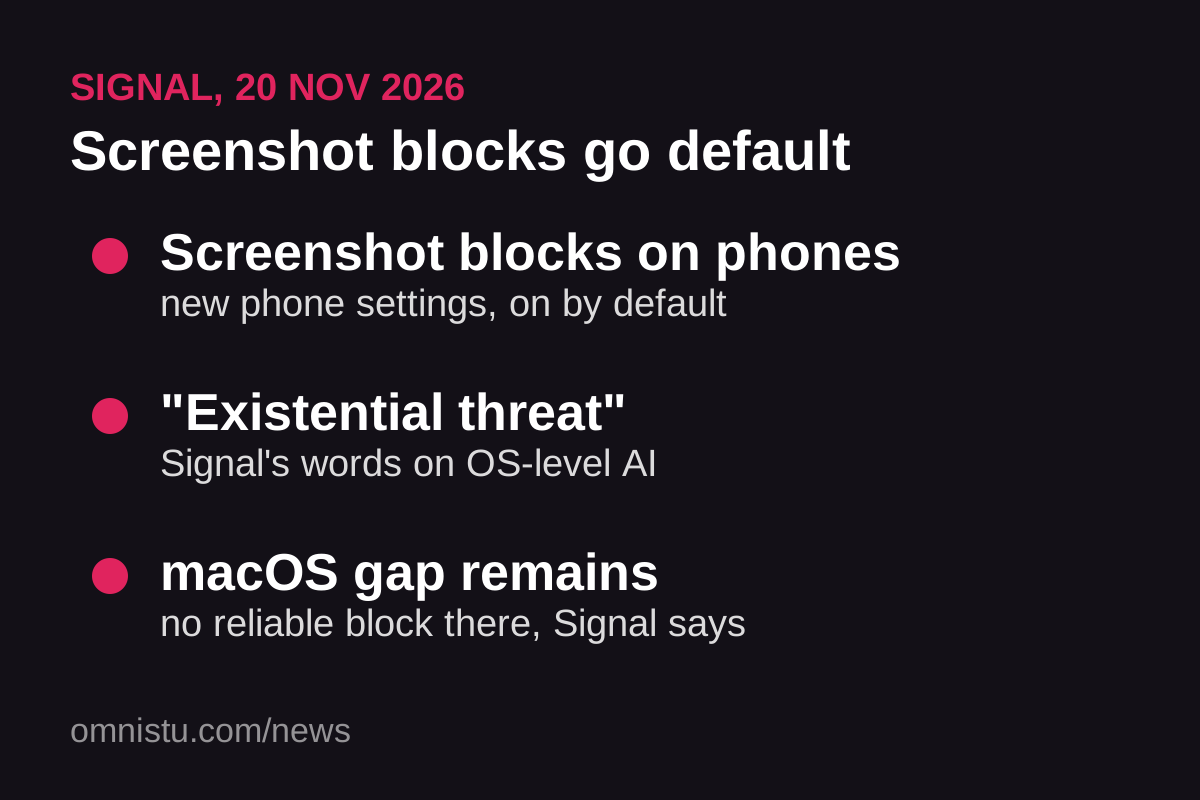
Signal is introducing new settings on phones that block screenshot access, switched on by default, aimed at keeping AI agents from screenshotting private conversations, Reuters reports. Users get pop-up options to lift the blocks when Signal detects screenshot attempts or an AI assistant trying to access the screen, depending on the device.
Why Signal acted
In a blog post provided to Reuters ahead of publication, Signal said agentic AI built into operating systems - it named Apple's Siri AI and Google's Gemini Intelligence - is "changing this environment in a way that's making it increasingly hostile to privacy," calling it "an existential threat to Signal, and our ability to responsibly uphold our mission." Agents designed to see the screen and act across apps can pull messages out of Signal's end-to-end-encrypted environment onto whatever servers the agent uses, the company said.
The gap Signal says it cannot close
Signal called its new protections "incomplete" and urged operating-system providers to give developers concrete ways to opt their apps out of AI data processing - screen reading, notifications and file-system access - and to disclose more about how their agents function. The company blocked Microsoft's Recall AI from taking screenshots on Windows last year, but said it cannot reliably offer the same protection on Apple's macOS. Reuters' own reporting illustrates why: Meta's Muse agent was able to bypass its official Connector tool and read Signal messages on an Apple computer and a phone running Google's operating system, using broad OS-level permissions granted at setup. An Apple update this week closed that specific pathway, Reuters reports, while adding new agent permissions with similar capabilities and more user warnings. Meta told Reuters that agents need to see and interact with computers to work on a user's behalf, and that Muse accesses other apps only through permissions users explicitly grant.
Why it matters
This is one of the first times a major privacy app has shipped default-on defenses specifically against AI agents, and it lands as Apple, Google and Microsoft race to put screen-reading agents into their operating systems. Signal's stance sets up a direct fight over whether apps or operating systems get the final say on what an agent can see.
What to keep in mind
The strongest language ("existential threat") is Signal's own advocacy from its blog post, carried by Reuters as an exclusive; the protections are real but admittedly partial, with macOS unprotected. The Muse account comes from Reuters' reporting and includes Meta's response. Whether OS providers offer the opt-outs Signal wants is an open question - none had committed in the reporting.
- Reuters via US News (20 November 2026): Exclusive - Signal Restricts Screenshots to Block AI Agents From Reading Messages
- Reuters via The Economic Times (20 November 2026): Signal restricts screenshots to block AI agents from reading messages