Australian creatives unite against a reported AI-training permit plan, with First Nations advocates demanding stronger protections
A reported proposal to let AI companies buy permits to train on Australian content, possibly exempting music, was rejected by the music industry, writers, unions and crossbenchers within a day. The government has not confirmed the plan, and Guardian Australia could not independently verify it.
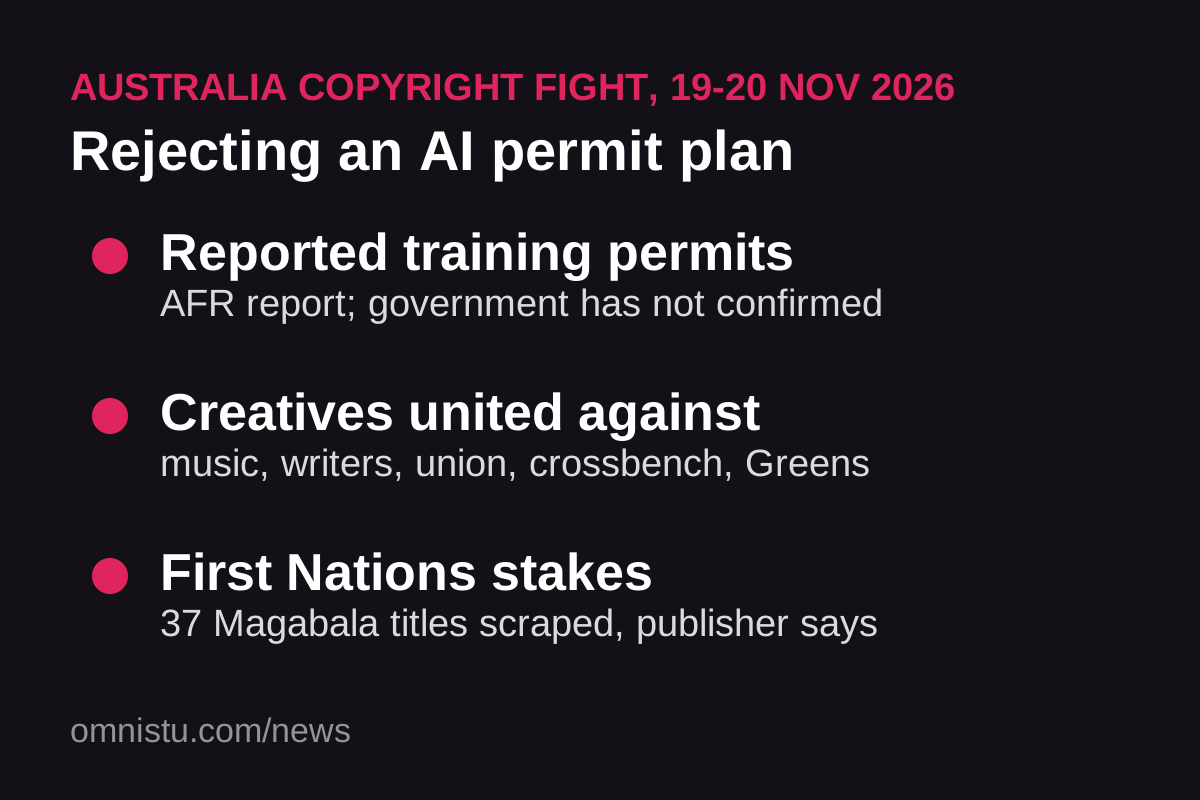
Australia's creative industries closed ranks on 19 November 2026 against a reported proposal that would let AI companies buy permits to train on Australian content, with music possibly carved out. The plan, reported by the Australian Financial Review and not confirmed by the Albanese government, was rejected within hours by the recording industry, the writers' guild, the creatives' union and parliamentarians across parties. Guardian Australia reported it could not independently verify the proposal's details.
The reported proposal
Per the AFR's report as described by Guardian Australia, the government was weighing a copyright change under which AI companies would purchase permits to train on Australian content, with music potentially exempted. The Guardian noted the shape of the idea echoes positions AI companies have floated: Anthropic has suggested "conditional approval" to scrape content unless a rightsholder objects, and OpenAI told a parliamentary committee it would "potentially" support paying into a fund for creators. The government declined to comment on the report, though senior ministers have recently hardened their language: industry minister Tim Ayres said "the status quo is no good" for creative workers, acting prime minister Richard Marles said "people are being ripped off," and attorney general Michelle Rowland promised "certainty and strong protections for Australian artists."
Industry and parliament push back
Aria chief executive Annabelle Herd called the reported scheme "unnecessary, unworkable and designed to suit the commercial interests of AI companies, not protect creators," and said the music industry would not desert other creative sectors. Australian Writers' Guild CEO Claire Pullen said no creative workers would leave colleagues behind, adding that AI companies "have had an open invitation to sit down and negotiate for years." The Media, Entertainment and Arts Alliance said it was "alarmed" and that protections "must apply to all creative sectors." In parliament, shadow attorney general Michaelia Cash said the idea would "divide the rightsholders," independent David Pocock called it "some sort of divide and conquer strategy," and Greens senator Sarah Hanson-Young warned Australia would "become known as the Cayman Islands for AI" if such a loophole opened.
The campaign and the awards
The pushback lands days after the launch of "Not AI's To Take," a national campaign that opened at the ARIA Awards on 18 November with artists Jack River, Dobby, Josh Pyke and KLP, and a pre-recorded message from Elton John, per National Indigenous Times. Supporters include Jimmy Barnes, Paul Kelly, Peter Garrett and Ben Lee. The campaign urges the government to keep strong copyright protections and reject arrangements letting AI developers use creative work without permission or payment.
First Nations advocates say copyright is not enough
National Indigenous Times reports that Broome-based Magabala Books discovered 37 of its titles had been scraped from a pirated online archive and used by Meta to train its AI systems, according to chief executive Lilly Brown, who said authors felt betrayed. (The publication said it had contacted Meta for comment.) ICIP specialist Dr Terri Janke told the outlet that conventional copyright protects identifiable individual works, while much Indigenous cultural expression is communal, intergenerational and oral - so Dreaming stories, language and clan designs can fall outside it. She called for mandatory transparency about training data and standalone Indigenous Cultural and Intellectual Property legislation consistent with the UN Declaration on the Rights of Indigenous Peoples. A government spokesperson said creators "must retain ownership and control of their work," and that an expert working group's advice on a preferred ICIP model is expected in early December 2026.
What to keep in mind
The permit proposal is a media report, not an announced policy: the government has not confirmed it, Guardian Australia could not verify it, and some creative-sector figures doubt it is seriously on the table. Positions from Anthropic and OpenAI cited above are things the companies told inquiries or suggested previously, not responses to this specific report. The joint select committee examining the issue has not yet delivered its report to the government.
- Guardian Australia (19 November 2026): Australian music industry rejects 'divide and conquer' proposal to give musicians exemption from AI scraping
- National Indigenous Times (20 November 2026): 'Not AI's To Take': First Nations stories at centre of fight over artificial intelligence scraping