ECB staff say AI spending is shifting to debt, with over $4 trillion of off-balance-sheet commitments at big tech firms
A box in the European Central Bank's November 2026 Financial Stability Review lays out how the AI build-out is being funded and where it sees risk. These are ECB staff estimates, not a forecast of a crash.
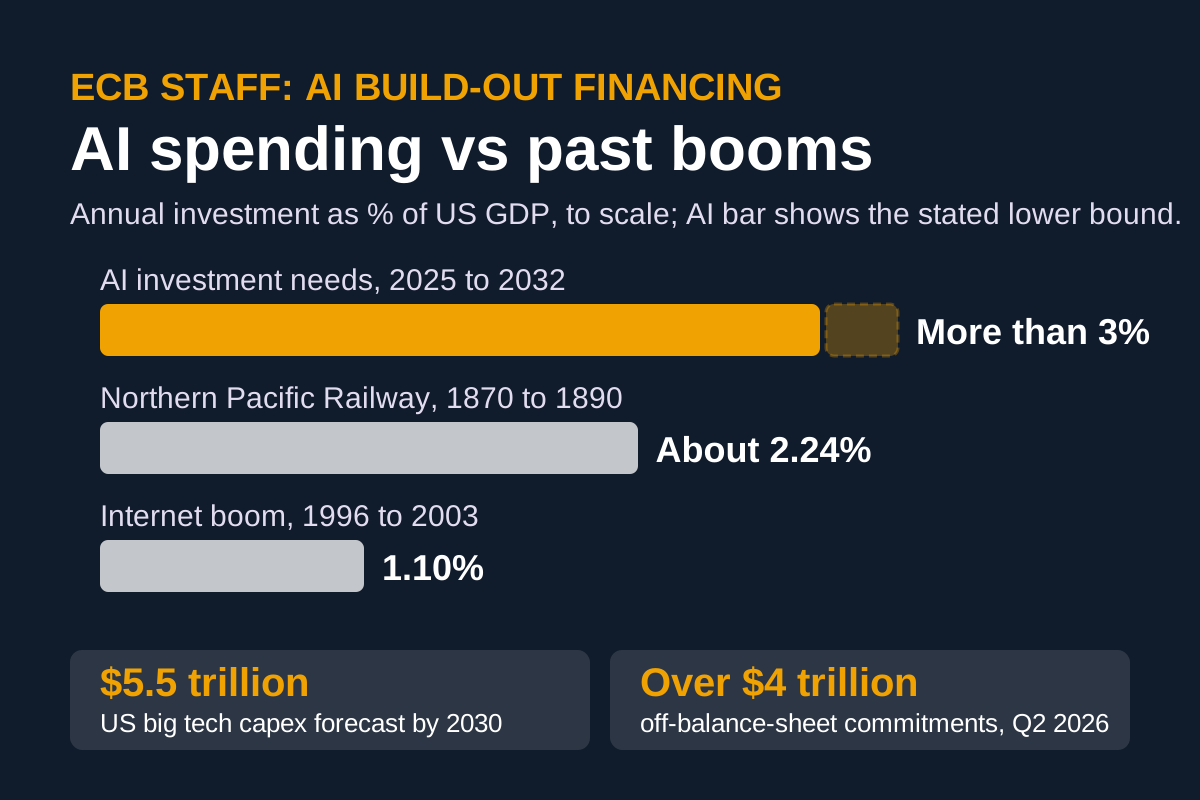

Original Omnistu chart from the ECB box cited below. Bars are to scale; the AI bar shows the ECB staff's stated lower bound ("more than 3%"), with the dashed segment marking the open end. Not the ECB's figure.
On 18 November 2026 the European Central Bank published its Financial Stability Review. In the press release the ECB says risks to euro area financial stability remain elevated, with AI valuations, fiscal imbalances and geoeconomic tensions named as the main concerns. It also says the euro area banking sector is well positioned to absorb shocks, helped by strong profits, capital buffers and liquidity. This article summarises one section: a staff box on how AI infrastructure is being financed.
How big the spending is, per ECB staff
The box says cumulative capital expenditure by US big tech firms is forecast to reach about USD 5.5 trillion by 2030, although estimates vary widely. It says overall AI investment needs would amount to more than 3% of US GDP a year between 2025 and 2032. For comparison it gives about 2.24% of US GDP a year for the Northern Pacific Railway between 1870 and 1890, and 1.10% for the internet boom of 1996 to 2003. These are the authors' estimates based on broker forecasts and a working paper, and the comparisons are theirs.
From cash to debt
The authors say free cash flows turned negative for most US hyperscalers in 2026 because AI infrastructure spending exceeded operating cash flows, so these firms are turning to outside equity and debt. They also describe contractual commitments to use data-centre and chip capacity, which lenders accept as security. The box says such commitments are debt-like but do not appear as liabilities on hyperscalers' balance sheets under US accounting standards, and estimates total off-balance-sheet commitments of more than USD 4 trillion as of the second quarter of 2026. The figure was compiled from company SEC filings using an AI model built by ECB staff and cross-checked manually, per the chart notes.
The risks the authors name
The authors say credit spreads on hyperscaler debt have widened relative to similarly rated corporate issuers, particularly at longer maturities, and that circular financing between chipmakers and customers could amplify losses if earnings fall short. They draw parallels with the dotcom and subprime episodes. They also say that so far hyperscalers' earnings have broadly kept up with expectations. This is not a prediction that a crash will happen, and it is not investment advice.
- ECB: Risks from AI valuations, fiscal imbalances and geoeconomic tensions weigh on financial stability outlook (18 November 2026)
- ECB Financial Stability Review, November 2026, box: The debt financing of AI and its implications for financial stability