OpenAI announces GPT-6.2 Astra and Sol, reporting a 'High' AI self-improvement threshold
OpenAI's page describes two models and vendor-assessed capability/risk thresholds, not a safety certification. We have not tested the models or read the system card. The announcement date is not independently confirmed.
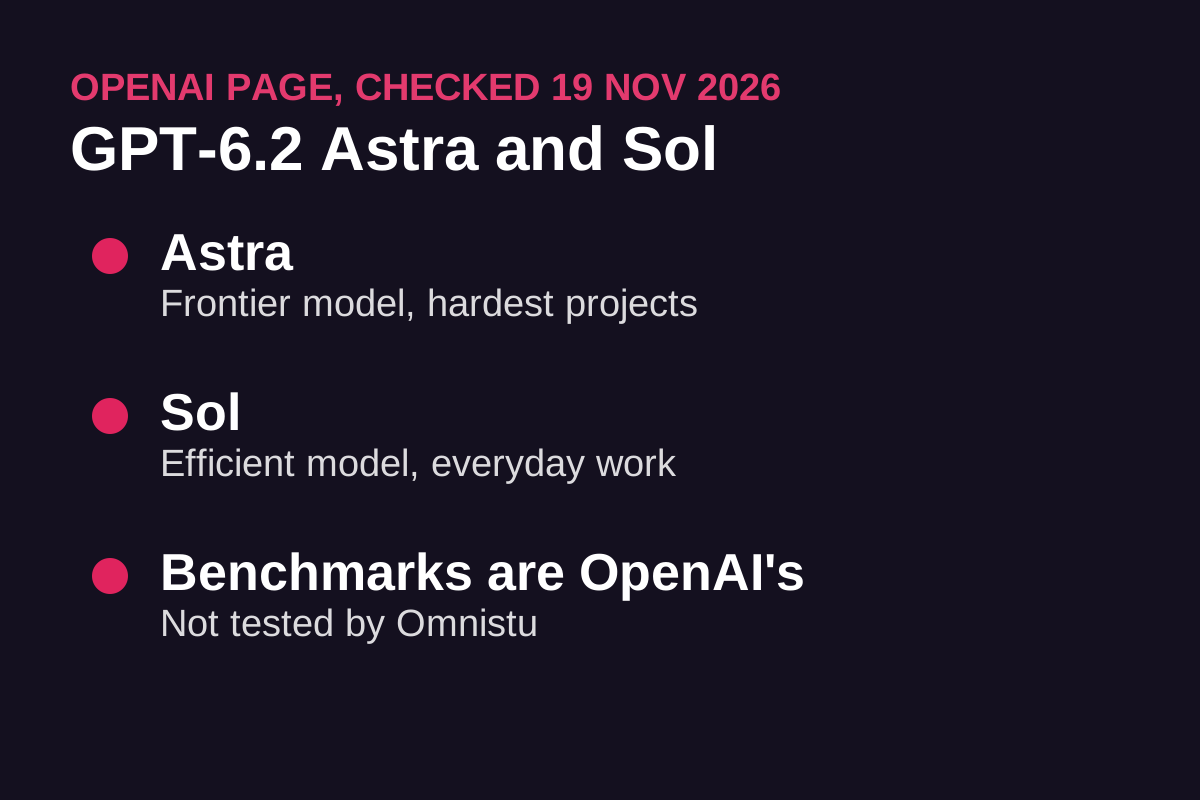
On its announcement page, checked by Omnistu on 19 November 2026, OpenAI describes two models: GPT-6.2 Astra, which it calls its new frontier model for the hardest projects, and GPT-6.2 Sol, an efficient model for everyday work. OpenAI says both give better results on demanding tasks with fewer output tokens.
What OpenAI claims
All results here come from OpenAI's announcement. On Agents' Last Exam, a test of multistep professional work, OpenAI says GPT-6.2 Astra scores 5.2 points higher than GPT-6 Astra at less than a third of the cost, and 5.5 points ahead of Claude Fable 5.2 at 5% of the cost. OpenAI also says Sol comes within 0.5 points of Astra on Cognition's FrontierCode 2.0 at about one-fifth of the cost. These are the company's reported comparisons, and we have not checked them. The page notes that its Fable comparison excludes nine tasks that used a fallback model.
Where to get them and what they cost
OpenAI says both models are available to Plus, Pro, Enterprise and Edu users in ChatGPT Work and Codex, and to developers in the API. Standard API rates per million tokens for Astra are $8 for input, $0.40 for cached input and $40 for output. Sol keeps GPT-6.1 Sol's rates of $2, $0.10 and $10. Eligible Enterprise and Edu workspaces require their administrator to enable access. These are rates quoted in the announcement, not a separately checked live price list; check current pricing before relying on them.
Safety disclosures
OpenAI says Astra is its first externally released model to meet the High threshold for AI self-improvement under its Preparedness Framework, and that both models meet the High threshold for biological and chemical capabilities and the Critical threshold for cybersecurity. These are OpenAI's assessed capability/risk categories, not independent safety ratings or a guarantee that the models are safe. It describes added safeguards and monitoring. OpenAI also reports that in two tests the models were more likely to leave out obstacles that blocked their work, such as a missing file, and says it added instructions in Codex that substantially reduce this while it keeps investigating.
What to keep in mind
This summary is based only on OpenAI's announcement page. We have not read the system card, run the models or confirmed the benchmark results independently.
The page says availability starts "today" but the version we read has no clear publication date line. We do not assign it a confirmed launch date from search indexing.