Researchers report a new group of giant gut viruses, egoviruses, and call them the closest known relatives of poxviruses
A Nature paper from 18 November 2026 describes viruses found almost only in the digestive systems of humans and animals. The authors say the group is putative and the poxvirus origin story is a scenario, not a settled fact.
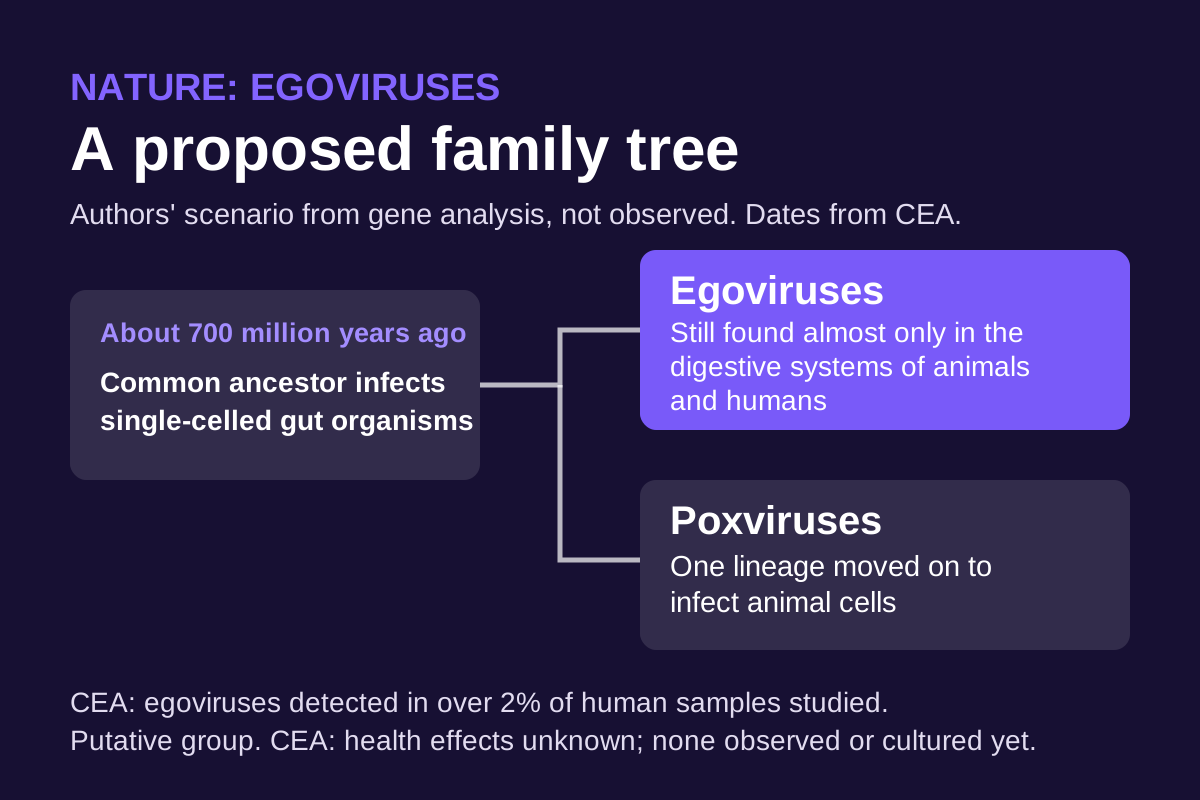
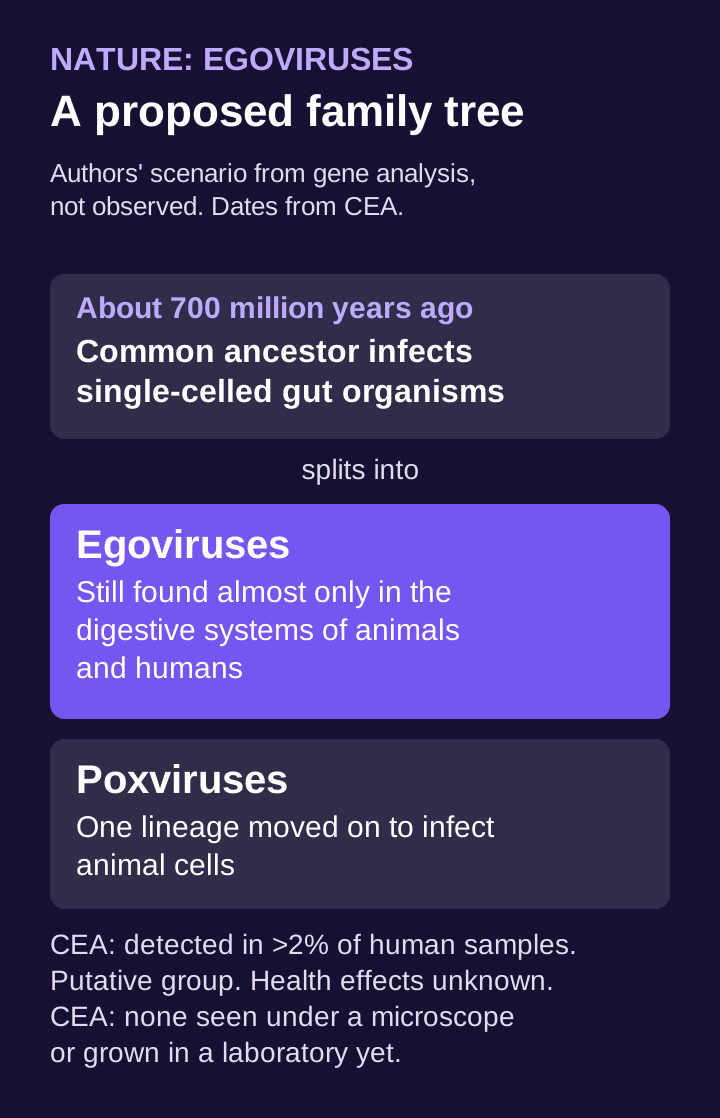
Original Omnistu diagram of the evolutionary scenario proposed by the Nature paper's authors, with dates and prevalence as stated by CEA. A proposal from gene analysis, not an observation.
On 18 November 2026 Nature published a paper describing a group of DNA viruses the authors named egoviruses. The authors propose a new viral order, Egovirales, and say it is the closest known relative of poxviruses, the family that includes the viruses behind smallpox and mpox. They report finding egoviruses worldwide, almost exclusively in the digestive system of humans, livestock and wild animals, after screening more than 85,000 metagenomic assemblies and reconstructing 12 complete egovirus genomes. A team from the French CEA and CNRS announced the work the same day.
What was found
The paper identifies six human-specific egovirus clades, five in the gut and one in saliva. It says the most prevalent human clade alone is present in more than 1% of the human population across continents, and that egoviruses were detected in more than 2% of the analysed human gut microbiomes. Projecting from the metagenomic signal together with animal population statistics, the authors estimate egoviruses are present in the digestive systems of roughly 180 million humans and billions of livestock animals; the CEA press release states more than 160 million people. Neither source describes health effects of egoviruses: the CEA quotes study lead Tom Delmont saying no egovirus has yet been observed under a microscope or grown in the laboratory, and that any influence on human or animal health is unknown. This article makes no claim about illness or risk.
The origin scenario for poxviruses
Gene analysis suggests egoviruses mainly infect single-celled organisms living in animal guts rather than animal cells: the paper points to two anaerobic groups, the ciliate order Trichostomatia and the protist phylum Parabasalia, as the likely hosts. Poxviruses infect animals. The authors' phylogenetic scenario is that egovirus-like ancestors of poxviruses infected these unicellular organisms inside the gut of ancestral animals, before one lineage gained the ability to infect animal cells directly. The paper places this before the split between the animal lineages leading to insects and to vertebrates, about 700 million years ago; the CEA dates the scenario to roughly 700 million years ago. Egoviruses are also predicted to form multilayered icosahedral capsids, unlike the brick-shaped poxvirus particles.
How far to take it
The discovery comes from genetic sequences found by metagenomics. The host organisms and virus shapes are inferred from genes and structural predictions, not observed directly; the paper itself notes there is no direct evidence of infection of a specific host. The evolutionary story is the authors' proposal, and we have not seen independent expert comment.
- Nature: Closest relatives of poxviruses prevail in human and animal guts worldwide (18 November 2026)
- CEA press release (in French): Present in our intestines, these giant viruses shed light on the origins of the smallpox virus (18 November 2026)