ESA's Hera has reached the asteroid NASA's DART hit, and says the first detailed images will be shown on 25 November
Hera arrived at the Didymos and Dimorphos pair. ESA has released early previews and says detailed images come on 25 November 2026. What the previews show, and what scientists still want to learn.
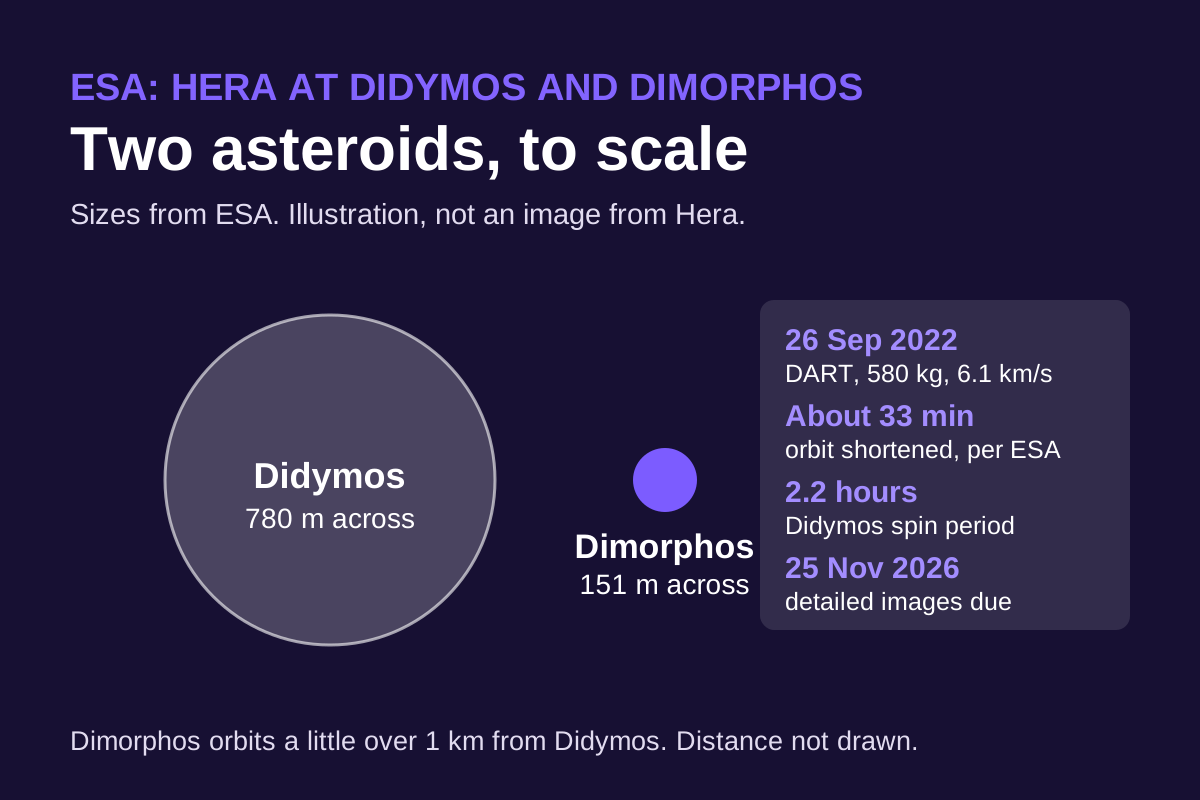
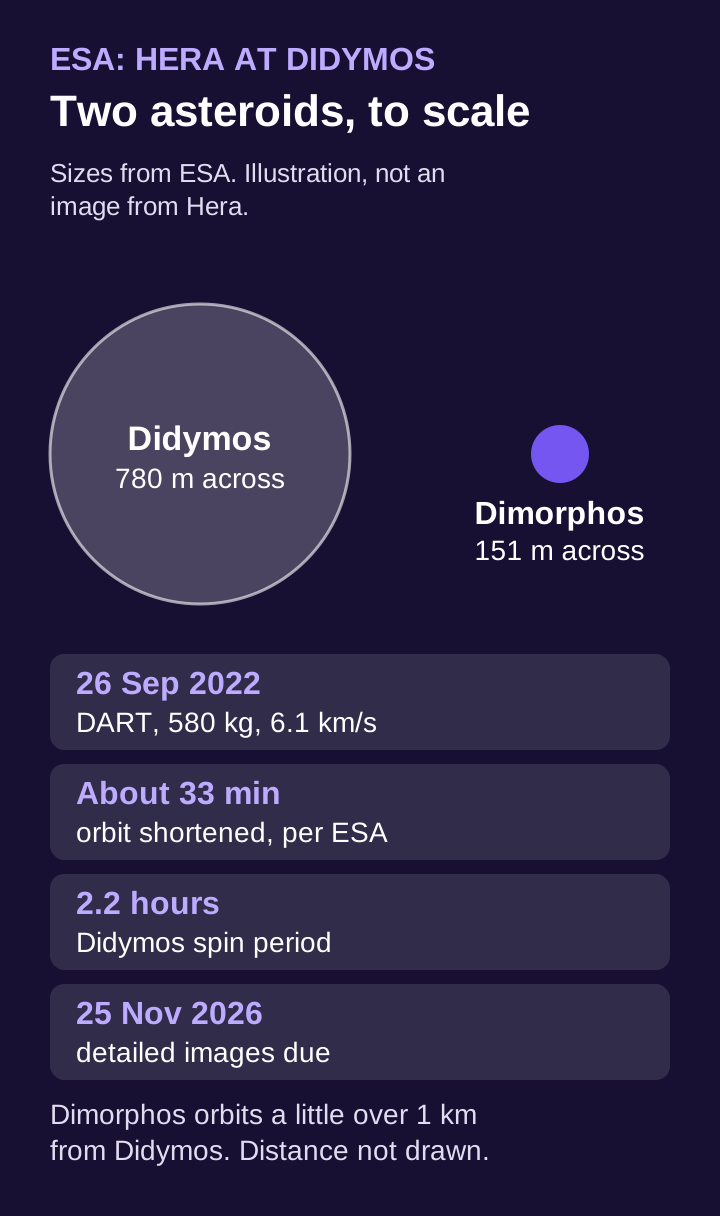
Original Omnistu illustration, drawn to scale from ESA's stated sizes. It is not an image from Hera; the orbital distance is not drawn.
ESA says its Hera spacecraft has arrived at the binary asteroids Didymos and Dimorphos, more than four years after NASA's DART spacecraft hit the smaller one, Dimorphos. In an 18 November 2026 post, ESA says it will share the first close-up images of the transformed asteroid in a livestream on Wednesday 25 November, 19:45 to 20:30 CET. The detailed images have not been released yet, so this article covers only the early previews and ESA's descriptions.
What DART did, per ESA
ESA says DART, a 580-kg spacecraft, hit Dimorphos at 6.1 km/s on 26 September 2022. Telescope observations later confirmed that the orbit of Dimorphos, 151 m across, around the 780-m Didymos was shortened by about 33 minutes. ESA says scientists need close-up data to turn this kinetic impact approach into a well-understood technique, and that is Hera's job.
What the early previews show
ESA's 12 November preview shows one face of Didymos from 56 km away, with part of Dimorphos peeking out near the top. ESA says it reveals large boulders, smoother regions and a surprisingly sharp equatorial ridge. ESA says that ridge may be linked to Didymos spinning once every 2.2 hours, which numerical models suggest can move material toward the equator. ESA adds that such a process might even help explain how Dimorphos formed. That is ESA's hedged suggestion, not a finding. ESA says Dimorphos orbits a little more than a kilometre from Didymos. A 17 November ESA post shows Didymos from 28.5 km with a resolution of about 2.7 m per pixel.
What is still unknown
ESA lists open questions: did the impact leave a crater or reshape the asteroid, and what is Dimorphos made of? Over the coming months Hera will do a close-up investigation of Dimorphos, and ESA says it will deploy two shoebox-sized CubeSats early in the new year. This summary is based on three ESA posts and does not include any independent expert comment.