EU Council and Parliament reach a provisional deal to speed up permits for renewables and power grids, with a final vote still to come
The 18 November 2026 agreement covers renewables, grids and storage. It is provisional: both institutions must still endorse and formally adopt it, and member states would then have 1.5 years to apply it.
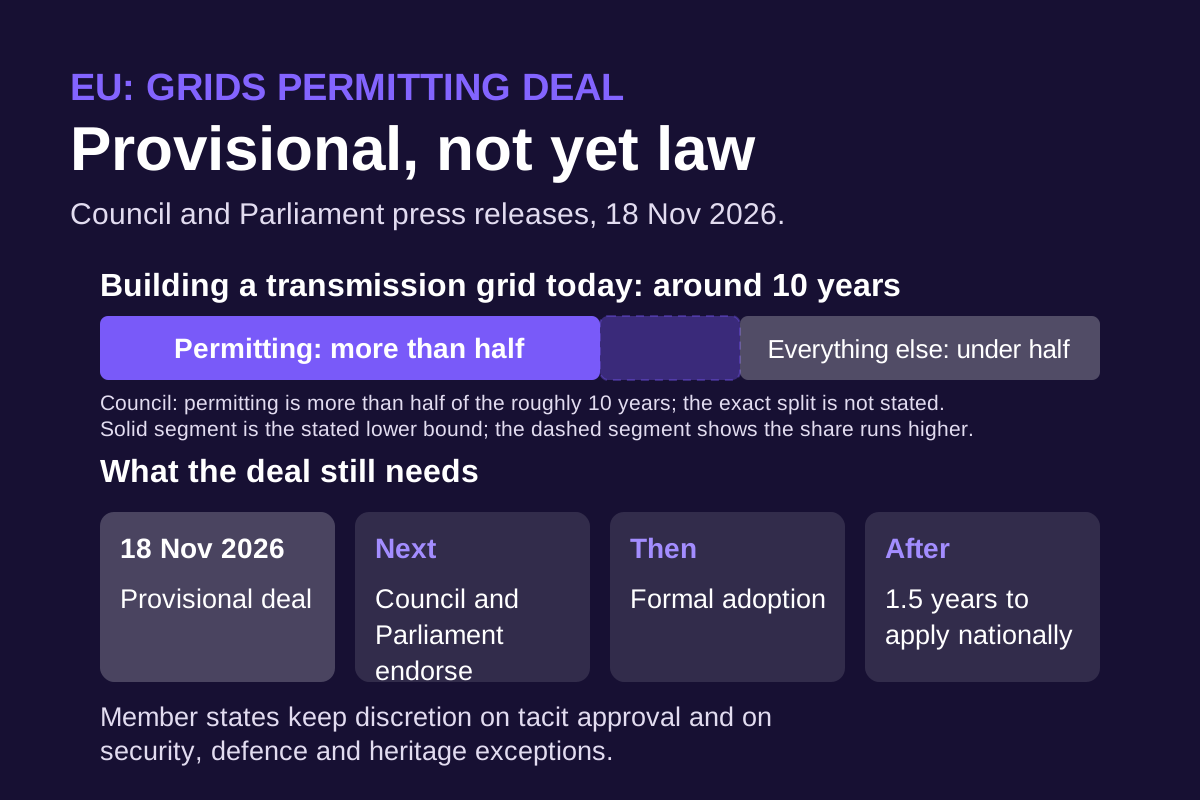
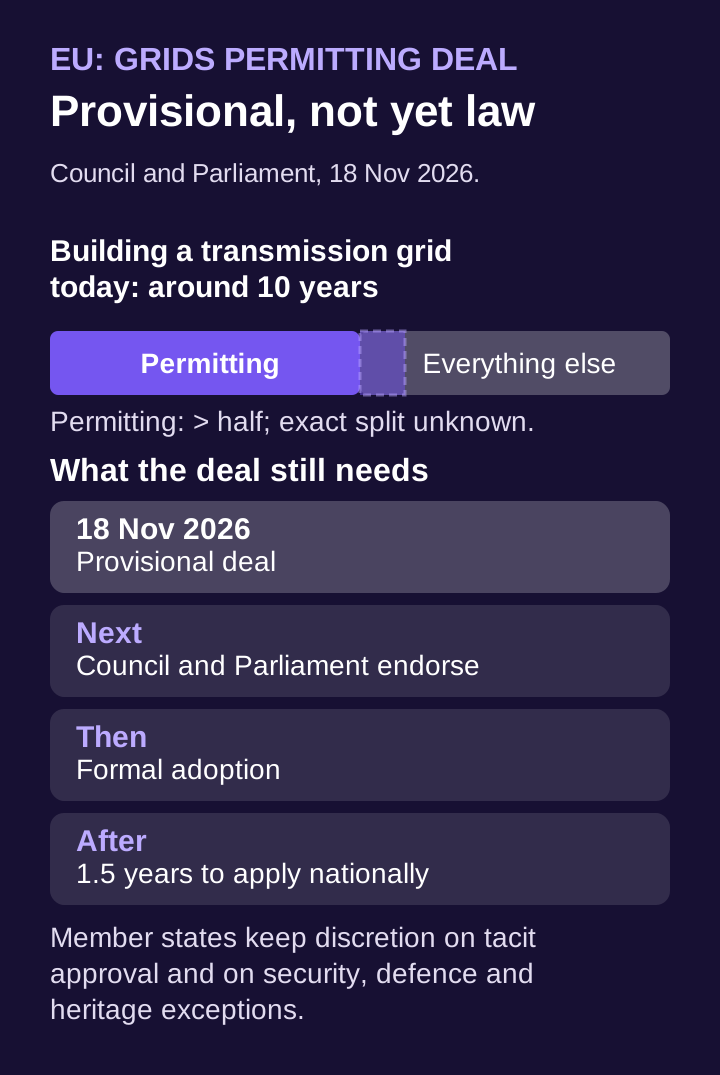
Original Omnistu status graphic from the Council and Parliament press releases of 18 November 2026. The permitting share is drawn at its stated lower bound with a dashed continuation; the exact split is not stated.
On 18 November 2026 the Council of the EU and the European Parliament reached a provisional agreement to accelerate permit-granting procedures for renewable energy projects, electricity grids and storage facilities, according to press releases from both institutions. The Council says the permitting directive is half of the European grids package, and that it amends the renewable energy directive, the electricity market directive and the gas market directive.
Why the institutions say it matters
Both releases say electricity transmission grids currently take around 10 years to complete, with permitting accounting for more than half of that time. The Council cites the Draghi report on EU competitiveness and the EU action plan for affordable energy. The Parliament adds that permitting renewable energy projects can still take up to nine years depending on the member state and the technology, and storage installations from one to seven years.
What the deal includes, per the two releases
Member states will be able to treat renewables and electricity grids as being of overriding public interest; the Parliament says they could disregard that presumption only in duly justified cases where the conflicting interest is cultural heritage or security and defence. The Council says member states may also decide that no response from authorities on intermediate permit steps counts as tacit approval. The agreement provides for a single digital portal for permitting steps. The Parliament reports shorter deadlines: no more than three months for solar equipment and co-located storage (excluding hydrogen), six months for stand-alone storage and recharging stations, and up to two years for pumped hydropower storage, with grid-connection deadlines of three months, extendable to six if justified. Permit thresholds for small-scale solar, storage and recharging rise from 100 to 200 kilowatts, recharging stations of 1 megawatt or less on artificial structures need no administrative permit, and the threshold for mandatory benefit-sharing with local communities drops from 10 to 7 megawatts.
What happens next
The Parliament says the text goes to a vote in its Industry, Research and Energy committee, then must be endorsed by the Parliament as a whole and by the Council before publication in the Official Journal. The Council says that after formal adoption following legal-linguistic revision, member states will have 1.5 years to bring the directive's provisions into national law. This summary is based on the two institutions' press releases. We have not read the legal text, and details such as exact deadlines may differ in the final wording.
- Council of the EU: Grids package: Council and Parliament agree to streamline permitting for a faster clean energy transition (18 November 2026)
- European Parliament: Electricity grids: MEPs reach deal with Council on faster project permitting (18 November 2026)