FDA approves Regeneron's Livsayis (cemdisiran) for generalized myasthenia gravis
The approval and indication are confirmed by FDA's own Novel Drug Approvals 2026 listing (18 November 2026). Trial results, the four-times-a-year dosing distinction and the first-siRNA framing are Regeneron's; the company reports a boxed warning for serious meningococcal infections, which we have not yet independently verified against the FDA label text.
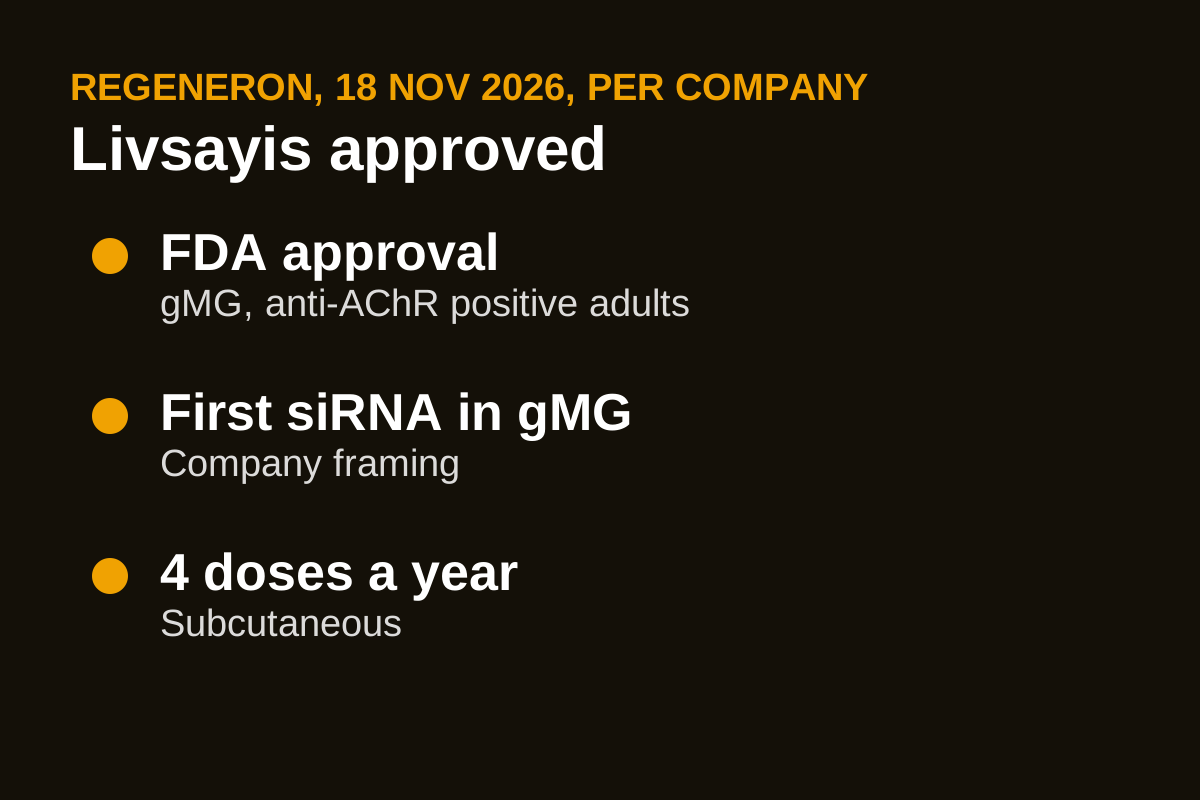
Regeneron announced on 18 November 2026 that the U.S. Food and Drug Administration has approved Livsayis (cemdisiran) for the treatment of generalized myasthenia gravis (gMG) in adults who are anti-acetylcholine receptor (AChR) antibody-positive. The approval and that indication are confirmed by FDA's own Novel Drug Approvals 2026 listing, which records Livsayis (cemdisiran) approved on 18 November 2026 "to treat anti-acetylcholine receptor antibody-positive generalized myasthenia gravis". The company separately describes Livsayis as the first and only approved siRNA therapy in gMG and the only FDA-approved gMG treatment administered subcutaneously four times a year; those characterisations are Regeneron's.
How it works
Livsayis is a small interfering RNA (siRNA) therapeutic directed at complement component factor 5 (C5). It reduces levels of circulating C5 protein, limiting terminal complement activation, which Regeneron calls a key driver of the disease. It is the company's first approved siRNA therapy and its first approved neurology medicine.
The trial evidence behind the approval
The approval was based on the Phase 3 NIMBLE trial. Per the company's release: Livsayis produced a 4.5-point improvement on the MG-ADL daily-function score at 24 weeks versus 2.2 points with placebo (placebo-adjusted 2.3 points, p=0.0005); 76.6% of treated patients improved at least 3 points, versus 44.1% on placebo. On the clinician-administered QMG score the improvement was 4.2 points versus 1.5 (placebo-adjusted 2.8, p=0.0015), with 48.4% versus 19.0% improving at least 5 points. The company said benefit was seen as early as two weeks and maintained through the dosing interval.
Safety and access restrictions
The prescribing information includes a Boxed Warning for serious meningococcal infections, plus warnings for other serious infections - consistent with other medicines that reduce C5 activity. The most common adverse reactions (at least 5% and more frequent than placebo) were injection site reactions, viral infections and urinary tract infections. Livsayis is available only through a restricted program, the Livsayis Risk Evaluation and Mitigation Strategy (REMS).
What is not yet known
Regeneron's release does not disclose pricing or the launch date, and the trial data are company-reported summaries rather than the full published study. The release contains no head-to-head comparison with existing gMG treatments, so the practical advantage of the four-times-a-year schedule against alternatives is asserted by the company, not established by comparative data cited here. Source limitation: the boxed warning and REMS details are reported from the company's account of the prescribing information; FDA's label databases did not yet show the full Livsayis label text when checked on 20 November 2026, so we could not independently verify the warning wording.