UNEP and WHO say evidence linking hormone-disrupting chemicals to harm has strengthened, with exposure starting before birth
The first major global update since 2012 finds stronger links to fertility, brain development and metabolism. The agencies also say important scientific gaps remain. Based on the UNEP-WHO press release, not the full report.
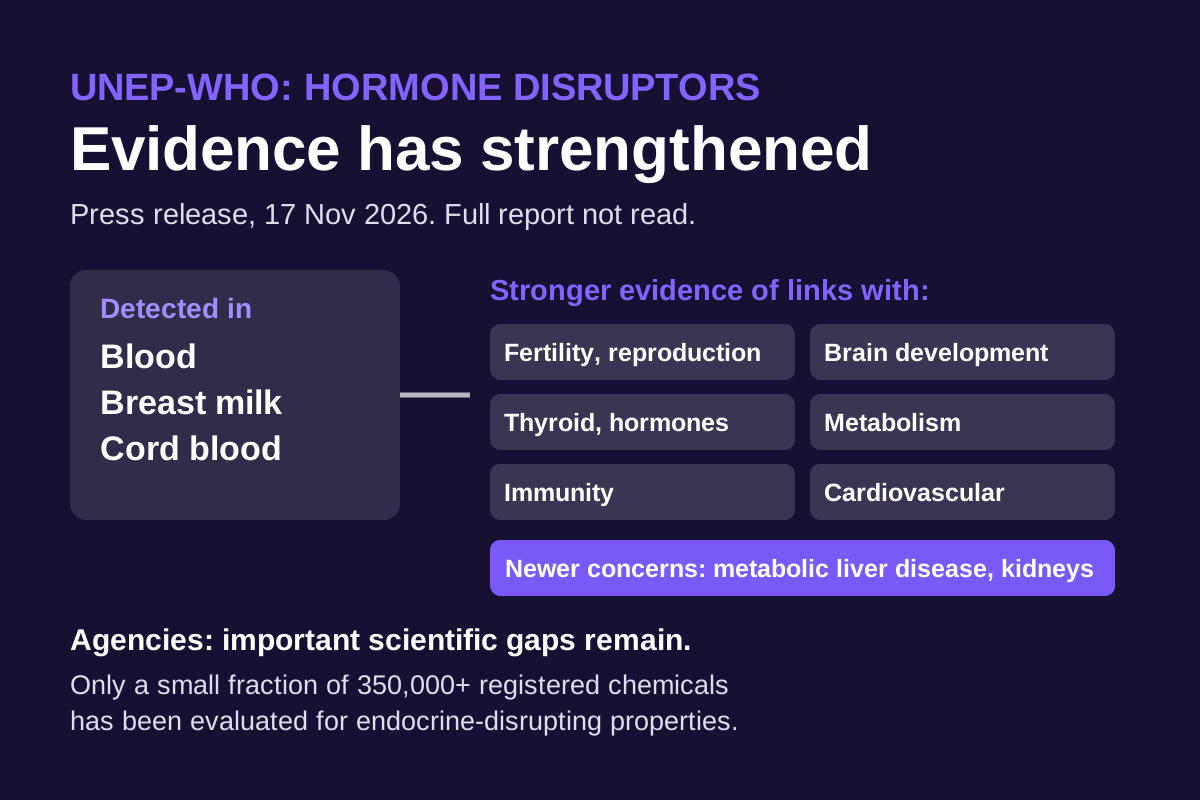
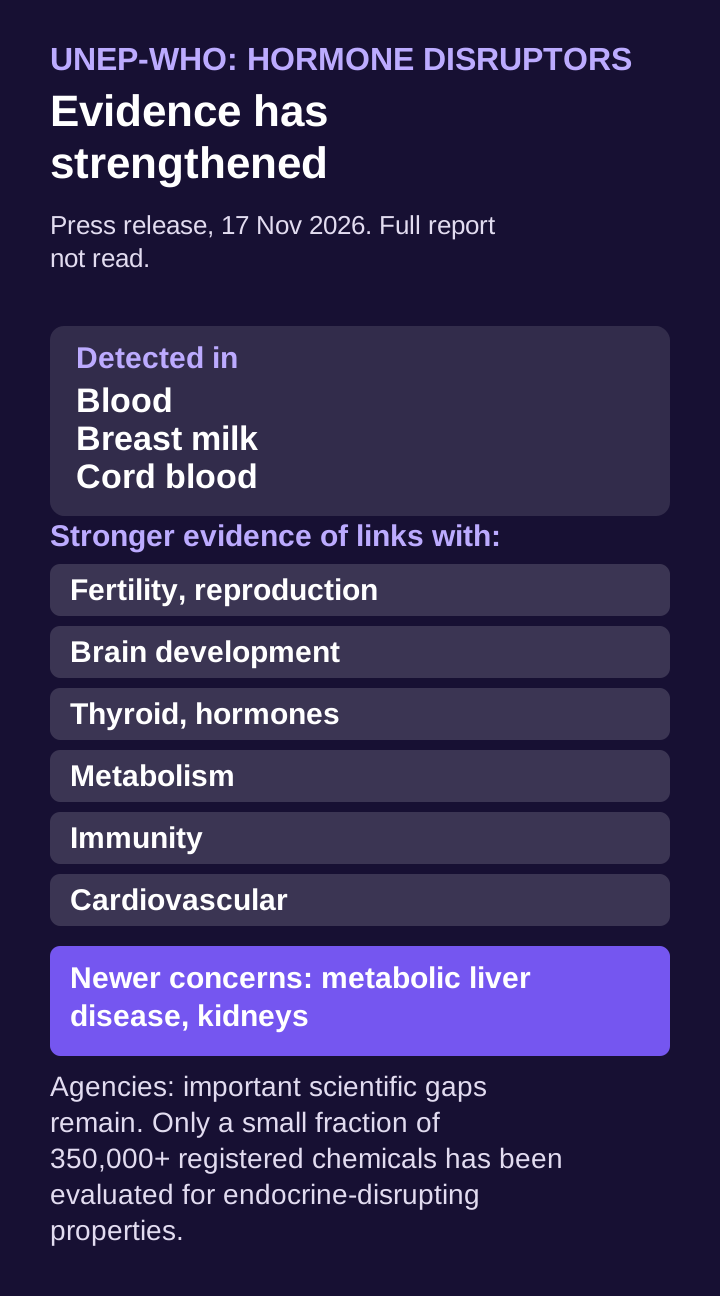
Original Omnistu summary graphic of the UNEP-WHO press release of 17 November 2026. It reflects the press release only; the full report and synthesis were not read.
The United Nations Environment Programme (UNEP) and the World Health Organization (WHO) released a new report on 17 November 2026 on endocrine-disrupting chemicals (EDCs), chemicals that can interfere with the body's hormones. It is the first major global update since the 2012 UNEP-WHO assessment. This summary is based on the agencies' press release. We have not read the full report.
What the agencies say
The release says EDCs have been detected in blood, breast milk and cord blood, and that exposure can begin before birth. It says stronger evidence links EDC exposure with effects on fertility and reproductive development, brain development and neurological function, thyroid and other hormone regulation, metabolism, immunity and cardiovascular health. Newer areas of concern are metabolic liver disease and possible effects on the kidneys, although the agencies say important scientific gaps remain.
Wildlife, mixtures and testing
Across fish, birds, amphibians and mammals, the release says EDC exposure has been linked to impaired reproduction, development and behaviour. More than 350,000 chemicals and chemical mixtures are registered for production and use globally, yet only a small fraction has been evaluated for endocrine-disrupting properties. The assessment also notes that people and wildlife are exposed to mixtures, while many regulatory systems still assess chemicals one at a time.
What happens next
UNEP also published a companion synthesis, From Evidence to Action, with suggested actions for policymakers across sectors including food packaging, cosmetics, toys and textiles. Both were launched at the first International Conference of the Global Framework on Chemicals in Geneva, running 16 to 20 November. The release notes that substantial uncertainties remain, and says action can be taken without resolving all of them. This is a summary of an agency release, not medical advice.
- WHO: Evidence mounts that exposure to hormone-disrupting chemicals starts before birth: UNEP-WHO report (17 November 2026)
- WHO: State of the Science of Endocrine-Disrupting Chemicals 2026 (report landing page; full report not read)
- UNEP: From Evidence to Action: Addressing Endocrine-Disrupting Chemicals Across Sectors (synthesis landing page; not read)