Google launches Tool Retrieval in the Gemini API so agents load tool schemas on demand
Preview in the Interactions API: defer_loading keeps parameter schemas out of the prompt until the model asks for them. Google says this cuts input tokens and latency for large tool libraries, at no separate charge. Based on Google's announcement.
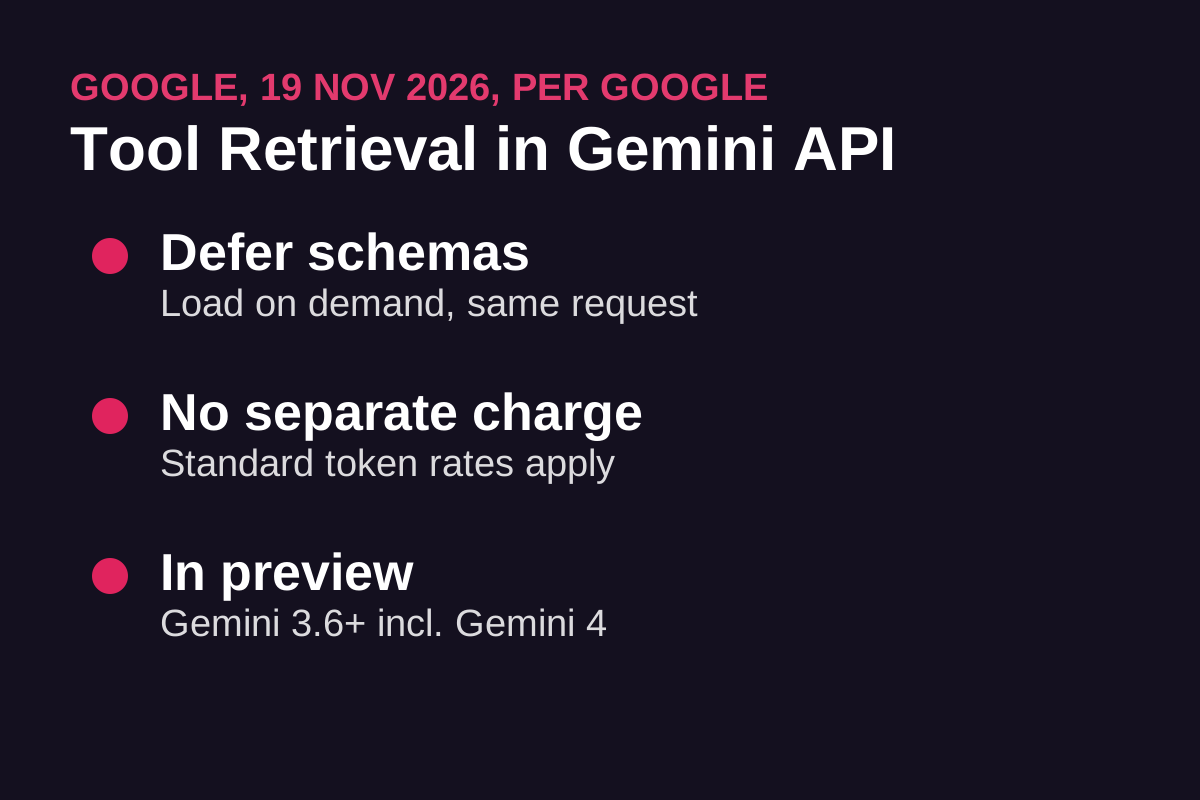
On 19 November 2026 Google announced Tool Retrieval in the Gemini API, available in preview in the Interactions API. The feature is aimed at agents that connect to dozens or hundreds of tools. Google says sending every full parameter schema on every request inflates input token counts, adds latency and lowers tool-selection accuracy as the candidate list grows. This summary is based on Google's announcement post by Lucia Loher, Product Manager for the Gemini API, and Nora Kassner, Research Scientist at Google DeepMind. We have not tested the feature.
How it works
To turn on Tool Retrieval, a developer adds a tool_search tool to the request and sets defer_loading: true on the tools to hold back. The model still sees the name and description of every deferred tool, but the parameter schemas stay out of context. When the model needs a tool it asks for it by name, the API loads the full schema and the model calls the function, all inside the same request. The steps appear in interaction.steps, so developers can inspect which tools the model considered. Google says the search runs on its servers, so there is no index to build or host, and the only code changes are the new tool and a flag. Frequent tools can stay loaded up front while the long tail is deferred, and the approach is compatible with prefix caching. Tool Retrieval also works with remote MCP servers: setting defer_loading on an mcp_server tool loads every tool that server exposes on demand.
A client-side option
Teams that keep their own tool registry, embedding index or per-user permission filter can declare tool_search with "execution": "client" and define their own search parameters. Google notes this adds one round trip per search because the app runs the lookup. Tools do not need to be declared upfront in this mode, so new tools can be exposed mid-conversation when a user connects an integration.
Pricing and supported models
Google says Tool Retrieval has no separate charge: input and output tokens are billed at the standard rates for the model called. Turning on tool_search adds a small fixed block of input tokens, and each schema the model loads is billed as input for the rest of the conversation, the same as a tool declared up front. Tokens are saved when the schemas never loaded outweigh the ones that are, which Google calls the usual case for large libraries while advising developers to measure it against their own traffic. Tool Retrieval works with Gemini 3.6 and later models, including all Gemini 4 models, in the Interactions API.
What is not yet known
The feature is in preview, and Google's post gives no benchmark figures for token savings or selection accuracy on public datasets. We have not independently measured latency, cost or accuracy effects.