MAS says it issued S$100 million of tokenised MAS Bills settled with wholesale CBDC, a first native issuance on its test network
Announced 19 November 2026: the 6 November issuance of 4-week bills was settled on the MAS-operated Singapore Dollar Test Network, with five Primary Dealers taking part and the auction more than twice subscribed. Figures and plans are the central bank's own.
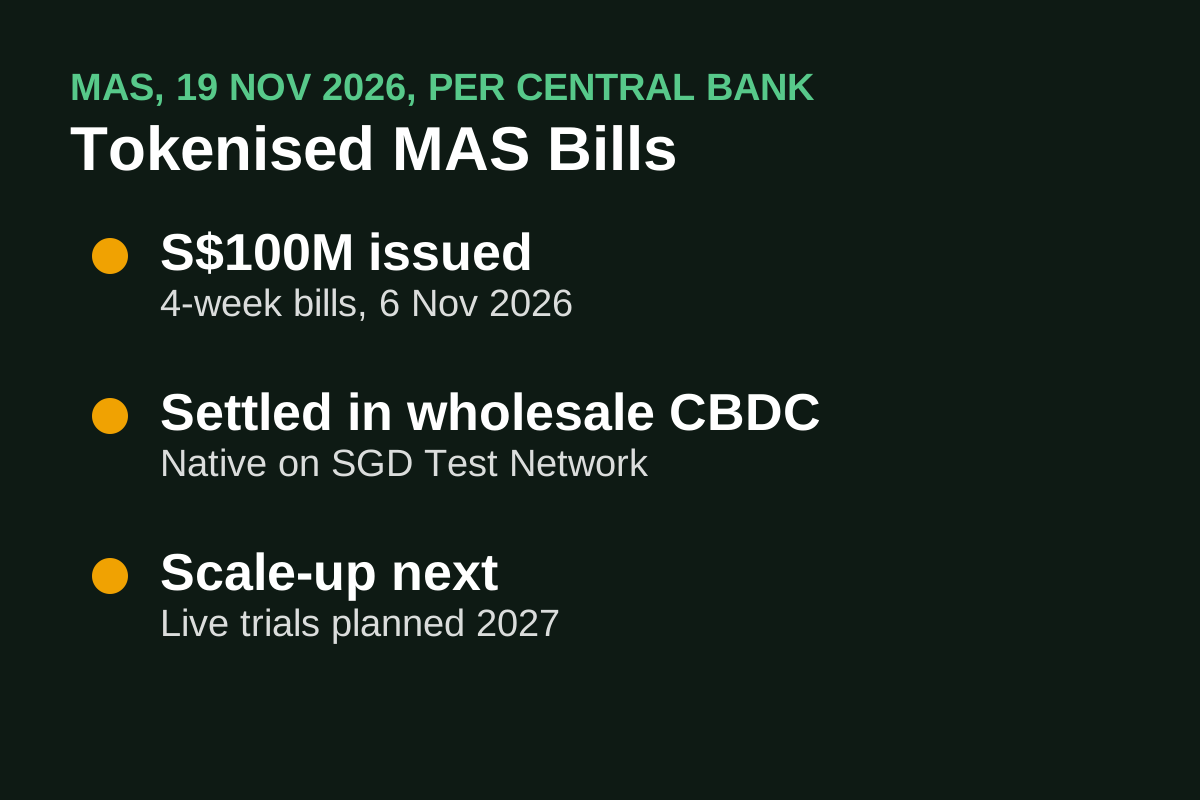
The Monetary Authority of Singapore announced on 19 November 2026 that it had successfully issued S$100 million of tokenised MAS Bills on 6 November 2026, the first issuance of the central bank's short-term debt instrument created natively on a blockchain-style ledger and settled using wholesale central bank digital currency (CBDC). All figures and plans in this summary are MAS's own.
What was issued and how it settled
The S$100 million of 4-week MAS Bills was issued natively on the MAS-operated Singapore Dollar Test Network, a shared ledger infrastructure that lets financial institutions test settlement of tokenised financial assets with wholesale CBDC, and settled using wholesale CBDC. MAS says native issuance removes the reconciliation and intermediaries needed when a conventional instrument is tokenised after the fact. The bills mature on 4 December 2026. MAS also said the Singapore Dollar Test Network will be renamed the SG Digital Ledger.
Who took part
Five Primary Dealers - banks approved by MAS as market makers for Singapore government and MAS securities - participated in the auction: DBS Bank, HSBC's Singapore branch, OCBC, Standard Chartered Bank (Singapore) and United Overseas Bank. MAS said the auction was well-subscribed, with applications more than double the issuance size.
Why MAS says it matters
The issuance builds on a live interbank overnight lending transaction settled via wholesale CBDC in 2025, adding a tokenised version of a commonly used SGD asset that can settle in wholesale CBDC. MAS said this paves the way for secured lending transactions involving tokenised assets on the network. Managing Director Chia Der Jiun said the live issuance let MAS test a new issuance method and enhance its in-house distributed ledger infrastructure, and that over time tokenised MAS Bills can play a complementary role to conventional ones. The announcement coincided with his keynote at the Singapore FinTech Festival 2026.
What comes next, and what is not yet known
MAS said it intends in the next phase to scale up tokenised MAS Bills issuances, bring on more participating institutions, and expand their use in collateral management, with live trials planned in 2027. What is not yet known: the release does not disclose the auction's yield or cut-off price, the exact subscription multiple beyond "more than double", or whether tokenised issuance costs less than conventional issuance in practice. One issuance of S$100 million is small against the conventional MAS Bills market, so the efficiency claims remain to be demonstrated at scale.