MBARI says El Niño warm water has caused a sharp plankton decline in Monterey Bay
The institute's instruments logged a drop in phytoplankton from early October and record deep-water warmth on 12 November 2026. Effects on larger animals are anecdotal so far, and MBARI says the full impact won't be clear until spring and summer.
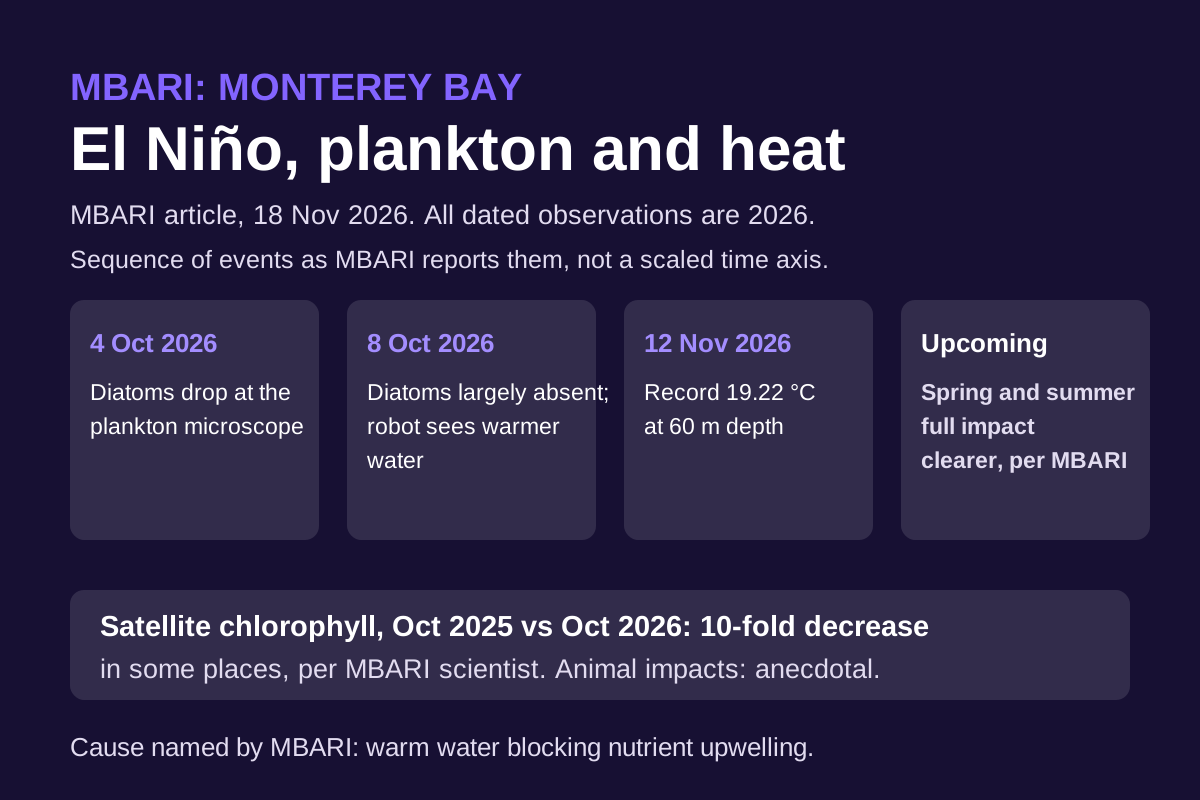
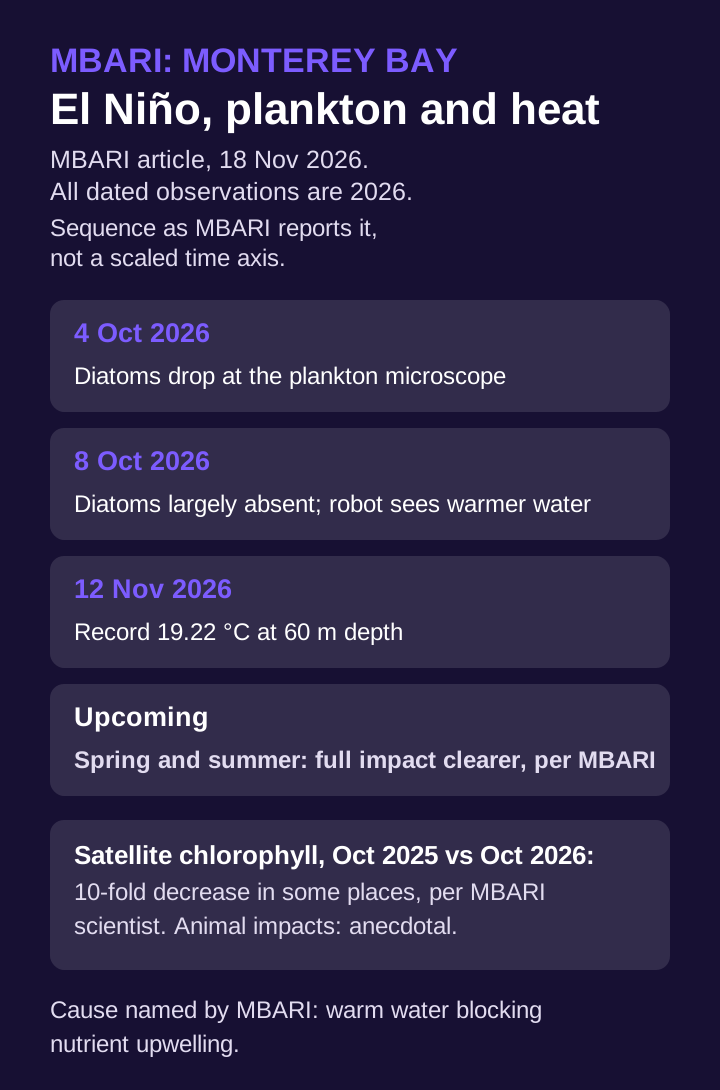
Original Omnistu summary graphic of MBARI's 18 November 2026 article. Cards show MBARI's reported sequence of 2026 observations and its stated future outlook; the spacing is not a time scale. Based on MBARI's account only, not the underlying datasets.
The Monterey Bay Aquarium Research Institute (MBARI) published an account on 18 November 2026 of what its monitoring equipment has recorded since El Niño warm water reached Central California. This summary is based on MBARI's own article. We have not seen the underlying datasets.
What the instruments recorded
MBARI says a robotic plankton microscope moored near the head of the bay's submarine canyon and an autonomous underwater vehicle surveying the north bay both documented a sharp decrease in phytoplankton abundance and average carbon biomass. Over three days in early October the microscope reported a significant decrease, and diatoms dropped significantly on 4 October 2026 and have been largely absent since 8 October 2026. MBARI links this to warm water pushing the thermocline deeper and blocking the upwelling of nutrients that phytoplankton depend on.
Temperature and satellite data
MBARI's M1 mooring, which has monitored the bay for nearly 40 years, logged a new time-series high of 19.22 degrees Celsius (66.6 F) at 60 metres depth on 12 November 2026. Comparing satellite data from October 2025 and October 2026, MBARI scientist Monique Messié says there is a 10-fold decrease in phytoplankton biomass in some places, such as off Big Sur, and that these are the lowest chlorophyll concentrations seen in the region since before 2000 in satellite data.
What is still unknown
MBARI says plankton feed krill and anchovies, which feed whales and commercially important fish, and that cascading effects are expected. Its evidence for animals so far is anecdotal: divers reported the clearest water they had seen at its buoy, whale-watching ships reported no humpback whales, and beachgoers reported malnourished and dead seabirds. Senior Scientist Francisco Chavez says other marine life will be severely impacted but the full impact won't become clear until the upcoming spring and summer.