Moonshot AI reportedly cancels $150M Nvidia Blackwell rental in Indonesia after new US chip-access rule
The Information, 19 November 2026, citing two people with direct knowledge: China's Moonshot AI cancelled a $150 million contract to rent Nvidia Blackwell Ultra B300 capacity from an Indonesian data center, days after a new US Commerce rule moved to limit Chinese companies' remote access to advanced chips. Neither company has confirmed the cancellation.
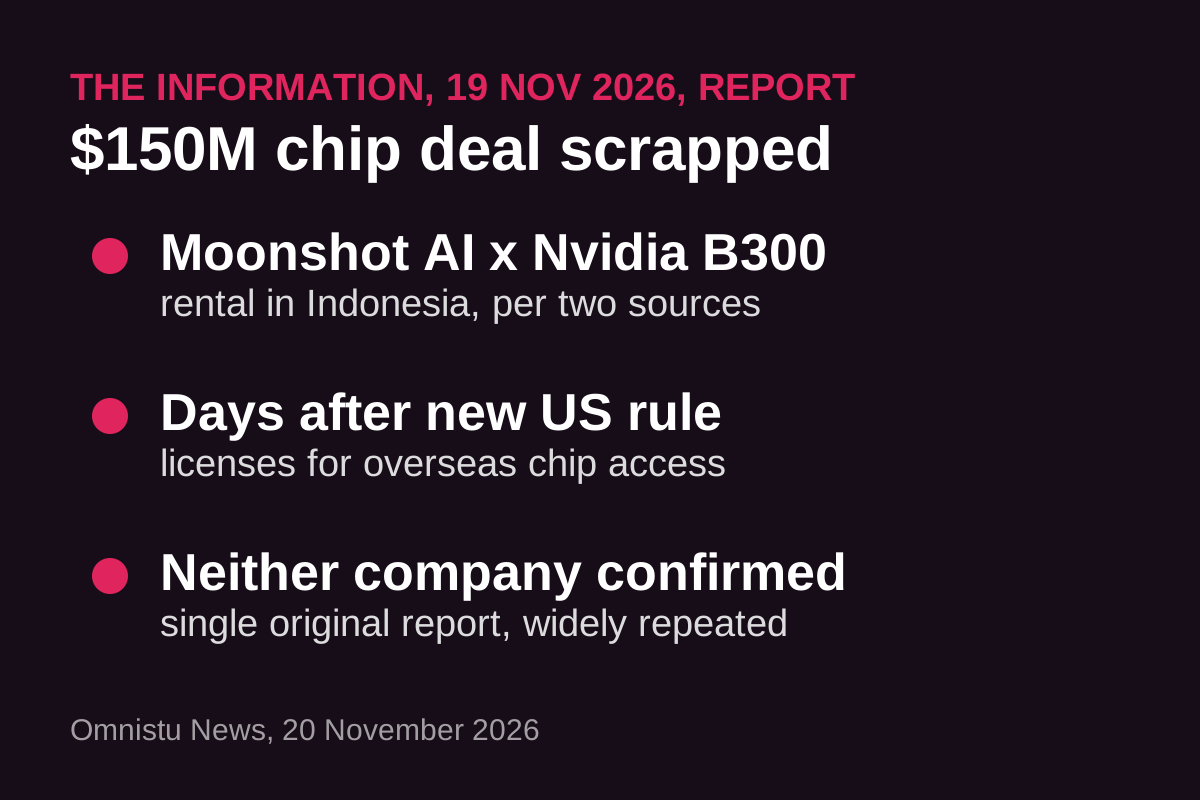
Moonshot AI, the Beijing-based developer of the Kimi models, has cancelled a $150 million contract to rent access to Nvidia Blackwell Ultra B300 chips hosted in an Indonesian data center, The Information reported on 19 November 2026, citing two people with direct knowledge of the matter. Neither Moonshot nor Nvidia has publicly confirmed the cancellation. The report was repeated by outlets including Newsquawk, Aiholics, Crypto Briefing, Kukmin Daily and Katadata; the accounts below trace to The Information's anonymous sourcing plus rule details reported by The Next Web.
What the reported deal was
According to The Information, Moonshot had signed with a Southeast Asian "neocloud" provider to rent a sizable cluster of Blackwell Ultra B300 chips, among Nvidia's most powerful AI chips, with access starting as early as next year. The US bars direct sales of such chips to China, and Chinese firms had been reaching restricted hardware by renting capacity in data centers outside China.
The new US rule
The Commerce Department's Bureau of Industry and Security issued the measure as an interim final rule, "Addressing Remote Access to Advanced Semiconductors" (91 FR 74970), announced by BIS on 16 November and effective on its Federal Register publication on 19 November 2026, with public comments due by 19 January 2027. Under the rule, exports, reexports and in-country transfers to overseas data centers that remotely supply significant volumes of compute to companies headquartered in Country Group D:5 or Macau now face license restrictions, with due-diligence duties on data centers, foundries and exporters covering direct or indirect D:5 or Macau ownership; commercial recommender systems are exempt. A separate new license requirement covers advanced-semiconductor exports to Indonesia, Malaysia, Singapore, Thailand and Brazil, described as presenting a higher-than-normal diversion risk, with an exemption for chips destined to US-headquartered companies that meet reporting requirements. The rule also formally rescinds the never-enforced Biden-era AI Diffusion Rule.
What is not established
The Information's public reporting does not name the neocloud provider, say whether any money had changed hands, or say how Moonshot plans to replace the capacity. The causal link - that the new rule triggered this specific cancellation - comes from The Information's sourcing and timing, not from any company statement. The $150 million figure and the two-source basis have not been independently confirmed by the follow-on outlets, which repeat the original report.
Why it matters
If accurate, the cancellation shows how quickly the new licensing regime can remove compute supply: a nine-figure contract disappearing within days of a rule's announcement. Southeast Asian neoclouds renting to Chinese buyers now face license requirements at both the chip and data-center level. Whether the rule actually changes where Chinese AI labs train their models will only become visible in their future releases.
- The Information: China's Moonshot AI Scraps $150 Million Deal to Access Nvidia Chips in Indonesia (19 November 2026)
- Aiholics: Moonshot drops a $150M Blackwell rental in Indonesia after new US rule (19 November 2026)
- Federal Register: Addressing Remote Access to Advanced Semiconductors, interim final rule, 91 FR 74970 (effective 19 November 2026)
- BIS press release: BIS Issues Rule Addressing Remote Access to American Super Intelligence Technology (16 November 2026)
- Newsquawk: China's Moonshot AI has reportedly scrapped its $150M deal to rent access to Nvidia's Blackwell Ultra B300 chips (19 November 2026)