Webb data helps reconstruct the Bao star merger in Andromeda
A Nature paper links years of brightening and a 2025 eruption to a smaller star spiraling inside a giant. The result combines telescope data with models, not a resolved picture of the collision.
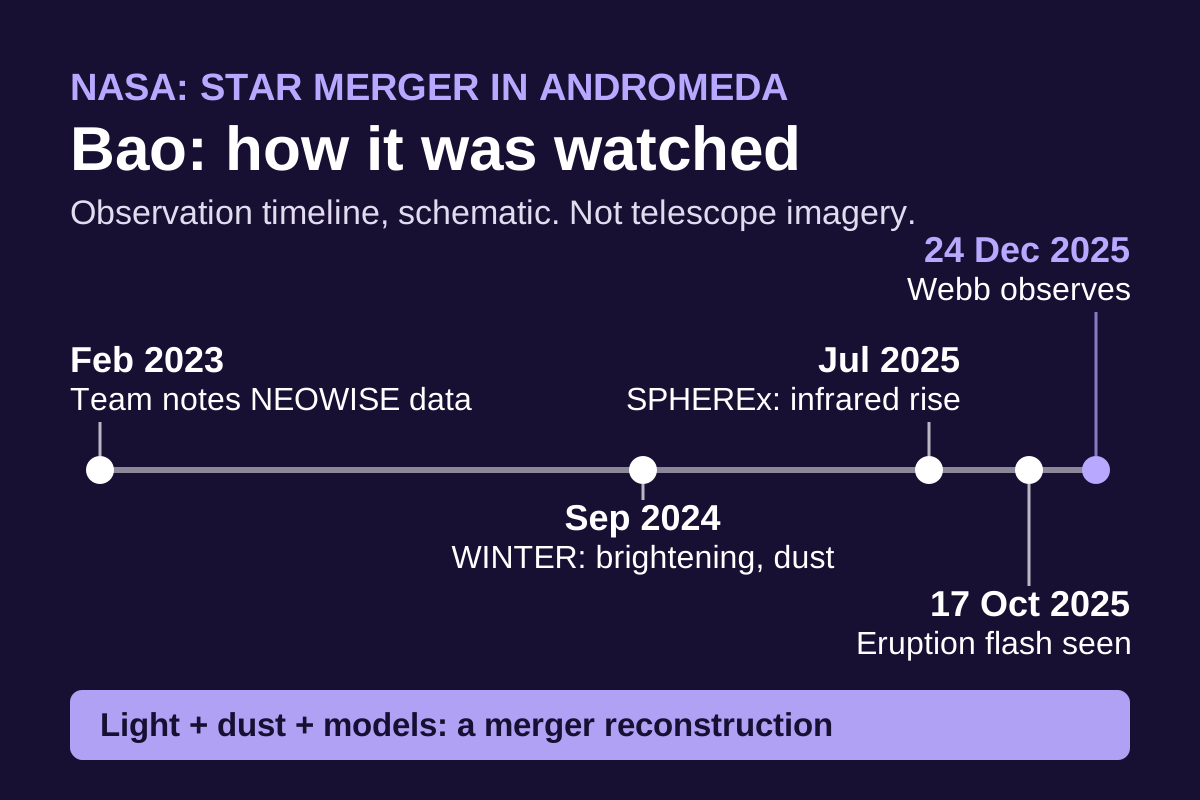
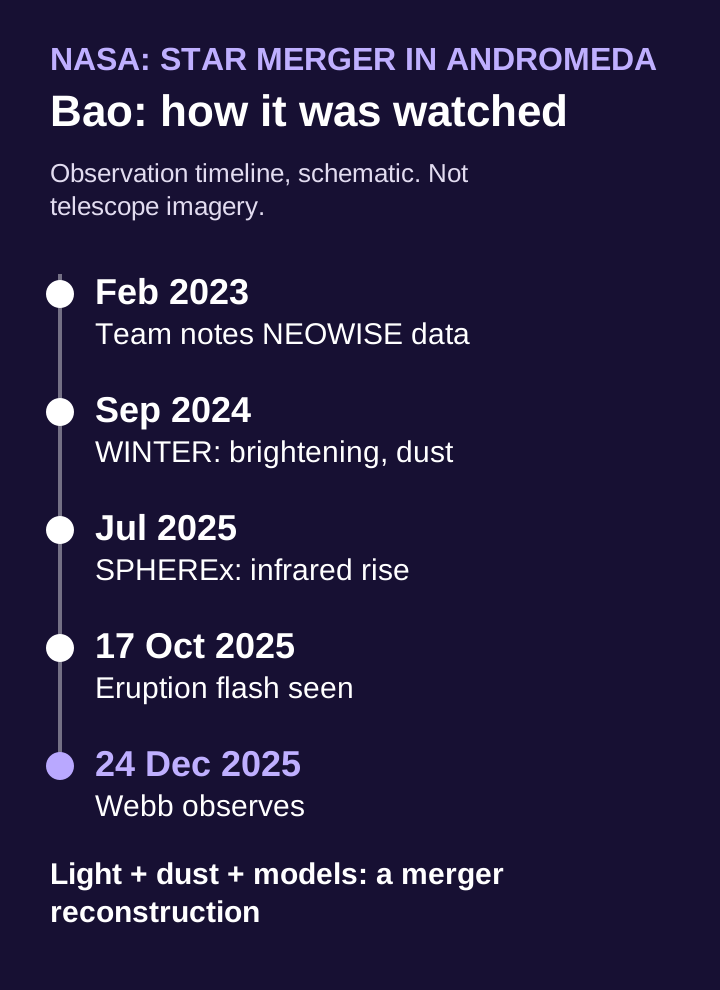
Original Omnistu observing timeline based on NASA and Caltech. Schematic spacing. The listed eruption and Webb observation dates are not a measurement of the time from peak brightness. No telescope photograph is shown.
A Nature paper published on 18 November 2026 describes a stellar merger in the Andromeda galaxy, formally known as AT 2025abao and nicknamed Bao. The researchers interpret years of observations as a smaller star spiraling inside a giant star's outer gas, then merging with its core. NASA says observations from the James Webb Space Telescope on 24 December 2025 helped complete that reconstruction.
Several telescopes, before and after
NASA says unusual behavior in NEOWISE data caught the team's attention in 2023. WINTER observations in September 2024 showed brightening and dust. In July 2025, SPHEREx recorded infrared brightening; Caltech's account distinguishes that from fading in visible-light ZTF data. These were different views of the same evolving system, not Webb watching the entire event.
The accounts also distinguish a reported discovery from observations recovered in survey data. Caltech credits amateur astronomer Koichi Itagaki with detecting the flash on 17 October 2025, and says the team found that ZTF and WINTER had captured it. NASA describes ZTF detecting the eruption on that date. Webb observed on 24 December, after the eruption, and the paper appeared almost a year later.
What the researchers infer
The Nature abstract describes a giant with about seven times the Sun's mass and a companion with about 0.7 times the Sun's mass. Those are estimates from the analysis, not two stars separately weighed in a photograph. The abstract says the companion's inward spiral best explains a seven-year period of gradual brightening, followed by a merger with the primary core. NASA describes about seven orbits during that final interaction.
The shared outer gas is called a common envelope. As the smaller star moves through it, drag removes orbital energy; the team links that energy to the observed brightening. The abstract describes the eruption ejecting the outermost roughly 10% of the giant's envelope, not 10% of the entire star. Science News reports that the amount and energy of the escaping gas helped the researchers distinguish a merger from two stars surviving in a tighter orbit.
What this does and does not show
This is not the first known stellar merger. The paper's specific advance is an end-to-end observational account of the common-envelope inspiral and its outcome. It combines light, spectra and modeling across several observatories; the smaller companion was not separately visible in the images. Science News notes that dust still prevents a direct view of what remains, and NASA says future observations are needed to see how the merged star settles.
We read NASA's release and observation notes, Caltech's account, the open Nature abstract and independent Science News reporting. The complete Nature paper is subscription-restricted and was not reviewed here. The timeline above is an original explanatory graphic, not telescope imagery. We have not reproduced the study's calculations or independently verified its model estimates.
- NASA Science: NASA Data Clinches First-of-Its-Kind Stellar Merger (18 November 2026)
- Nature: An inspiral of a star inside a common envelope with its giant companion (18 November 2026), abstract
- Caltech ZTF: For the first time, astronomers witness a stellar crash from beginning to end (18 November 2026)
- Science News: evidence for the merger and the dust-obscured remnant
- NASA observation notes: AT 2025abao and the observing timeline