Nine teeth from two Chinese caves suggest Homo erectus lived in southern China as recently as 184,000 years ago, two Nature papers report
Two open-access Nature papers published 18 November 2026 describe the same teeth. They report dating of 324 to 184 thousand years ago, plus protein and tooth-shape evidence. Findings are the authors' own and rest on nine teeth.
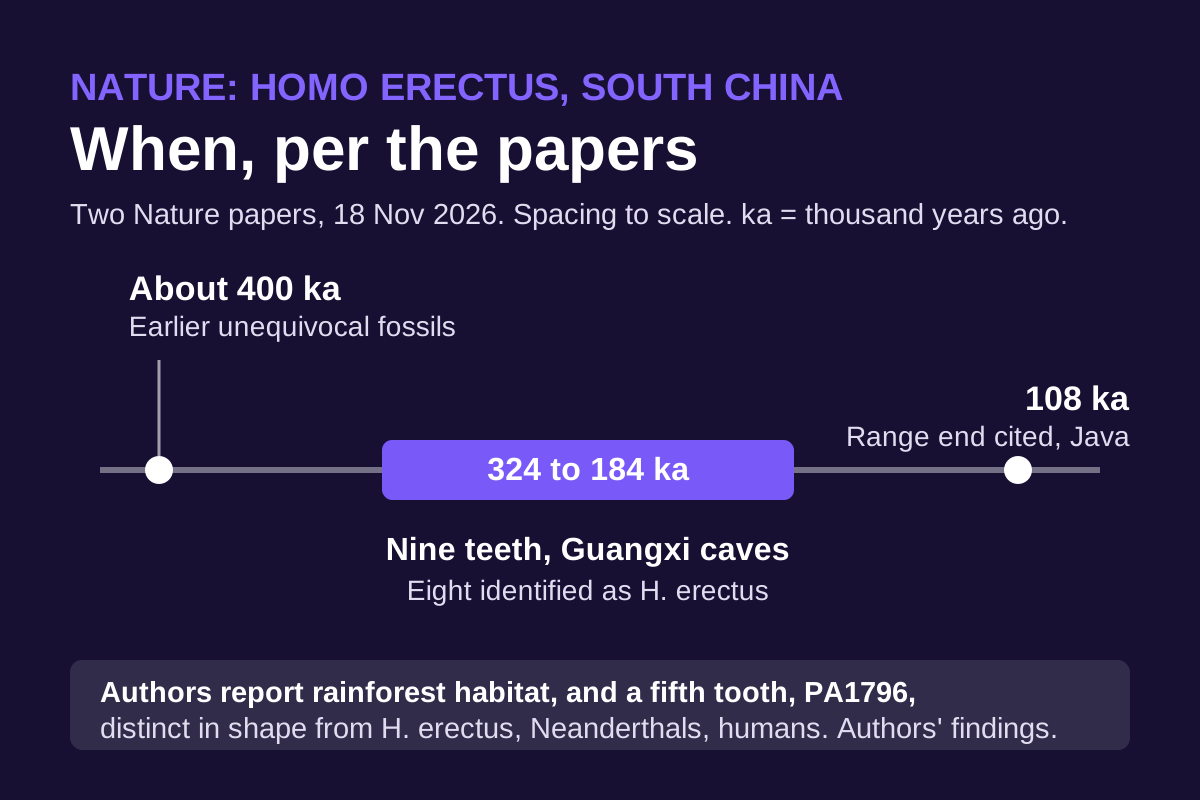

Original Omnistu guide from the two Nature papers. Date range is the authors' ChronoModel result at 2-sigma; a second model gives a narrower range.
On 18 November 2026 Nature published two open-access papers on nine hominin teeth from the Naxian and Baxian caves at Chongzuo in Guangxi, southern China. The teeth are dated to around 324 to 184 thousand years ago, according to the papers. One paper is led by K. E. Westaway and R. Joannes-Boyau, the other by W. Liao and colleagues.
What the dating paper says
The first paper says eight of the nine teeth were identified as Homo erectus by shape and by protein evidence. The team measured 45 radiometric ages from five dating techniques and modelled 43 of them with two Bayesian programs. One program, ChronoModel, places the fossil-bearing layers at 324 to 184 thousand years ago at 2-sigma uncertainty; the other, OxCal, gives 312 to 161 thousand years ago. The authors use the ChronoModel result, saying it is more robust to outliers, and state a 95% probability that H. erectus was in the area sometime within that range. That is substantially more recent than the roughly 400 thousand years ago previously established for unequivocal H. erectus fossils in this region. Chemical measurements in the teeth suggest these people lived in closed rainforest, an environment the authors say was thought to be the domain of Homo sapiens only. Study co-author Yingqi Zhang told ABC News the teeth were likely gathered by ancient porcupines, which collect and gnaw bones.
What the protein paper says
The second paper studied ancient proteins in five of the teeth. Four carry a protein change that the authors say has so far been seen only in older H. erectus specimens from China, but they differ from earlier Chinese H. erectus proteins at another position, which the authors suggest represents a previously unsampled H. erectus population. The fifth tooth, PA1796, does not match H. erectus, Neanderthals or modern humans in shape. The authors say at least two hominin lineages, H. erectus and Denisovans, may have been present in the region towards the end of the Middle Pleistocene, and that PA1796 could possibly represent a Denisovan. The youngest previously known H. erectus, at Ngandong in Java, is dated to 117 to 108 thousand years ago; the new find closes part of the gap between the mainland record and that Javanese endpoint.
What independent experts say
Griffith University palaeontologist Julien Louys, who was not involved in the research, told ABC News it is the first evidence that Homo erectus lived in rainforest environments, and that the studies suggest the region's hominin species came much closer to overlapping in time than previously demonstrated. La Trobe University archaeologist Jesse Martin, also not involved, said the survival in rainforest is not shocking given the species lasted in Indonesia until about 100,000 years ago, and suggested competition with other hominins, including modern humans, may ultimately have driven H. erectus extinct. These are outside researchers' interpretations, not findings of the papers themselves.
How far to take it
Nine teeth are a small sample, and the species attributions and date ranges are the authors' conclusions, reached with the modelling choices described above; other researchers may weigh the evidence differently. The protein work covers five of the nine teeth, and the possible Denisovan link for PA1796 is the authors' own hedge, not a confirmed identification.
- Nature: Rainforest adaptation in late Homo erectus from southern China (18 November 2026), open access
- Nature: Evidence for late Middle Pleistocene Homo erectus in mainland East Asia (18 November 2026), open access
- ABC News: Fossil teeth discovery in China is evidence more than one human species lived in rainforests (19 November 2026)