NVIDIA's Vera Rubin systems are running in Azure as the Microsoft partnership expands to Windows PCs
At Microsoft Ignite, NVIDIA and Microsoft announced Vera Rubin NVL72 systems running in Azure data centers with VM access in preview, Nemotron 3.5 open models on Microsoft Foundry, and new options from Azure Local edge deployments to RTX-powered Windows PCs.
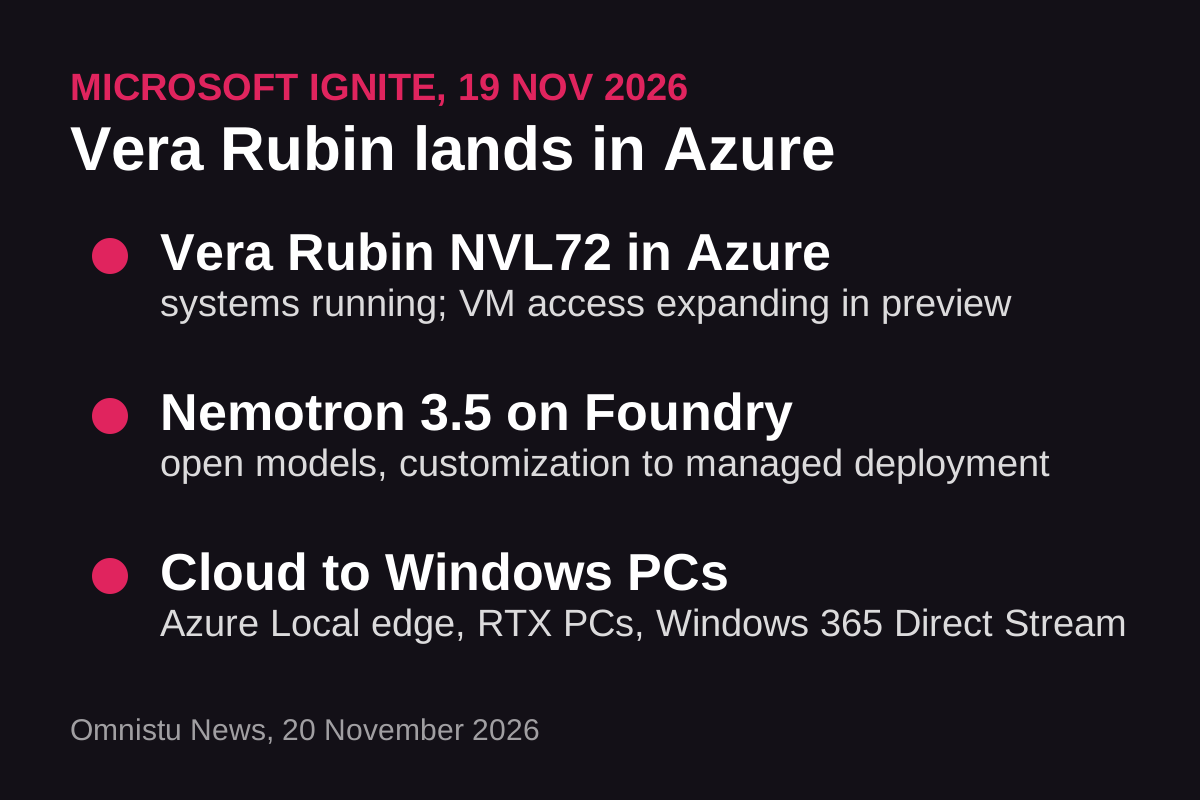
NVIDIA and Microsoft used Microsoft Ignite, which ran 17 to 20 November 2026 in San Francisco, to announce an expansion of their partnership across cloud, on-premises and PC products. NVIDIA's announcement, dated 19 November, says Vera Rubin NVL72 systems, the company's next generation after Blackwell, are already running in Azure data centers, with access to Azure virtual machines powered by them expanding as a preview. Trade outlet DIGITIMES independently reported the expansion on 20 November, describing cloud-to-PC scope.
In the cloud: Vera Rubin and confidential computing
Per NVIDIA's post, the companies are also extending confidential computing to bare-metal and rack-scale AI infrastructure, using attestation so customers can verify the computing environment before releasing sensitive models, data or keys, and collaborating on power efficiency through NVIDIA MaxLPS. NVIDIA cited recent MLPerf results as evidence of the Azure partnership's scale: in MLPerf Training v6.1, Azure scaled to 10,240 NVIDIA GB200 NVL72 GPUs on the DeepSeek-V3 model, which NVIDIA described as the largest scale in the round, and in MLPerf Inference v6.1, Azure's GB300 NVL72 systems led cloud submissions on DeepSeek-R1 interactive throughput by over 10 percent, a measurement NVIDIA attributes to analysis firm Signal65.
Open models on Microsoft Foundry
Microsoft Foundry gains expanded access to NVIDIA's Nemotron 3.5 open models: Super, designed for long-running agents across coding, research and business workflows, and Lightning, aimed at fast responses and tool use, alongside companion models for retrieval (Embed, Rerank), document extraction (Parse) and content safety (Content Safety). Bolt, for high-throughput low-latency reasoning, and Transcribe, for speech recognition, are listed as coming soon. Microsoft's serverless Programmed Training offering lets developers control post-training workflows while Foundry manages infrastructure, and Foundry Managed Compute adds support for deploying custom model weights. NVIDIA's post says EY used Programmed Training to adapt Nemotron open models for classifying corporate purchasing records, reporting 55 percent higher accuracy on its own evaluation dataset and 15 times lower cost compared with proprietary frontier models; those figures are EY's evaluation of its own use case, not a general benchmark.
From Azure Local to Windows PCs
Beyond the cloud, Nemotron 3.5 support in Foundry Local brings reasoning, coding and tool-using agents to Azure Local environments, Azure Local will support NVIDIA RTX PRO 6000 Blackwell GPUs from hardware partners, and it is expanding to NVIDIA Jetson Thor and Jetson Orin edge platforms for industrial uses, with NVIDIA's Cosmos physical AI models coming to Foundry Local. On Windows PCs powered by NVIDIA RTX Spark, the companies are demonstrating local large language model experiences at Ignite, and for Cloud PCs they are bringing Direct Stream to GPU-accelerated Windows 365, supporting up to two 4K streams at 60 frames per second; a limited preview is open for sign-ups with public preview planned for early 2027. For scientific research, NVIDIA's BioNemo Agent Toolkit and ALCHEMI Toolkit are expanding into the Microsoft Discovery catalog, with an initial integration using the RFD4-Proteina protein-structure model developed with the University of Washington's Institute for Protein Design. Microsoft is also a customer: NVIDIA's post says Microsoft AI uses NVIDIA Dynamo inference software for reinforcement-learning rollout during post-training and RTX PRO 6000 Blackwell GPUs for Bing search models.
- NVIDIA Blog: NVIDIA and Microsoft Expand Accelerated Computing From Azure to Windows PCs (19 November 2026)
- DIGITIMES: Nvidia, Microsoft bring Vera Rubin systems to Azure, widen AI options from cloud to Windows PCs (20 November 2026)
- Microsoft Azure Infrastructure Blog: Join NVIDIA and Microsoft at Ignite 2026 (12 November 2026, conference program)