NVIDIA launches Nemotron for Science, claiming small lab-trained models can beat frontier AI on research tasks
The package pairs the open 120-billion-parameter Nemotron 3.5 Super VL with a new open chemistry dataset and post-training recipes, all available on Hugging Face now. The accuracy and cost figures are NVIDIA's and its partners', not independent measurements.
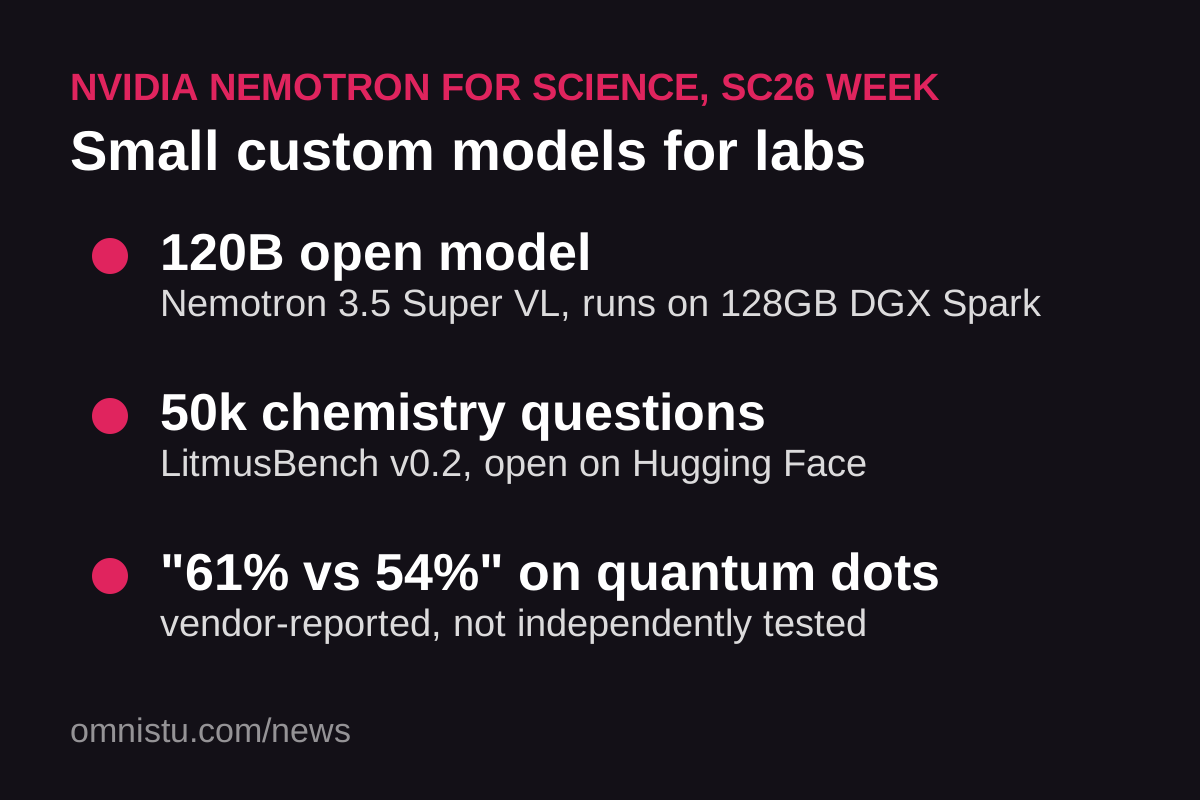
NVIDIA has introduced Nemotron for Science, a package for building research AI agents, announced on 16 November during the SC26 supercomputing conference in Chicago, according to the company's newsroom and HPCwire's conference reporting. It combines the open Nemotron 3.5 Super VL model, a new open chemistry dataset called LitmusBench v0.2, and post-training recipes that let laboratories adapt the model to their own data and instruments.
The pitch: small and custom over big and general
NVIDIA's argument is that a 120-billion-parameter open model, post-trained on a lab's own results, can match or beat much larger general models on narrow scientific tasks at a fraction of the running cost. The company and its partners supplied the numbers behind that pitch, and HPCwire notes they are vendor and partner figures across differing tasks, not independent measurements. Lila Sciences says its customized version reached 61% accuracy making quantum dots, against 54% it attributes to GPT-6 Astra, and NVIDIA says Lila's model costs 10 to 20 times less to run. Terray Therapeutics reports identifying about 76% of annotated reactions on the RxnScribe test after training the model to read chemical diagrams, which NVIDIA describes as better than previously published results. Therna, working on mRNA therapies, says its version was nearly twice as accurate as frontier models at predicting protein output, and that its scientists preferred the customized model's explanations 96% of the time.
From desktops to national labs
NVIDIA says the model is optimized to run locally on a 128GB DGX Spark desktop system as well as in data centers. At KTH Royal Institute of Technology, researchers built an agent that repairs broken GROMACS molecular-dynamics setups on its own; in one overnight run on a single DGX Spark it fixed 81% of test cases with reasoning enabled, and every fix was then checked by GROMACS itself. Argonne National Laboratory is integrating Nemotron into StructBioReasoner, a multi-agent system for designing protein-based treatments, while RIKEN has made the models available on its RIKYU AI supercomputing platform through its RiVault inference gateway. The Jülich Supercomputing Centre is also integrating the model into its scientific discovery agents, NVIDIA says.
Why it matters
If the vendor-reported results hold up in outside testing, the economics of specialized research computing shift: a lab with sensitive data could run a competent custom model on infrastructure it controls instead of paying frontier API prices. The open release on Hugging Face, including the roughly 50,000-question LitmusBench v0.2 chemistry dataset built from molecular property and drug-discovery data, lowers the barrier for smaller institutions to try that path.
What to keep in mind
Every performance and cost figure in this launch comes from NVIDIA or one of its named partners, covers different tasks and benchmarks, and has not been independently reproduced; the comparisons show what specialized models might do, not that smaller models win across science. Nemotron 3.5 Super VL itself is not new - the 120-billion-parameter open model was introduced in October 2026 - what launched this week is the science packaging around it: the dataset, evaluations and post-training recipes.
- NVIDIA Newsroom (16 November 2026): NVIDIA Introduces Nemotron for Science to Accelerate Discoveries With Agents
- HPCwire (17 November 2026): Nvidia's Nemotron for Science Challenges Larger AI Models on Cost and Accuracy
- Engineering.com (20 November 2026): NVIDIA launches Nemotron for scientific discovery agents