OpenAI reports chip-design gains, but its PPA claims and RISC-V scores measure different things
The company reports smaller Jalapeño compute blocks and up to 14% PPA improvement on AMD GPU IP. Its processor benchmark is a separate, simulation-based test, not a measured speedup for a shipping GPU.
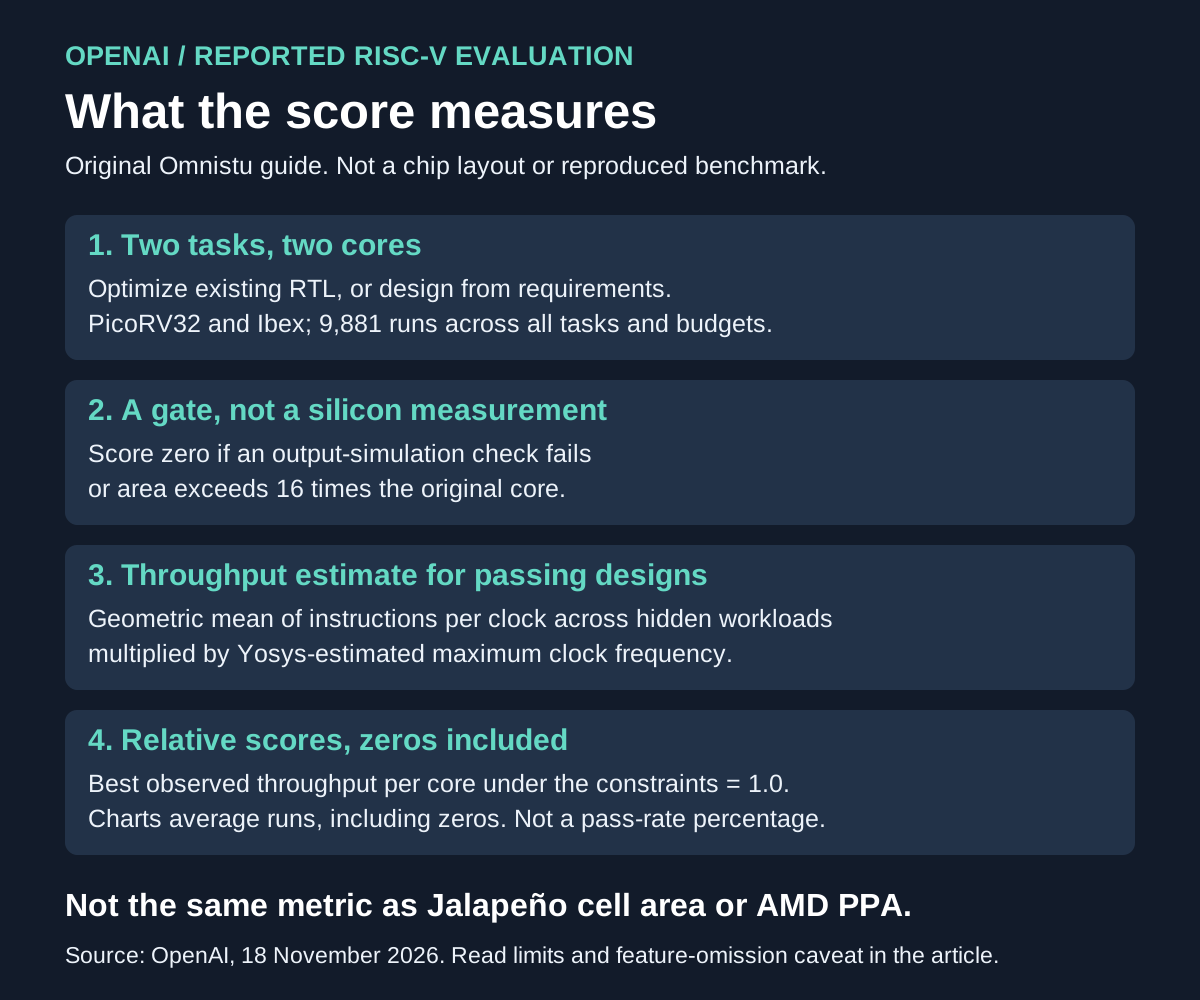
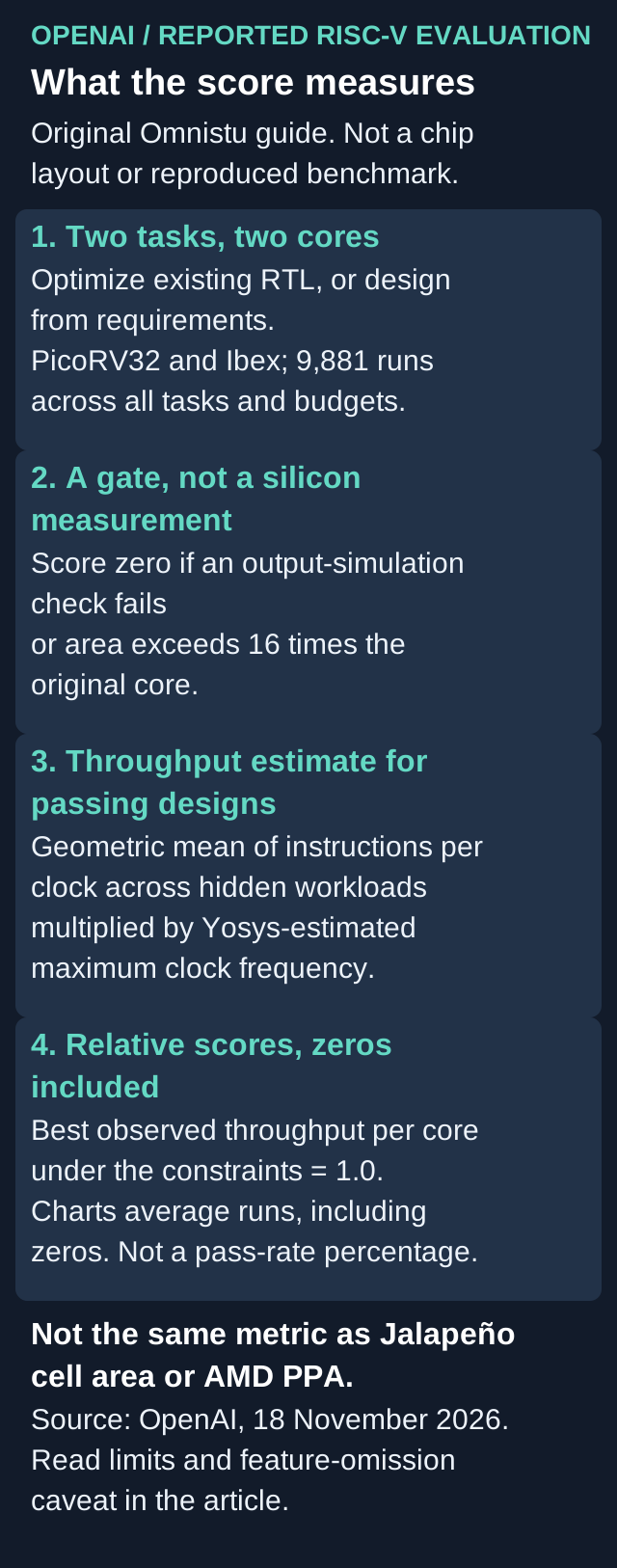
Original Omnistu guide to OpenAI-reported evaluation scoring. Production PPA and cell-area claims use different measures. This is not a chip layout or reproduced benchmark.
OpenAI says model-proposed circuit changes reduced standard-cell area in two parts of its Jalapeño inference chip and improved AMD chip designs. Its 18 November 2026 post also describes 9,881 scored processor-design runs. Those are three different evidence categories, not a single result showing that AI designed an entire chip or made every GPU 14% faster.
We read the owning post and its linked Jalapeño and Synopsys material, checked AMD's own collaboration account, and compared independent coverage and the two core projects' documentation. The production-design percentages below remain OpenAI's claims. We did not obtain proprietary RTL, reproduce the evaluation or independently measure silicon.
Jalapeño: area savings in named compute blocks
OpenAI says it began using GPT-4o on Jalapeño in early 2025. It estimates that model-proposed changes reduced standard-cell area by about 13% in the vector unit and 10% in the matrix unit, and says the optimizations were silicon proven during bring-up. These are block-level cell-area figures, not a 13% reduction in the entire chip, its power bill or its price.
One matrix multiplier redesign reportedly used about 15% less cell area in synthesis while reducing latency from two clock cycles to one. A separate adder redesign reportedly cut cell area by about 15% while keeping two-cycle latency. Do not merge those examples into a claim that every arithmetic operation doubled in speed. The linked August Jalapeño post describes measured system-level inference results, but those are a separate comparison, not a public before-and-after isolation of these individual circuit rewrites.
AMD: up to 14% PPA is not 14% faster
OpenAI reports up to 14% improvement in power, performance and area (PPA) relative to heavily optimized baselines on AMD's flagship GPU IP. It says its models rewrote SystemVerilog register-transfer-level (RTL) descriptions and used Synopsys tools to check preserved block behavior and evaluate trade-offs. The announcement does not turn that PPA figure into three separate 14% gains, a whole-GPU speedup, or a percentage reduction in manufacturing cost.
According to OpenAI, AMD included some changes in a recent design sent for manufacturing, added others to production design files for later versions, and verified single-digit PPA gains in key blocks of an upcoming flagship CPU. Sending a design to manufacturing is not evidence that a retail product containing the changes is shipping. The post does not identify a product a buyer can use to verify that claim.
AMD's July collaboration account confirms broader joint hardware, software and systems work. It does not establish the new 14% result. We did not find a direct AMD confirmation of that number in the owning AMD material checked; the November reporting we read attributes it to OpenAI. That is a limit of this check, not proof that no AMD statement exists. OpenAI's comparison to roughly a year of progress in under five months is also its own estimate.
The RISC-V benchmark has a different denominator
OpenAI separately tested two open-source 32-bit processor cores, PicoRV32 and Ibex, on optimizing existing RTL and designing a core from written requirements and interface templates. The total of 9,881 scored runs spans both tasks, both cores and all token budgets. It is not 9,881 manufactured chips or the number of trials for each model.
- A design scores zero if it fails an output-simulation check or exceeds 16 times the original core's area.
- For passing designs, instructions per clock are measured on workloads hidden from the models. OpenAI takes the geometric mean across those workloads and multiplies it by maximum clock frequency estimated with Yosys, giving estimated instructions per second.
- For each core, the best throughput observed under the same constraints is assigned 1.0. The plotted mean includes zero-scoring runs.
A normalized score of 0.75 is not 75% of a commercial GPU's speed, a 75% pass rate or a 75% power saving. The score combines success under the checks with relative throughput. The frequency is estimated, not measured on manufactured examples of these generated cores.
OpenAI reports that GPT-6.2 Astra had the highest mean score on both cores at a comparable budget of about 112,000 tokens per run. That is a result within this evaluation. It does not establish the cost of deploying the design process, success on an arbitrary chip, or general availability of the named research setup.
Why starting from requirements can look better
At roughly 112,000 tokens, OpenAI says all five models scored higher starting from requirements than modifying the original core. The company also says the generated designs could omit original features such as performance counters and additional instructions. Features that do not help the hidden workloads can still matter in real systems. OpenAI says retaining them, tightening the area cap and checking timing after physical synthesis would make the test more representative of production work.
The upstream PicoRV32 and Ibex documentation confirms that these cores offer configurable instruction, interface and implementation features. Those repositories describe the original cores, not OpenAI's generated designs, test harness or results. The owning November post links the August Jalapeño account and Synopsys announcement, but we found no linked evaluation repository or raw run package there. We have not checked equivalence of any generated core against all original features. Output simulation in this benchmark should not be confused with the separate production-block verification claim.
What Synopsys confirms, and what remains a claim
Synopsys' own 30 September announcement confirms a multi-year agreement to develop GPT-Synopsys, an EDA-tool-focused model. Reuters independently reported the deal and the continued need for conventional verification tools and engineering sign-off. That supports the partnership, not independent validation of November's AMD percentages or proof that the planned model is generally available.
The useful takeaway is narrower than an autonomous-chip headline: OpenAI describes model-assisted RTL changes in production design work and a separate processor-design evaluation with meaningful limits. Public block-by-block baselines, reproducible artifacts and measured post-physical-design results would make the gains easier to compare. We have not audited AMD or Synopsys, tested a device, or verified the proprietary improvements.
- OpenAI: owning 18 November chip-design post and scoring description
- OpenAI: linked August Jalapeño results, separate system benchmark
- AMD: July collaboration account, not confirmation of the new percentage
- Synopsys: 30 September GPT-Synopsys agreement
- Reuters: partnership and verification/sign-off context
- The Next Web: November report, AMD result attributed to OpenAI
- PicoRV32: original core documentation, not evaluation artifacts
- Ibex: original core features and configuration notes