Orange releases five open-weight Wolof language models, free for noncommercial use
On 17 November 2026 Orange published the Wolof-Qwen3 family: five open-weight models adapted from Alibaba's Qwen3, from 0.6B to 14B parameters, for Wolof, a language spoken by about 23 million people, mostly in Senegal. They are on Hugging Face under a CC BY-NC-SA 4.0 license and are already in internal customer-care pilots.
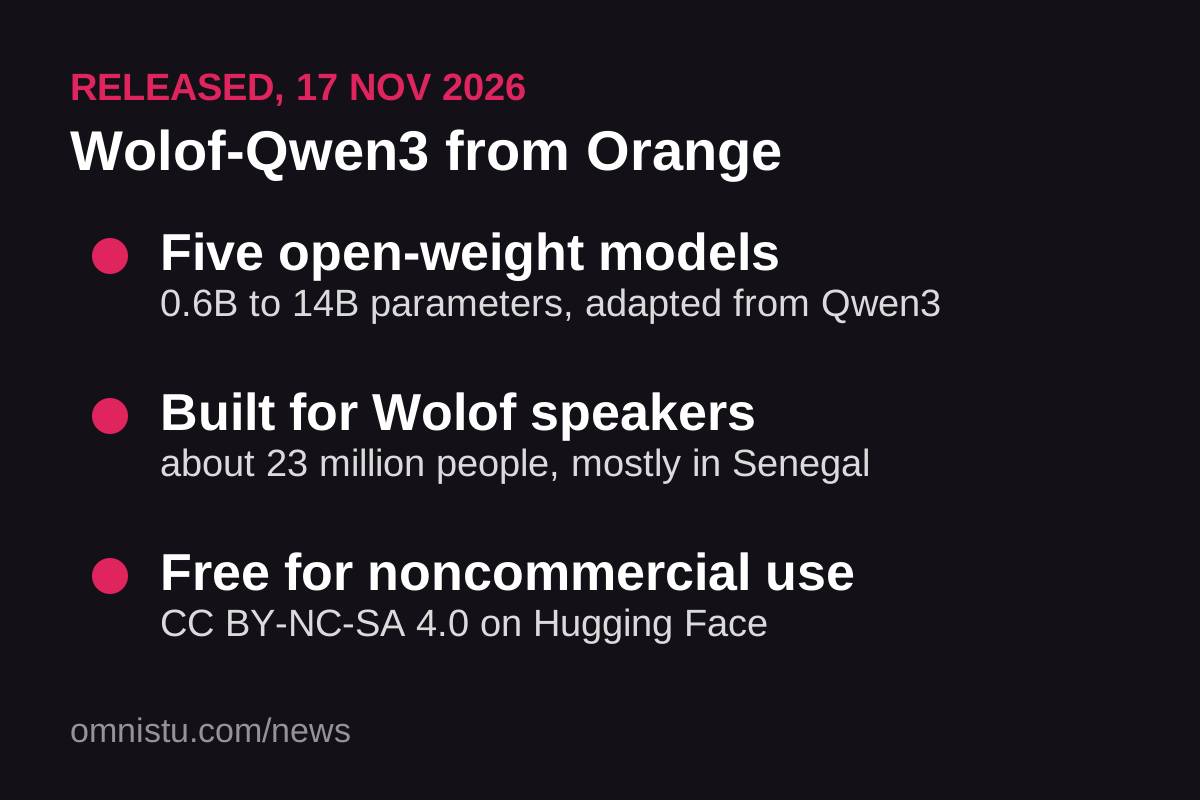
Orange Research has released five open-weight language models adapted for Wolof, covering sizes from 0.6 billion to 14 billion parameters. The Wolof-Qwen3 family, published on 17 November 2026 on Hugging Face, adapts Alibaba's Qwen3 models through Wolof-focused supervised fine-tuning, preference alignment (DPO) and model merging, on roughly 446,000 training examples including French-Wolof translation pairs. The models keep useful French and English capability alongside Wolof.
Why Wolof
Wolof is spoken by about 23 million people, mostly in Senegal, but is weakly supported by open-weight models, the Orange Research paper says, while closed API models raise cost, data-governance and sovereignty concerns for local deployments. The work was motivated by multilingual conversational systems and customer-service applications in Senegal; the models are being evaluated in internal customer-care pilots.
Performance and limits, per Orange's own measurements
In the team's evaluations across 63 public and in-house tasks, the 8B and 14B models are described as competitive with substantially larger commercial systems on Wolof understanding and generation, while the largest model still trails GPT-5 and Gemini 2.5 Pro overall. These are the developers' own measurements, not independent benchmarks. The model card also notes limited long-context testing and says the models are not designed or validated for autonomous agentic systems.
License and what is next
The models are free for noncommercial use under CC BY-NC-SA 4.0; commercial use requires a separate agreement with Orange. Intended uses include Wolof translation, question answering, summarization and intent classification. Orange also cites work on Lingala and Swahili, without announcing a timeline.
What to keep in mind
Performance figures come from the model developers' own paper and model cards. The noncommercial license means most business use needs a separate agreement, and the makers themselves recommend human oversight and additional safeguards for consequential decisions.
- Hugging Face: Orange Wolof-Qwen3-8B model card
- arXiv (16 November 2026): Wolof-Adapted Industry-Ready Open-Weight Language Models, Orange Research
- IA Académie RDC (18 November 2026, French): independent coverage of the release