Pony.ai says Q3 revenue rose 75% to $44.6 million and its robotaxi fleet hit 2,768, while net loss more than doubled
Company-reported figures from its own results release. The company says the net loss rise was primarily attributable to fair value losses on trading securities. Targets are company forecasts.
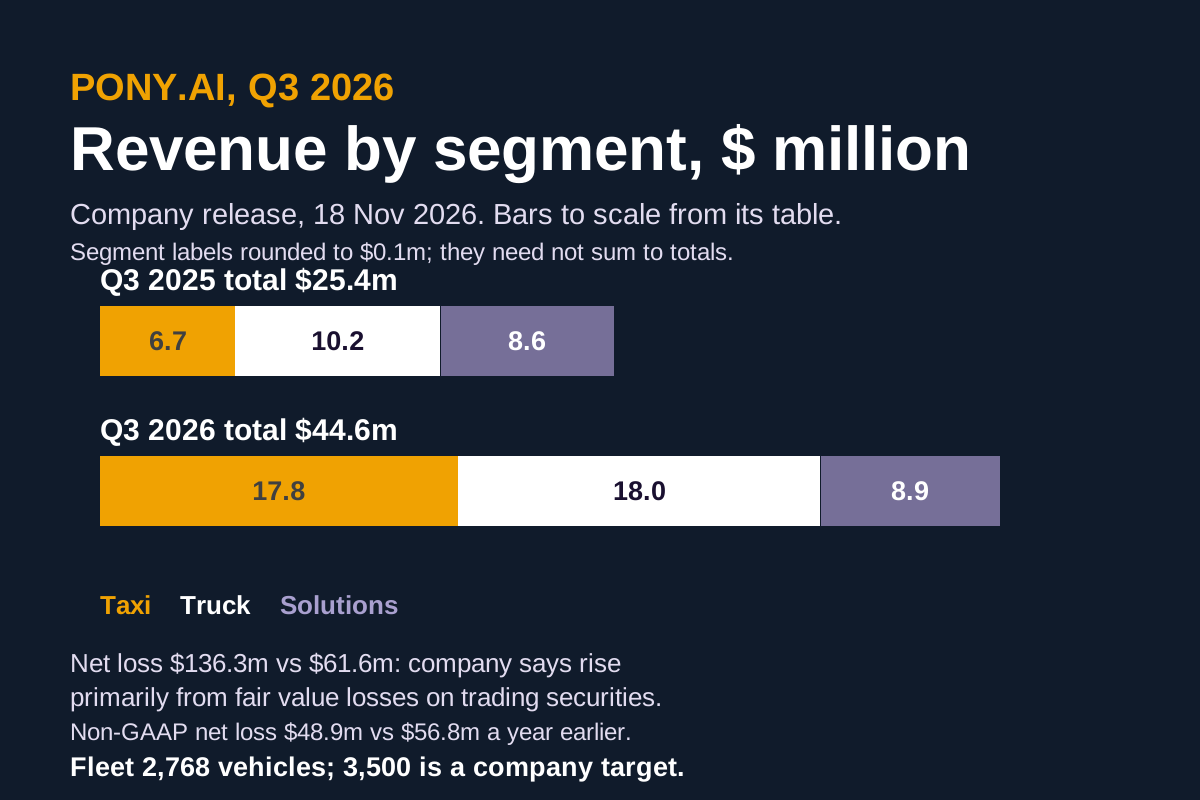
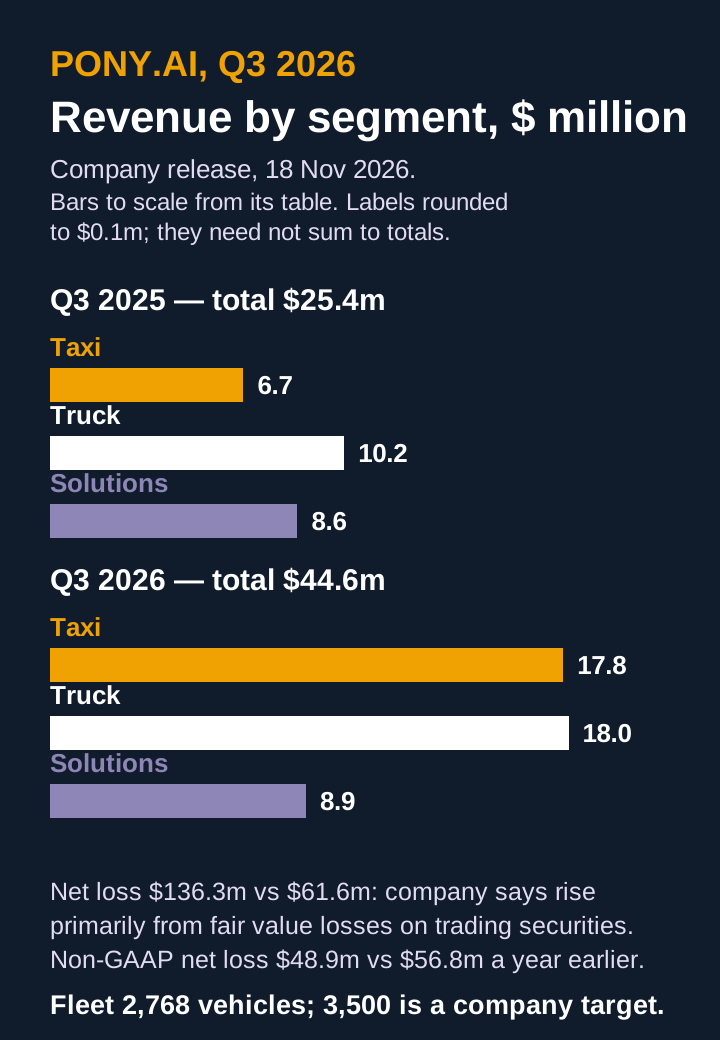
Original Omnistu chart drawn to scale from the segment table in Pony.ai's 18 November 2026 results release. Segment labels are rounded to $0.1 million and need not sum to totals. Company-reported figures, not checked against filings.
Pony.ai, the autonomous driving company, published its third-quarter 2026 results on 18 November 2026. Everything below comes from that release. We have not checked it against filings or analyst commentary.
Revenue
Total revenue was $44.6 million, up 75.2% from $25.4 million a year earlier. Robotaxi services revenue was $17.8 million, up 165.4% and about 40% of the total. Robotruck services revenue was $18.0 million, up 76.3%. Intelligent solutions revenue was $8.9 million against $8.6 million a year earlier, which the company calls broadly flat. Segment figures are rounded to the nearest $0.1 million, so they need not sum to the totals. The company says its robotaxi fare-charging revenue grew by nearly 400%, and that part of the robotaxi increase came from higher deliveries of vehicles under its joint deployment model.
Losses and cash
Loss from operations was $68.7 million, against $69.7 million a year earlier. Net loss was $136.3 million, against $61.6 million. The company says the increase in net loss was primarily attributable to fair value losses on trading securities. Its non-GAAP net loss, which excludes those losses and some other items, was $48.9 million against $56.8 million. Cash, restricted cash and wealth-management debt instruments totalled $1,154.0 million at 30 September, down from $1,206.1 million at 30 June.
Fleet and targets
Pony.ai says its robotaxi fleet reached 2,768 vehicles on 30 September 2026 and that it is working toward a full-year target of 3,500 vehicles in 20 cities worldwide. These are the company's own forward-looking statements. It also says its Guangzhou operating area now exceeds 1,000 square kilometres, and that it began fully driverless test rides with invited passengers in Zagreb, Croatia, in September. This is a summary of a company release, not investment advice.