Two EU antibiotic-resistance targets are off track in ECDC's 2025 data; MRSA meets its target
Estimated EU bloodstream infection incidence rose 72% for carbapenem-resistant Klebsiella and 16.4% for a resistant E. coli group since 2019. These are population rates, not a patient's chance of infection.
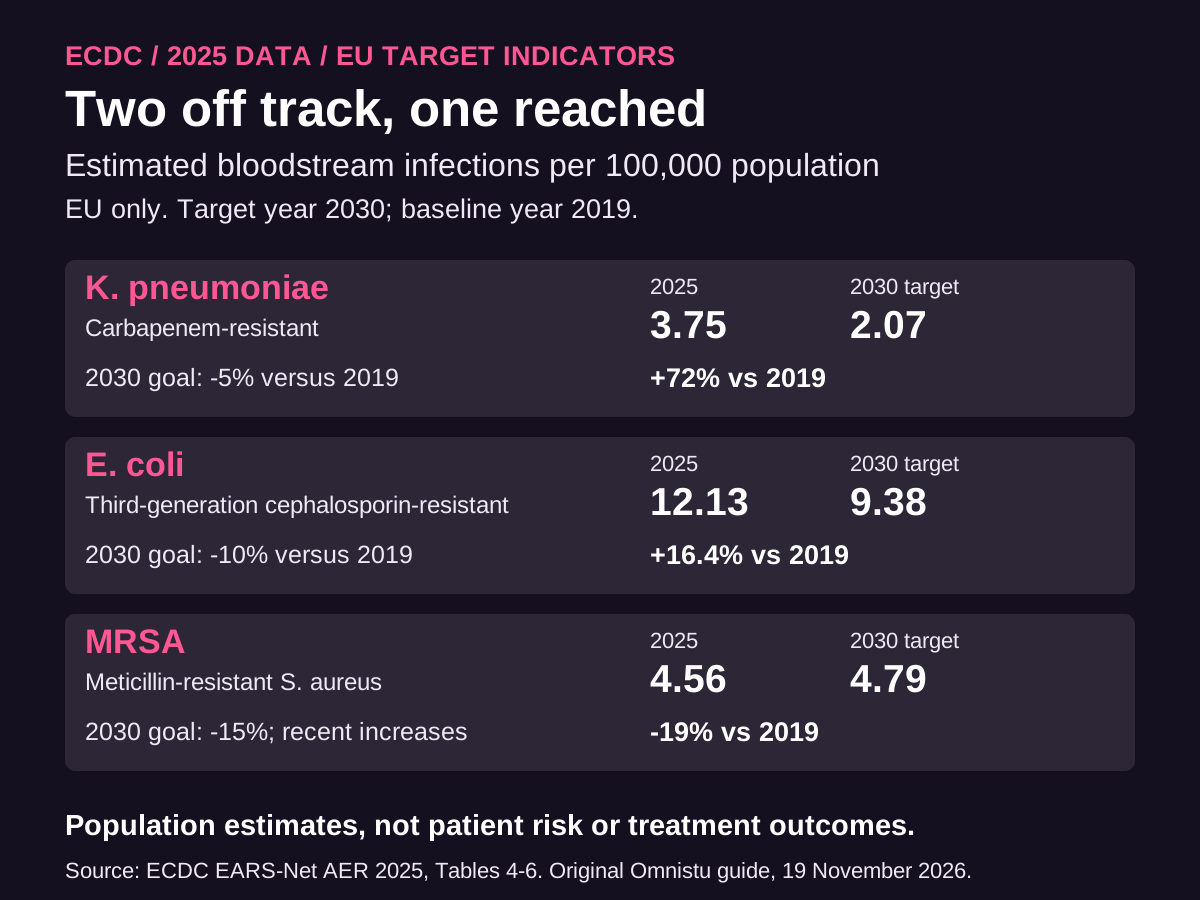
Original Omnistu guide to ECDC estimates. EU incidence per 100,000 population, not resistance percentages or a patient risk calculator. Targets use the 2019 baseline.
The European Centre for Disease Prevention and Control (ECDC) and WHO/Europe published new antibiotic-resistance findings on 18 November 2026. Two of the EU's three bloodstream-infection reduction targets are off track in the 2025 estimates. The third, for meticillin-resistant Staphylococcus aureus (MRSA), has been reached at EU level, although recent increases threaten that progress.
The important distinction is what each number measures. The EU target indicators are estimated bloodstream infection incidence per 100,000 population. The broader WHO European Region figures describe the share of tested bacterial isolates that are resistant. Neither is the probability that a particular patient will acquire an infection or that their treatment will fail.
The three EU indicators, with their units
ECDC's full EARS-Net annual report, Tables 4 to 6, gives the following EU estimates. The 2030 targets use 2019 as their baseline:
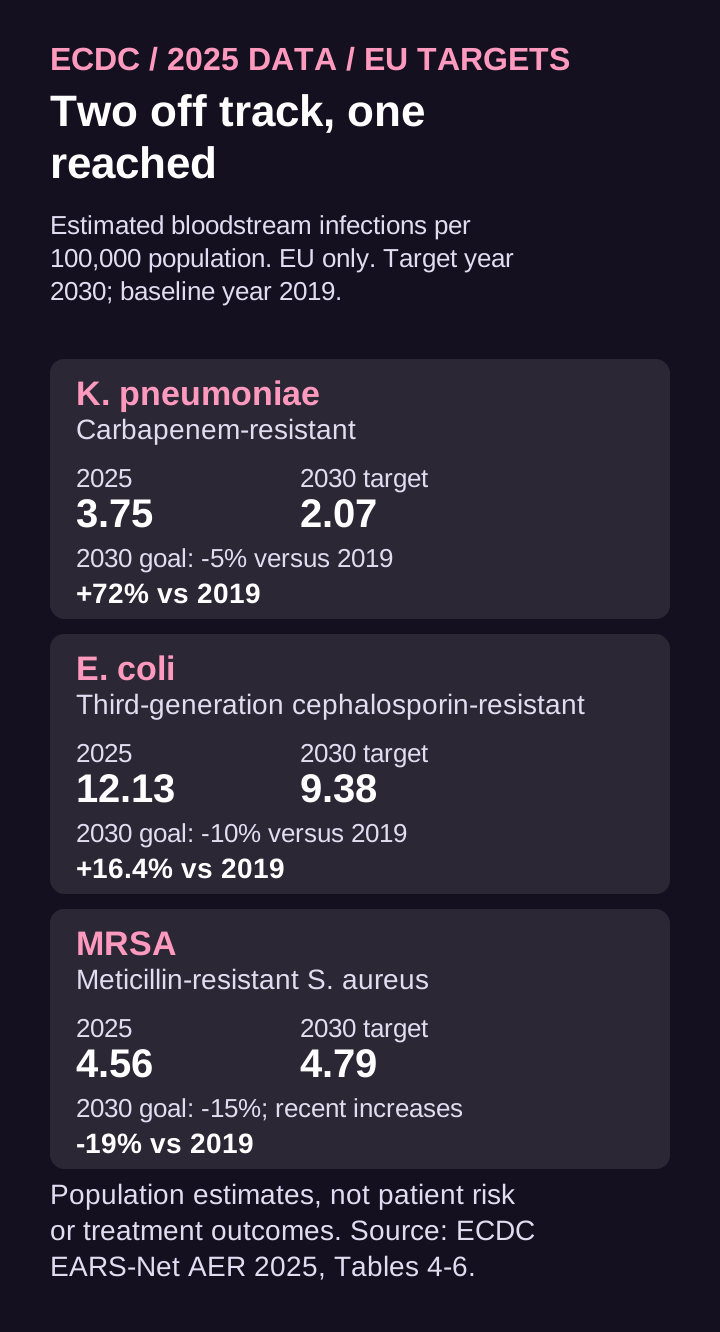
- Carbapenem-resistant Klebsiella pneumoniae: 3.75 bloodstream infections per 100,000 population in 2025, versus a 2030 target of 2.07. The estimated incidence rose 72% from 2019, instead of the targeted 5% fall. ECDC detected a statistically significant increasing trend over 2019-2025.
- Third-generation cephalosporin-resistant E. coli: 12.13 per 100,000 in 2025, versus a target of 9.38. The estimate was 16.4% above 2019, rather than the targeted 10% reduction. ECDC did not detect a statistically significant overall trend across 2019-2025, despite the higher endpoint and increases in the last two years. A difference between two years is not the same as a significant trend across the whole period.
- MRSA: 4.56 per 100,000 in 2025, below the target of 4.79. That was 19% below 2019, exceeding the 15% reduction target. The report nevertheless notes increases in the last two years. Meeting the target in 2025 does not guarantee it will remain met through 2030.
These are the EU rows, not the EU/EEA rows. For example, the corresponding 2025 EU/EEA estimate for carbapenem-resistant K. pneumoniae is 3.70 per 100,000, not 3.75. The geographical labels matter when comparing a headline with a table.
The wider region tells a different kind of story
The joint executive summary combines EARS-Net data from 30 EU/EEA countries with CAESAR data from 17 other countries in the WHO European Region. Not every country reported every bacterium-antibiotic combination. WHO/Europe says 21 of 43 reporting countries had third-generation cephalosporin resistance in at least half of their tested K. pneumoniae isolates. For carbapenem resistance in that bacterium, the count was 10 of 43. For carbapenem-resistant Acinetobacter, it was 21 of 38.
Those are counts of countries crossing a resistance-percentage threshold among tested invasive isolates. They do not mean that half of all people, all infections, or all countries in the 53-member Region share the same risk. They also should not be placed on the same numerical scale as the EU incidence rates above.
Why surveillance limitations change the reading
We obtained the full EARS-Net report and read its methods, EU target analysis and tables, discussion and limitations, alongside the joint executive summary and both organizations' announcements. EARS-Net uses routine susceptibility results from blood and cerebrospinal-fluid isolates. In the de-duplicated data, more than 99% were from blood; the report uses these invasive isolates as a proxy for bloodstream infections.
The incidence estimates adjust for reported national population coverage. That coverage is itself estimated, and the incidence calculation does not adjust for differences in blood-culture sampling rates. National laboratory coverage, hospital and isolate representativeness, testing practices and changes over time can affect comparisons. ECDC also warns that changes in identifying and naming K. pneumoniae species may affect reported resistance percentages; the size of that effect is unknown. The latest report can revise earlier years, so these comparisons should use a consistent report rather than splice together older releases.
Euronews independently reported the release and discussed prevention with ECDC. Expert commentary published by SMC Spain also stresses the limited set of invasive infections and antimicrobials measured. These sources provide context, not an independent recalculation of the surveillance estimates. We have not reviewed every country appendix, reproduced ECDC's statistical models, or assessed a particular hospital.
Public-health priorities, not personal treatment advice
WHO/Europe and ECDC call for stronger infection prevention, laboratory capacity, surveillance and careful antibiotic use, with staffing and funding to support those measures. A national plan alone is not an outcome measure. The figures here do not show which antibiotic an individual needs, whether a specific infection is resistant, or what caused a particular country's change.
This is a summary of surveillance, not medical advice. Anyone with concerns about an infection or a prescribed antibiotic should ask their treating clinician; do not change treatment on the basis of these population figures.
- ECDC: full EARS-Net Annual Epidemiological Report for 2025, methods and Tables 4-6
- WHO/Europe and ECDC: joint executive summary, 2025 data
- WHO/Europe: 18 November 2026 announcement and data definitions
- ECDC: 18 November 2026 announcement and EU targets
- Euronews: independent reporting and ECDC interview context
- SMC Spain: expert reaction and surveillance-scope context