WHO publishes second edition of its Code on international recruitment of health workers, with a stronger focus on co-investment
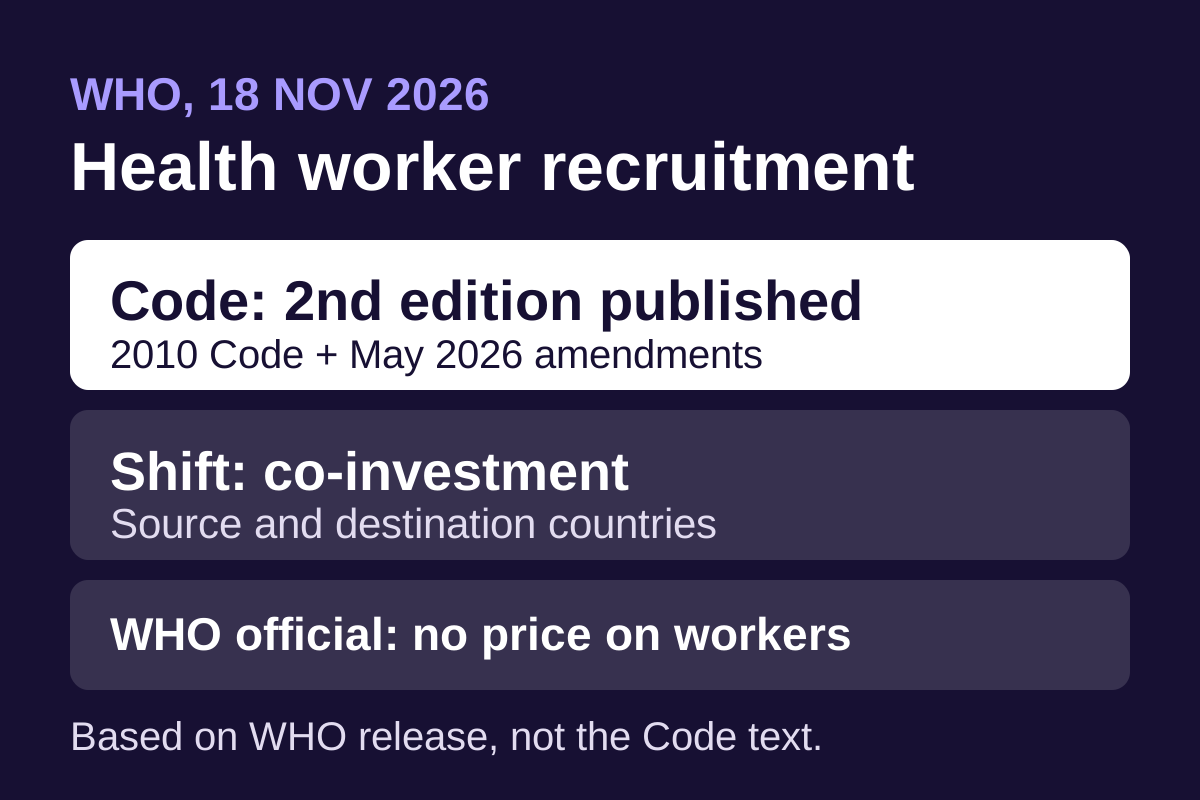
WHO says the update merges the 2010 Code with the amendments adopted in May 2026. Based on WHO's news release, not the Code text.
Original Omnistu summary of the WHO release. We have not read the Code text or measured implementation effects.
In a news release dated 18 November 2026, WHO announced that it has published the second edition of its Global Code of Practice on the International Recruitment of Health Personnel. WHO says it brings together the Code the World Health Assembly adopted in 2010 and the amendments adopted in May 2026. This summary is based on WHO's news release. We have not read the Code text itself.
What changed
WHO says the second edition incorporates the first amendments to the Code since its adoption 16 years ago. According to WHO, the amendments give greater clarity on the Code's application during emergencies and to health workers employed as care workers in destination countries. They also substantially strengthen the emphasis on co-investment. The amendments followed the third review of the Code by a Member State-led Expert Advisory Group.
What co-investment means, per WHO
WHO describes the heart of the update as a shift towards co-investment and proportional benefits. International recruitment should increasingly come with arrangements where source and destination countries, together with development partners where appropriate, jointly invest in health workforce and health system priorities that source countries identify. WHO lists education, employment, retention and broader system strengthening. The stated aim is that the benefits of health worker mobility are shared more fairly among migrant health workers, source countries and destination countries.
What WHO says it is not
WHO's Dr Tomas Zapata, Director of the WHO Academy, is quoted saying co-investment is not about placing a price on individual health workers or restricting their right to migrate.
What happens next
WHO says it will keep supporting Member States, on request, in implementing the updated Code. That includes technical assistance on bilateral agreements, co-investment approaches and policy dialogue. The release does not say which countries have agreed to anything new, and it gives no figures on health worker movement. Figures and effects are not covered here.