EU institutions say AI Omnibus moves high-risk rules to 2027 and 2028
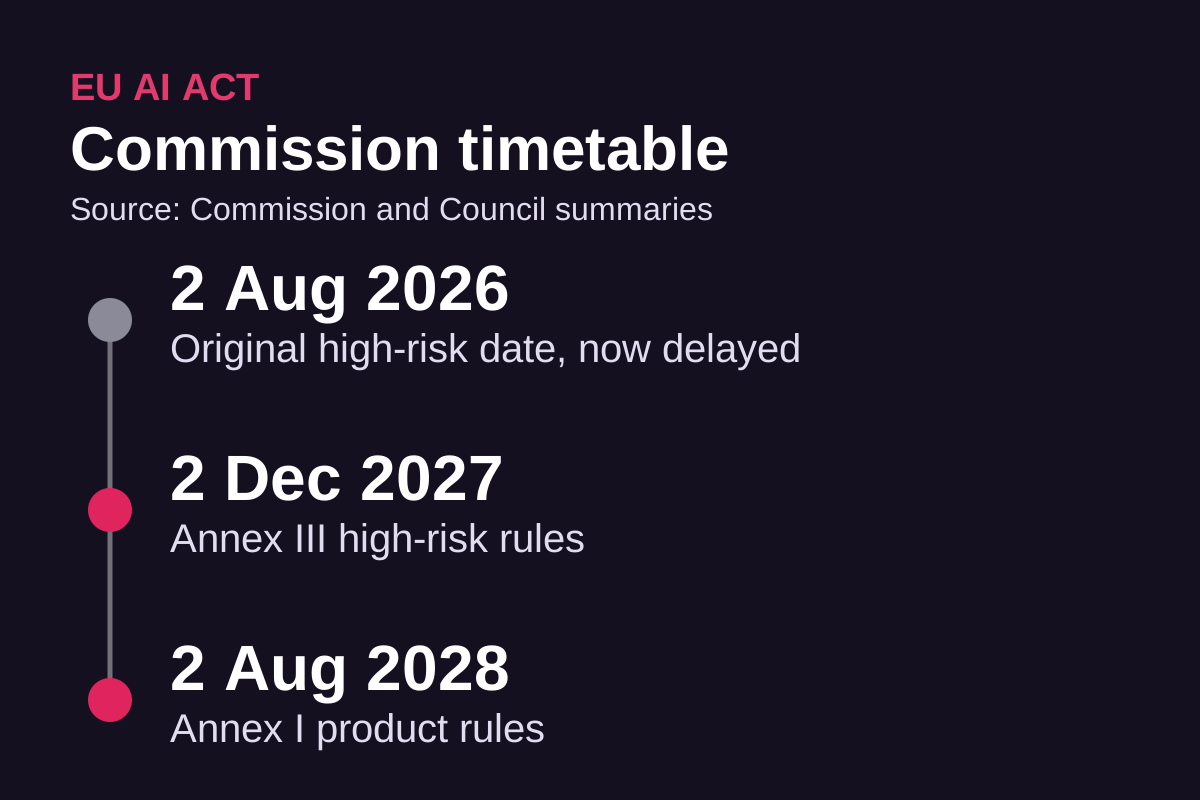
The Commission says the AI Omnibus entered into force on 27 July 2026, with high-risk rules starting on 2 December 2027 and 2 August 2028. The Council says its nudification-app ban is set to apply from December 2026. This is a summary of institutional announcements, not legal advice.
The European Union's AI Omnibus, a law that amends the AI Act, entered into force on 27 July 2026, according to the European Commission.
New dates for high-risk AI
The Commission says rules for high-risk systems listed in Annex III of the AI Act now apply from 2 December 2027. It says rules for high-risk AI embedded in products such as machinery, toys and lifts (Annex I) apply from 2 August 2028. The Council said the high-risk provisions were due to apply on 2 August 2026 before the delay.
A new prohibition
The law adds a ban on AI systems that generate non-consensual sexual or intimate content, and on AI-generated child sexual abuse material. The Council said systems that generate nude images of real people, or edit clothes out of existing photos, are "set to be banned as of December this year." The Commission page we read does not give a separate start date for the ban.
Other changes
Measures meant for small and medium-sized firms now also cover small mid-cap companies. The Commission says the AI Office gets extended oversight of certain AI systems, including those built on general-purpose models. The Council said the deadline for providers to apply transparency solutions for AI-generated content moves to 2 December 2026.
Status
The Commission and Council describe this as adopted law, not a proposal. The Council gave final approval on 29 June 2026, and the text is published as Regulation (EU) 2026/1744 of 8 July 2026.
- European Commission: AI Omnibus enters into force (27 July 2026)
- Council of the EU: final green light (29 June 2026)
- EUR-Lex: Regulation (EU) 2026/1744