Google Quantum AI measures quantum contextuality on processors up to 105 qubits in new Science paper
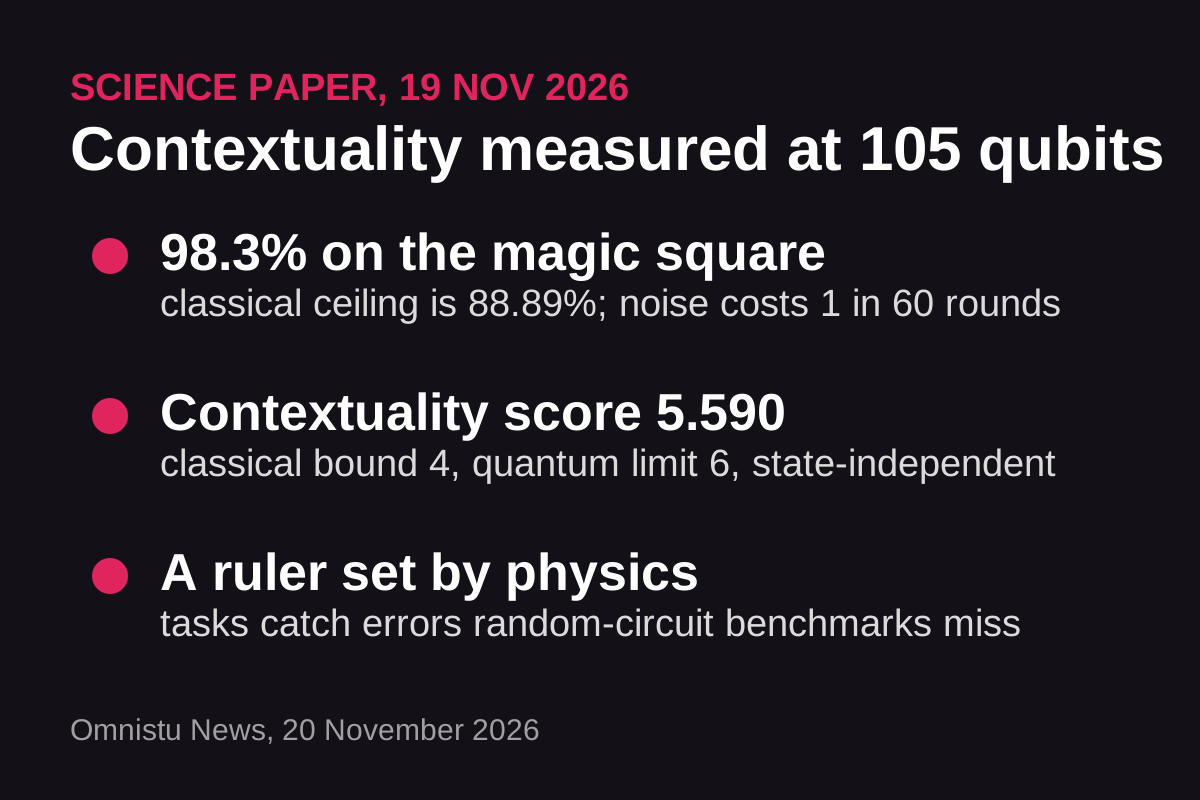
In a Science paper published 19 November 2026, Google Quantum AI reports measuring quantum contextuality on its superconducting processors: a 98.3% win rate on the classically unwinnable magic square game, a Bell-Kochen-Specker value of 5.590 against a classical bound of 4, and hidden-linear-function instances solved on up to 105 qubits.
Google Quantum AI has published a set of experiments in the journal Science (19 November 2026, DOI 10.1126/science.aec3042) demonstrating and measuring quantum contextuality, the property that measurement outcomes cannot be treated as pre-existing values but depend on which other compatible measurements are made alongside them, on superconducting quantum processors at scales up to 105 qubits. A growing body of theory treats contextuality as the deeper resource behind quantum advantage, deeper than entanglement alone, but it had previously been demonstrated almost exclusively in systems of a few particles; whether it survives in many-body hardware was an open question, per the team's companion Research Google blog post.
The magic square game
The headline demonstration is a two-player game built on a 3x3 grid paradox: no table of +1 and -1 entries can make every row multiply to +1 while every column multiplies to -1. Any pre-agreed classical strategy therefore loses at least one round in nine, a ceiling of 88.89%. Playing all nine versions of the game 100,000 times each on its Willow processor, with the players sharing entangled Bell pairs instead of a pre-written table, Google's qubits won 98.30% of rounds (plus or minus 0.0001), losing about one round in 60 to hardware noise.
A number for how contextual the machine is
The team then measured a Bell-Kochen-Specker quantity, chi, which bundles the game's correlations into one figure. Any universe with predetermined outcomes scores at most 4; quantum mechanics allows up to 6. The test is state-independent, making it a property of the machine rather than of a chosen input. Using an ancilla qubit to run 540 sequential measurements without disturbing the two measured qubits, repeated 1,000 times, the team reports chi = 5.590 plus or minus 0.008: past the classical bound and 7% below the quantum limit.
Up to 105 qubits
To test scale, the researchers ran a GHZ parity game with up to 71 players, one per qubit, staying above the best classical strategy throughout, and verified genuine entanglement across 45 qubits. They also ran the hidden-linear-function algorithm, for which a 2018 theorem proved a constant-depth quantum circuit beats any constant-depth classical circuit, on grids of up to 105 qubits with success probabilities above one-half. Per the blog post, that algorithm had never been run at scale on real hardware; success fell from near 1 to about 0.6 at maximum processor size, still above the conjectured classical bound.
A side effect: a better benchmark
The team reports that because these tasks require many qubits to agree simultaneously and exactly, they surfaced subtle coherent errors, slight off-target rotations of the quantum state, that conventional random-circuit benchmarks tend to average away. That gives contextuality tasks a second use as a hardware ruler whose ceiling is set by physics rather than by classical machines: the gap between what a processor achieves and what nature permits becomes an objective score. The blog post links the work to the magic states error-corrected quantum computers need, which the team says it recently prepared using magic state cultivation. The results are Google's own measurements on its own hardware, peer-reviewed in Science with an accompanying Perspective.
- Research Google: A game you cannot win unless you have a quantum computer (19 November 2026)
- Science: Quantum-classical separation in bounded-resource tasks arising from measurement contextuality (19 November 2026, Vol 394, Issue 6826, pp. 870-874)