Incode launches Know Your Agent, tying every AI agent to a verified human with a live face check
The identity platform detects agents in a business's traffic, verifies the person behind each one against government records, and enforces the task and spending mandate that person sets. The fraud and adoption figures it cites come from the company's own announcement.
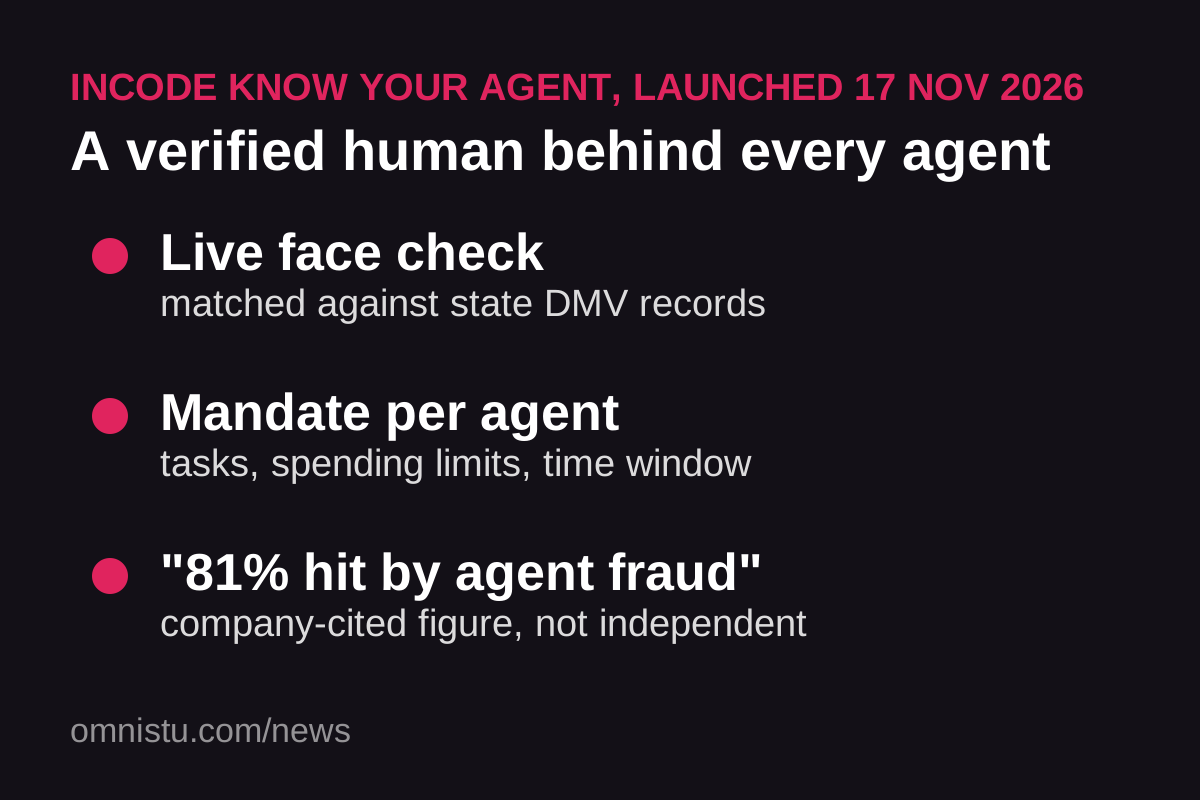
Incode, a San Francisco identity-verification company, launched Know Your Agent on 17 November, a product that ties every AI agent acting on a customer's behalf to a verified person and to the mandate that person set, according to the company's announcement and Biometric Update's reporting. The system detects agents in a business's traffic, including ones that do not identify themselves, then verifies the human behind each agent with a live face check matched against government records before letting it act.
How it works
The person verified behind an agent sets its mandate: which tasks it may perform, how much it may spend, and for how long. Every action the agent takes is checked against that mandate and recorded under the person who authorized it; an agent with no verified person behind it is stopped before it acts. The face check rests on two existing Incode technologies: Deepsight, its liveness and deepfake detection, and GovFaceMatch, launched in August, which compares a live facial image against state DMV photo records. Incode says the product works across payment rails and AI agent providers, and argues that because it operates none of them, every party can trust the record it keeps.
Why now
The launch lands as businesses split over how to treat AI agents. Incode says a fraudster's agent can arrive with the same valid credentials as a customer's, and that this fall major US retailers and financial institutions restricted access by third-party AI agents - a blunt fix the company argues turns real customers away. "An agent with no human behind it is a stranger with your customer's password," said founder and CEO Ricardo Amper.
The figures it cites, and their limits
Incode's announcement cites research saying 69% of Americans would let a bank's AI assistant complete at least one financial task for them, a McKinsey estimate that AI agents could orchestrate $900 billion to $1 trillion in US retail sales by 2030, and a figure that 81% of companies have already faced attempted or successful agentic fraud. These numbers come from the company's own announcement and its footnoted sources, not from independent verification of this product. The same applies to Incode's claims that more than 800 enterprises trust its platform, including nine of the top 10 US banks, and that GovFaceMatch produces 1,000 times fewer false acceptances than Social Security number checks - vendor-stated figures.
Why it matters
As agents start spending real money, businesses face a fork: block all agents and lose customers, or admit them and absorb fraud. A verification layer that binds agents to identified humans is one answer, and Incode is betting banks, marketplaces and telecoms will pay for a neutral referee rather than build their own. If agentic commerce grows anywhere near the cited projections, the mandate-and-record model this product embodies will matter well beyond one vendor.
What to keep in mind
This is a product launch reported largely from the company's own materials: the adoption statistics, the fraud figures, the customer counts and the accuracy claims are all vendor-cited. The named organizations building with Incode are described only by category, and how well agent detection works against agents designed to evade it is untested in public. Biometric Update's coverage draws on the same announcement.
- Incode newsroom (17 November 2026): Incode launches Incode Know Your Agent to anchor AI agent trust in verified human identity
- Biometric Update (18 November 2026): Incode extends fraud protection to AI agents with biometric liveness
- UK Tech News (20 November 2026): Incode launches Incode Know Your Agent to anchor AI agent trust in verified human identity