Nous Research and Microsoft launch Hermes Enterprise, putting the open agent inside Teams and Azure
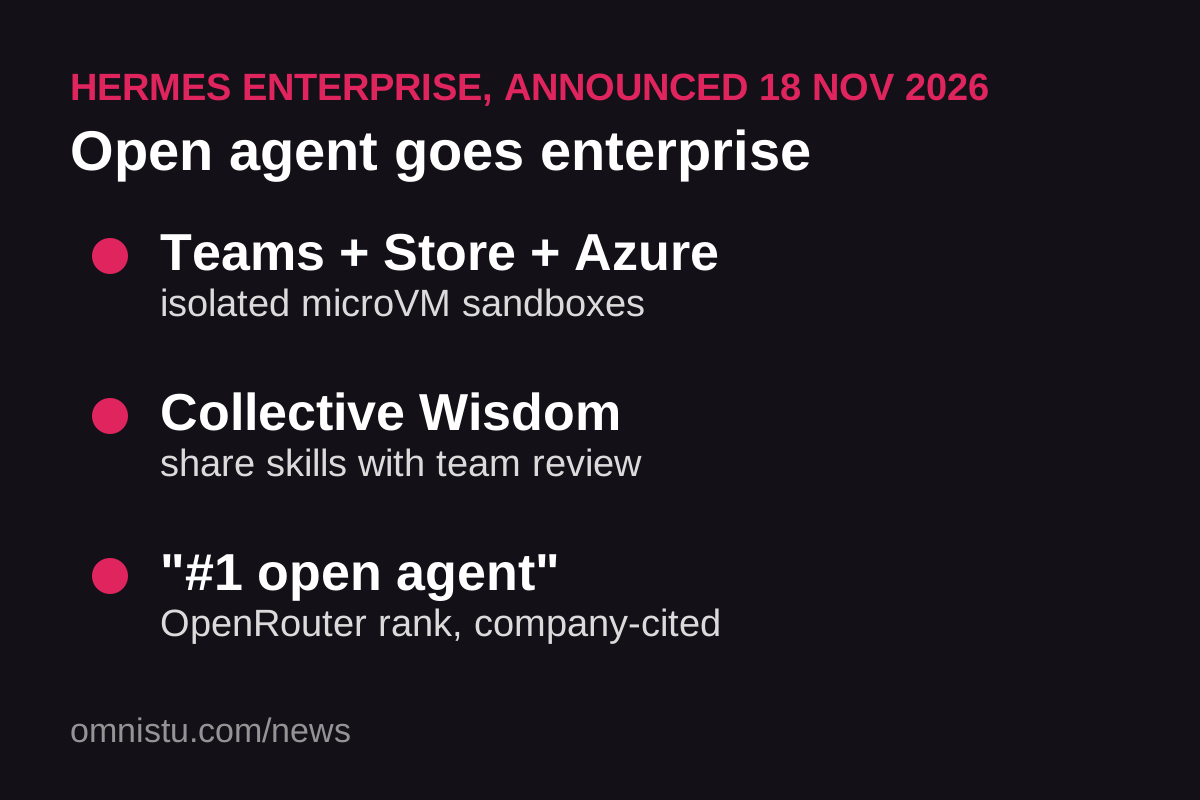
Announced 18 November during Ignite week: employees assign work in Microsoft Teams, agent workloads run in isolated Azure Container Apps Sandboxes, and a Collective Wisdom feature turns one employee's successful approach into a reviewed, shareable skill. The popularity figures come from the company.
Nous Research, the open-source AI company behind Hermes Agent and a portfolio company of M12, Microsoft's venture fund, announced Hermes Enterprise on 18 November, packaging its agent for the Microsoft workplace, according to the company's press release and GIGAZINE's reporting. The announcement landed during Microsoft Ignite week in San Francisco, where Nous Research is presenting a session on running secure agent loops in isolated sandboxes.
What enterprises get
Hermes Enterprise shows up in three places: Hermes Desktop for Windows in the Microsoft Store; Microsoft Teams, where employees can assign knowledge work such as financial analysis, document drafting or inbox triage and review the finished result in the same conversation; and Azure Container Apps Sandboxes, where agent workloads run in isolated microVMs that Nous says start in under a second and release compute when idle. Organizations with strict data residency or procurement requirements can run Hermes Enterprise in their own Azure tenant under what the company calls a similar product and pricing model.
Collective Wisdom: the differentiating bet
The feature Nous is leaning on is Collective Wisdom. As an employee delegates recurring work, Hermes automatically turns a successful approach into a reusable skill - a written definition paired with code that runs the stable steps the same way each time, which the company says makes established workflows use less inference and become more reliable. Employees can then propose and publish those skills for teammates with a review step, so the next person attempting a similar task starts from the best approach anyone on the team has found. Nous emphasizes that this shared intelligence remains a private asset of the organization rather than training data for an AI vendor.
The popularity claims, and who is making them
Nous Research says Hermes Agent ranks number one among public open agents on OpenRouter's global ranking and processes nearly 2 trillion tokens a day - company-cited figures. "Hermes became the most popular open agent because it gets better the more you use it," said CEO Dillon Rolnick. Michelle Gonzalez, CVP and global head of M12, called Hermes "one of the most widely used open agents in the world" - a partner endorsement, not an independent measurement. GIGAZINE, which previously tested the consumer Hermes Agent on Windows, describes an agent that automates tasks by combining web searches and file operations while remembering procedures from earlier tasks.
Why it matters
Open-weight agents have largely lived with developers and hobbyists; a Microsoft-distributed enterprise package with store, Teams and Azure channels is a direct attempt to move them into managed workplaces. The Collective Wisdom model also stakes out a position in the debate over who owns the know-how agents accumulate: the company, not the model vendor, if Nous's design works as described.
What to keep in mind
The ranking, token-volume and reliability claims come from Nous Research and its investor; independent enterprise references are not yet public. "Self-improving" describes the vendor's skill-caching mechanism, not autonomous model improvement. Pricing is not stated in the announcement beyond the own-tenant option, and how Collective Wisdom's review workflow holds up against bad or sensitive skills proposed inside a large company is untested in public.
- Nous Research press release (18 November 2026): Nous Research partners with Microsoft to bring Hermes Agent to the enterprise
- GIGAZINE (20 November 2026): Nous Research and Microsoft announce Hermes Enterprise for Teams
- TokenPost (19 November 2026): Nous Research Brings Hermes Agent to Microsoft Teams and Azure