Perplexity says its Computer agent now writes and updates its own skills from past sessions
Research post by Perplexity Engineering, 18 November 2026: the Brain system now creates and refines personal and built-in skills from session evidence, in a four-stage loop with automated checks and, for shared skills, human review. The reported gains are Perplexity's own measurements.
In an 18 November 2026 research post, Perplexity Engineering describes giving Brain, the personalization system inside its Computer agent, the ability to write and update agent skills from past sessions. Until now Brain maintained a knowledge wiki about the user and their work. Perplexity says the change adds procedural memory: reusable instructions the agent can load into context when a similar task comes up again.
Two kinds of skills
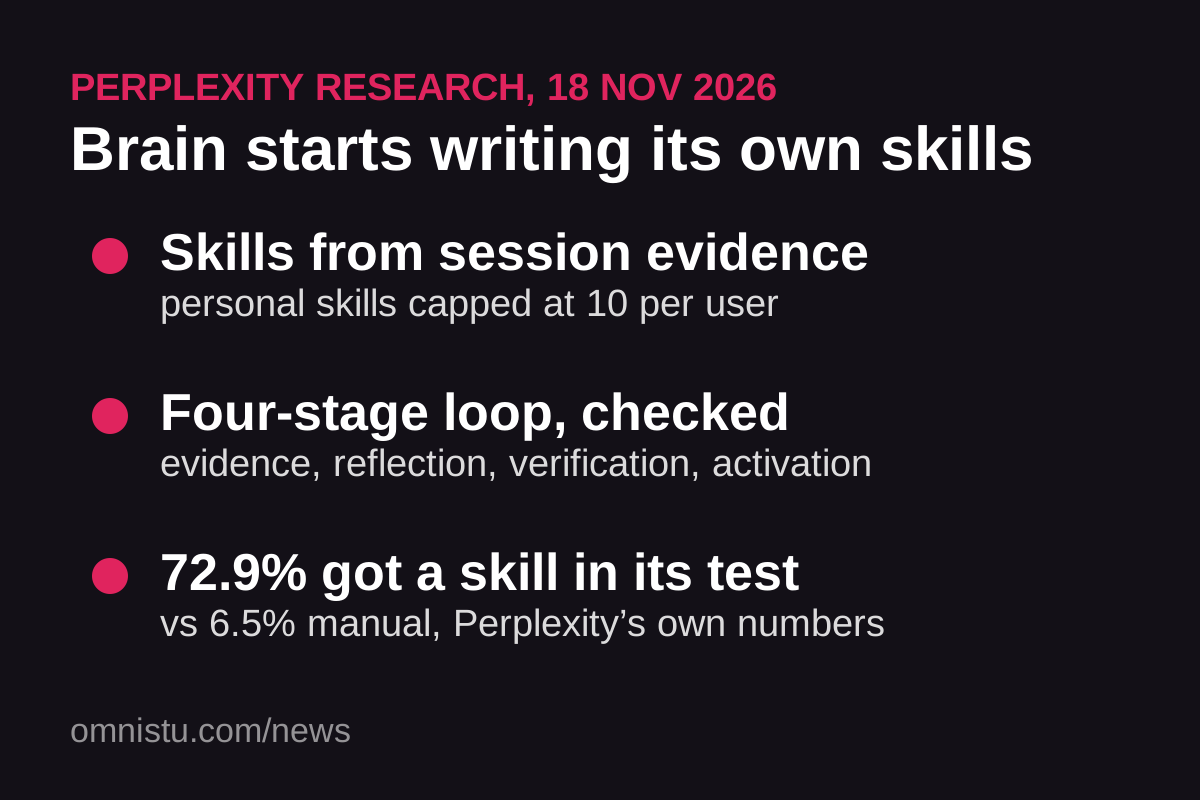
Personal skills are built from one user's memory and session history. Perplexity caps automatically created personal skills at 10 per user; at capacity a new skill can only replace an existing one, with a justification. Built-in skills are shared by every Perplexity user, so the bar is higher: candidate revisions must pass a paired replay against generated failure scenarios and then an internal human review before they merge.
The four-stage improvement loop
Perplexity describes the same loop for both skill types. In the evidence stage, Brain finds past sessions where a skill was used, especially ones where it fell short, using skill-load events and structured diagnostics the agent files when it sees frustration, broken behavior or clear inefficiency. In reflection, an improvement agent works in a sandbox with a frontier model, the evidence and the current skill library, but no internet access. Creating a skill requires two independent occurrences of the same reusable behavior; an update can rest on one grounded occurrence, and updates are scoped to one change per skill per run. In verification, deterministic checks confirm proposals are well-formed, and an LLM judge audits sampled proposals. Activation then applies the change for future sessions. For built-in skills, evidence is sanitized to strip credentials, secrets, attached files and media before use.
What Perplexity reports
Perplexity says Brain wrote more than 80,000 personal skills for over 20,000 users between 1 August and 14 November, and applied more than 100,000 automatic updates to over 30,000 existing personal skills between 4 September and 14 November. In an eight-week randomized test on production traffic, it reports that 72.9% of users with automatic skill improvement enabled received at least one new personal skill, versus 6.5% of the control group who added one manually; 53% of the enabled group had a personal skill loaded in a conversation they started, versus 13% of controls; and 63% of users who received a Brain-written skill used one again within four weeks. Perplexity also reports tool-call failures fell 11% across all Computer activity (about 7% excluding the system's own background runs) and user dissatisfaction, measured as medium or high-dissatisfaction threads per user, fell 7.6%, with no measurable change in cost or response time. In a smaller offline experiment on nine task families, task success rose from 43.8% without skills to 62.5% with generated skills across 16 paired instances, and one built-in ecommerce skill case showed a 6% quality increase at 32% lower cost, with quality scored by an automated judge.
Availability and what to keep in mind
Personal skill improvement is available to all US Max subscribers, on by default for eligible users, and can be turned off; the Plugins tab identifies skills authored by Brain. All of the figures above come from Perplexity's own post and have not been independently verified. The offline experiment covered 16 paired instances, which is a small sample, and the production-test results come from the company's own measurement of its own system. Personalization changes context and instructions, not model weights, so the underlying model is unchanged.
- Perplexity Engineering: Self-improving skills (18 November 2026)
- Related: Perplexity adds a Multiagent level to Computer (Omnistu News, 19 November 2026)