Amazon Bedrock AgentCore agents get Strands defaults and lifecycle guardrail hooks
AWS announcement, 19 November 2026: the Amazon Bedrock AgentCore harness now runs on the open-source Strands harness with managed defaults (recommended model, task-oriented system prompt, prompt caching, context management, built-in tools) plus lifecycle hooks that run deterministic Lambda checks at four points in the agent loop. Existing harnesses get both updates automatically.
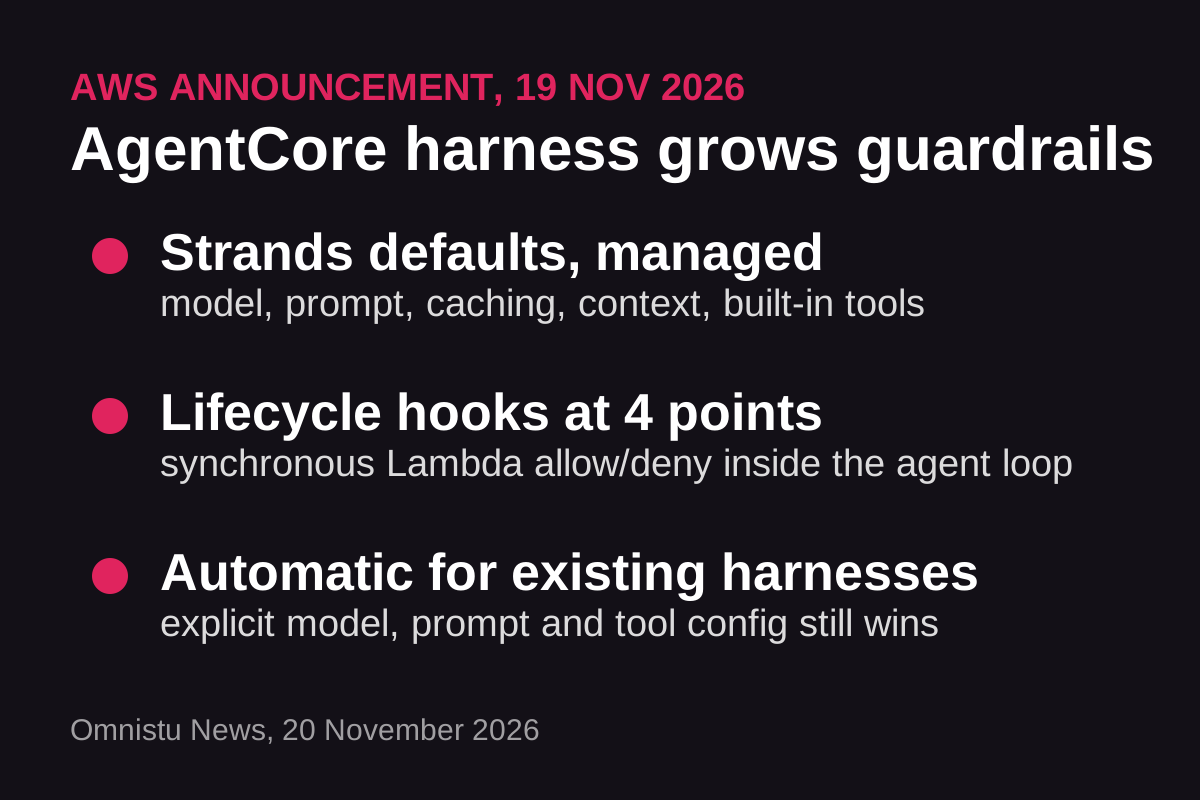
AWS announced on 19 November 2026 that the Amazon Bedrock AgentCore harness is being upgraded to run on Strands, its open-source agent harness released earlier this year under an Apache 2.0 license, and is gaining lifecycle hooks for deterministic checks inside the agent loop. There is no new resource type or integration to adopt: existing AgentCore harnesses receive both updates automatically, while customers keep control over model, instructions, tools, permissions and lifecycle policies.
What the managed defaults now include
Agents using the managed defaults get a recommended model that evolves as new models ship (explicit model choices still take precedence), a task-oriented system prompt that tells the agent to gather context, use tools, adapt to failures and verify its work, and automatic prompt caching, initially for Anthropic models on Amazon Bedrock, which lets repeated calls use lower-priced cache-read tokens. Proactive context management summarizes older turns once the context window passes a configurable threshold; AWS claims this lets the harness run at about 34% lower token cost than other leading harnesses, its own comparison. New built-in tools cover context offloading (large tool results move out of immediate context, retrievable on demand), planning across invocations via todo_write, delegation to an internal subagent, web retrieval via web_fetch, and granular filesystem access through separate read, write and edit tools. AWS notes that because the default tool set can gain capabilities over time, applications with a fixed security boundary should pin an explicit allowedTools list.
Lifecycle hooks for consequential actions
Lifecycle hooks run a customer's own deterministic code at four defined points: before_invocation (a denial stops the run), before_tool_call (a denial skips the call and the loop continues), after_tool_call (a denial retains the result and stops before further inference), and after_invocation (a denial is reported, though already-streamed output cannot be retracted). Only AWS Lambda hooks can change the agent loop, running synchronously with an allow or deny verdict; Amazon SNS and EventBridge hooks are non-blocking notifications for recording activity or starting asynchronous workflows. AWS's example: a customer-support agent investigates an order on its own while a before_tool_call hook checks each refund against an approval limit before the refund tool executes.
Why it matters
The upgrade moves two things agent builders usually assemble themselves into the managed layer: a maintained default stack (model, prompt, caching, context, tools) and a governance seam where deterministic policy code, not the model, decides whether a consequential action runs. The subagent that delegated work runs inside the parent's invocation, shares its limits and is covered by the same tool-call hooks, so the guardrail boundary follows delegation rather than stopping at it.