US Senate passes sweeping permitting overhaul that would make data centers pay for their energy costs
The 62-33 vote on the Bipartisan American Affordability and Jobs Act split Democrats weeks after their midterm wins. The bill speeds energy-project permitting, would force hyperscalers to fund grid upgrades, and now heads to the House.
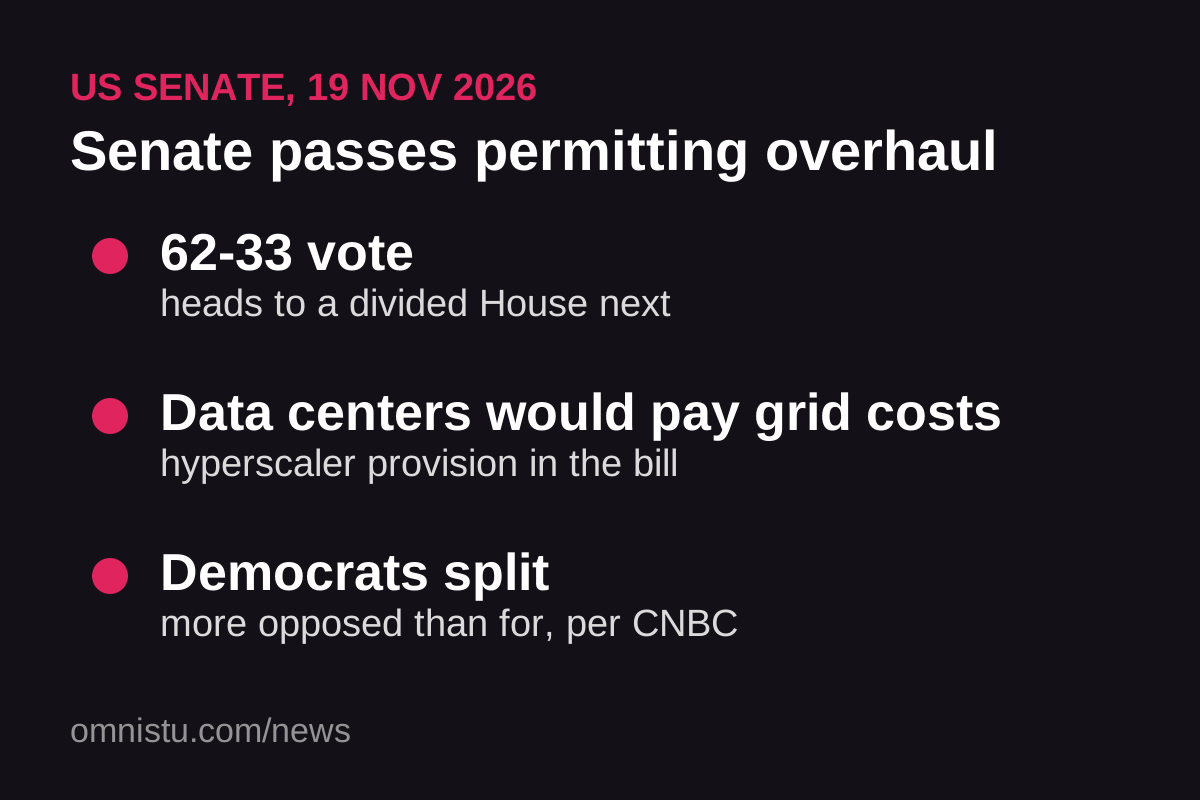
The US Senate voted 62-33 on 19 November 2026 to pass the Bipartisan American Affordability and Jobs Act, a permitting and transmission overhaul that shortens timelines for big energy projects and would require data centers to pay for the energy they use, per the Associated Press. The bill now heads to the House, with President Trump supporting it, CNBC reported.
What the bill does
According to CNBC, the bill speeds environmental permitting, overhauls electricity transmission rules, and includes measures aimed at blocking the president from cancelling already-permitted wind and solar projects. AP reports it would make sure data centers pay for the energy they use; CNBC describes a provision that would force hyperscalers to pay for upgrades to the grid. Economic research firm Rhodium Group estimates the bill could allow 17 to 249 additional gigawatts of clean energy by 2040 and change annual 2040 greenhouse-gas emissions by between 5 and 148 million metric tons - projections with a wide range, not guarantees.
A split vote
CNBC reports more Democrats voted against the measure than for it, though more than a dozen - including Senate Minority Leader Chuck Schumer - supported it, weeks after midterm wins that give the party control of both chambers in January. The deal was brokered by Senators Martin Heinrich, Mike Lee, Sheldon Whitehouse and Shelley Moore Capito. Supporters framed it as an affordability win; opponents, including the Natural Resources Defense Council, argued it rewards fossil fuel companies and data center developers. Senator Ron Wyden unsuccessfully pushed an amendment to block data centers on public lands.
Why it matters for AI
The bill lands as AI data centers drive surging electricity demand and rising power prices become a campaign issue; AP notes anger over data centers helped elect Democrats pledging to clamp down on them. The tech industry still stands to benefit overall, per CNBC, because faster permitting and more transmission make power available for new facilities - even with the hyperscaler payment provision.
What happens next
The bill moves to the House, where Republican leadership is expected to try to pass it and Democrats are expected to split again: Representative Scott Peters urged passage before the end of this Congress, while likely incoming Natural Resources chair Jared Huffman urged Democrats to vote no and seek a better deal.
What to keep in mind
Senate passage is not law: the House could amend or block the bill. The gigawatt and emissions figures are Rhodium Group projections cited by CNBC, not measured outcomes, and they span very wide ranges. The claims about consumer price effects come from the bill's supporters.
- Associated Press (20 November 2026): Senate approves bill to speed up permitting reviews, force data centers to pay for energy costs
- CNBC (19 November 2026): Senate passes BAAJA permitting reform bill backed by AI, energy sectors