ESA member states select Plasma Observatory: seven spacecraft to track the Sun's energy through Earth's magnetic shield
ESA announcement, 19 November 2026: the mission is selected as the agency's next medium-class mission - a decision, not a launch. Seven coordinated spacecraft will measure the magnetosphere at several scales at once, a first. Future selection dates are ESA's stated schedule.
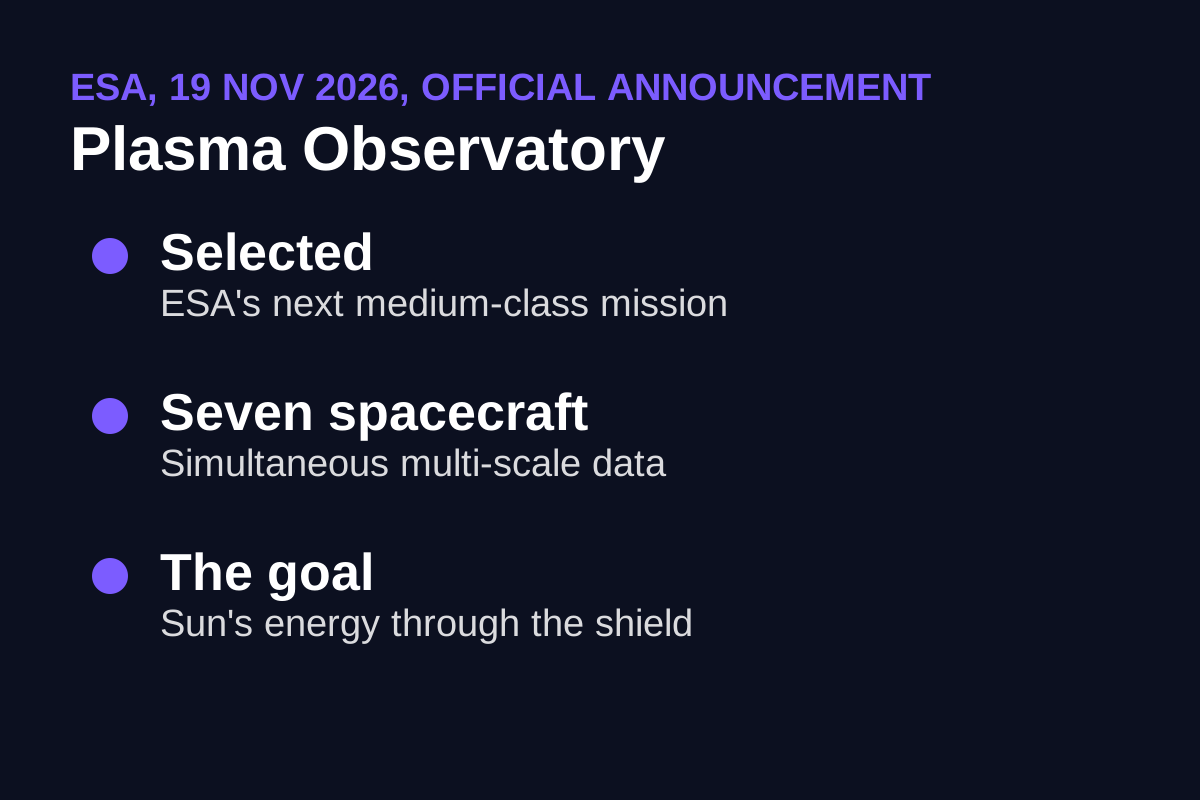
ESA member states have selected Plasma Observatory as the agency's next medium-class science mission, ESA announced on 19 November 2026. The mission's seven coordinated spacecraft will, for the first time, track how the Sun's energy moves through Earth's magnetic shield across different scales of distance and time. Selection is a programme decision, not a launch: this article reports what was decided and what the mission is designed to do.
Why plasma
Plasma, a gas of charged particles, makes up 99% of the visible Universe, and energy transfer within it drives phenomena from solar storms to auroras - and, at the extreme, power outages affecting satellites and grid infrastructure. The solar wind, the stream of plasma the Sun constantly blows out, meets Earth's magnetic field, which shields the planet from much of the impact. ESA's Study Scientist for the mission, Matt Taylor, said Earth's magnetosphere can serve as a natural laboratory for plasma phenomena that also occur around other stars spacecraft cannot visit.
What seven spacecraft add
Earlier missions such as ESA's Cluster quartet found that solar wind plasma interacts with Earth's magnetic environment on scales from a few kilometres to tens of thousands of kilometres, and from milliseconds to minutes - but Cluster could examine only one scale of space and time at a time. Plasma Observatory's simultaneous measurements of magnetic and electric fields and particles in seven places at once are intended to connect small, fast events to larger changes across the magnetosphere. ESA's Director of Science, Prof. Carole Mundell, said the mission would build on Cluster's results and "take European leadership in heliophysics into the next decade and beyond."
Other mission selections announced
In the same announcement, ESA said it has narrowed candidates for its following medium-class mission to four and for its next fast-class mission to three. All seven candidates undergo initial studies during 2027; ESA's stated schedule is to select the fast-class mission in about a year and the medium-class mission in 2030.
What is not yet known
The announcement does not give a launch date, a cost figure, or the industrial consortium for Plasma Observatory. The 2027 and 2030 selection dates are ESA's current schedule, not completed milestones, and candidate missions can be descoped or dropped during study phases.