NASA says Voyager 1 reached one light-day from Earth on Nov. 18, after 49 years of travel
The probe crossed the milestone at 2:16 a.m. PST on 18 November, about 16.1 billion miles (25.9 billion km) away. NASA confirmed it via the carrier signal while engineers analyze a data issue; radio now takes 24 hours each way. Based on NASA's release.
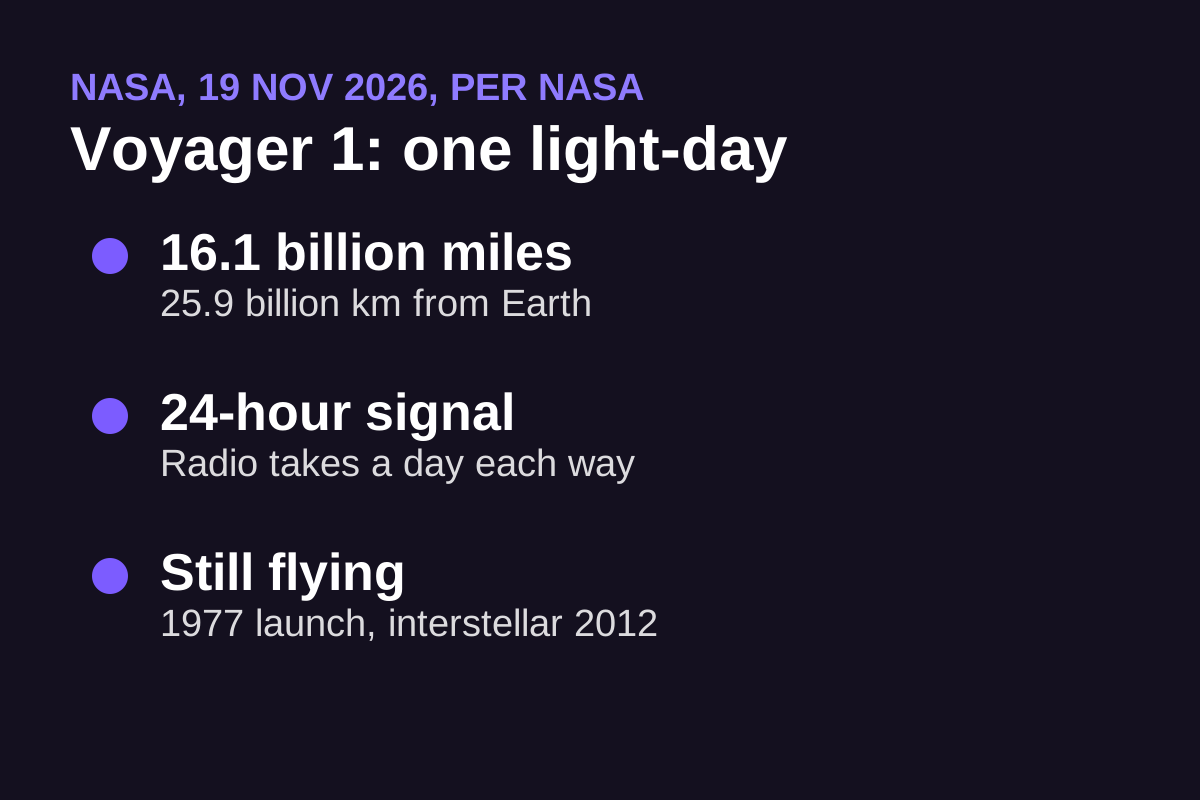
NASA's Voyager 1 probe, humanity's farthest-flying spacecraft, reached one light-day from Earth at 2:16 a.m. PST (5:16 a.m. EST) on 18 November 2026, NASA said in a release on 19 November. A light-day is the distance light travels in 24 hours, about 16.1 billion miles (25.9 billion kilometers). The milestone comes after more than 49 years of constant travel since the probe's 1977 launch. This summary is based on NASA's release; we have no independent measurement.
How the milestone was confirmed
Voyager team members at NASA's Jet Propulsion Laboratory in Southern California heard from the probe 24 hours later, the time its radio signal, traveling at the speed of light, needed to reach Earth. NASA says the team has not received science and engineering data from Voyager 1 since 14 November, but the spacecraft is still sending its carrier signal, which normally conveys that data. Engineers used the carrier signal and trajectory calculations to confirm the light-day milestone and continue to analyze the issue affecting the science and engineering data.
What a light-day means
Light travels at about 186,000 miles (299,000 kilometers) per second in a vacuum. Sunlight passing Earth takes about 1.3 seconds to reach the Moon, about four hours to reach Neptune, and another 20 hours to reach Voyager 1. NASA notes a light-year, by comparison, is 5.88 trillion miles (9.46 trillion kilometers). Signals between Earth and Voyager 1 now take 24 hours in each direction; the Deep Space Network's antennas at three facilities around the world manage the link, with the team listening daily and sending commands weekly.
An aging but operating probe
Voyager 1 travels at about 38,000 mph (61,155 kph) and in 2012 became the first spacecraft to enter interstellar space; its twin Voyager 2 crossed in 2018. Both lose about 4 watts of power each year as their plutonium decays. Earlier this year engineers switched off three devices on Voyager 1 and substituted three lower-power alternatives, a move NASA says should keep the current science instruments running until at least the probes' 50th launch anniversaries in 2027. Both spacecraft also carry the Golden Record, a gold-plated copper phonograph of images and sounds from Earth.
What is not yet known
NASA has not said what caused the interruption to science and engineering data since 14 November or when it expects to resolve it. Future milestones depend on how long the power supply and transmitters last.